By Mick O'Brien · carpenter & builder · sheds-to-homes, cabins and things that stay up in a storm
“I once left a cabin with R-2.5 insulation only to watch the heater run all night and my water tank freeze solid.”
By Mick O'Brien · carpenter & builder · sheds-to-homes, cabins and things that stay up in a storm
“I once left a cabin with R-2.5 insulation only to watch the heater run all night and my water tank freeze solid.”
R-value is the single most quoted number in insulation marketing, and it is also the single most misapplied number on Australian job sites. The product label tells you what the batts achieve in a laboratory under perfect conditions. Your roof, walls and floors live in a different world: humid coastal air, 38 °C summer afternoons, steel framing that conducts heat at 300 times the rate of timber, and a National Construction Code (NCC) that sets minimums, not targets.
This article explains what R-value actually measures, where the common shortcuts (including R-2.5) fall short, and what a realistic insulation specification looks like for a Queensland home or shed conversion.
R-value is a measure of how well an insulation product resists heat flow. The higher the R-value, the higher the level of insulation (yourhome.gov.au).
Two R-value terms appear on every datasheet and they are not interchangeable:
The Total R-value is what gets used when calculating energy ratings to measure a building's thermal efficiency (yourhome.gov.au). The minimum requirements for Total R-values in construction are set by the National Construction Code, with BASIX setting the equivalent requirements in New South Wales (yourhome.gov.au).
The practical takeaway: a product's R-value is a component spec, not a building performance spec. The wall or ceiling Total R-value is what matters for comfort and energy bills.
Insulation is a material that slows the flow of heat, used to reduce heat escaping in winter and heat entering in summer (yourhome.gov.au). Three physical mechanisms are used, sometimes in combination:
1. Trapping still air — bulk insulation products work by creating millions of tiny still-air pockets. Fibreglass batts, cellulose, wool and polyester all rely on this. Bulk insulation products are also effective for sound insulation, which is why the same batts in your walls double as acoustic treatment (yourhome.gov.au).
2. Reflecting radiant heat — reflective foil laminates and some sarking products reflect heat rather than absorbing it. They work best when paired with an air gap on the reflective side.
3. Composite action — some insulation products combine both approaches, for example foil-faced rigid board that traps air in a foam core and also reflects radiant heat. Composite insulation products' R-values factor in the R-value of the component materials and are not just dependent on thickness (yourhome.gov.au).
"R-2.5" is a real product specification. It is also a classic example of the wrong number applied to the wrong assembly.
A few reasons R-2.5 batts (or similar low-density material) underperform in Australian homes:
A specific warning worth noting from the source material: if insulation is installed without proper shading in summer, built-up heat can be kept inside, creating an "oven" effect (yourhome.gov.au). Insulating a sun-soaked room without addressing heat gain at the glazing turns the room into a heat trap.
For any Australian building, you need to confirm three figures before ordering materials:
| Layer | What to specify | Source of requirement |
|---|---|---|
| Roof / ceiling | Total R-value for the ceiling assembly | NCC Section 3.12 (current edition) |
| Walls | Total R-value for the wall assembly | NCC Section 3.12 |
| Floor | Total R-value for the floor assembly | NCC Section 3.12 |
These NCC minimums are the floor, not the ceiling, of sensible design. Generally, colder climates require higher R-values (benjaminobdyke.com), but in Australia the rule is the same in reverse: hotter climates require higher Total R-values, not lower, because you are trying to keep heat out for more hours per year than you are trying to keep it in.
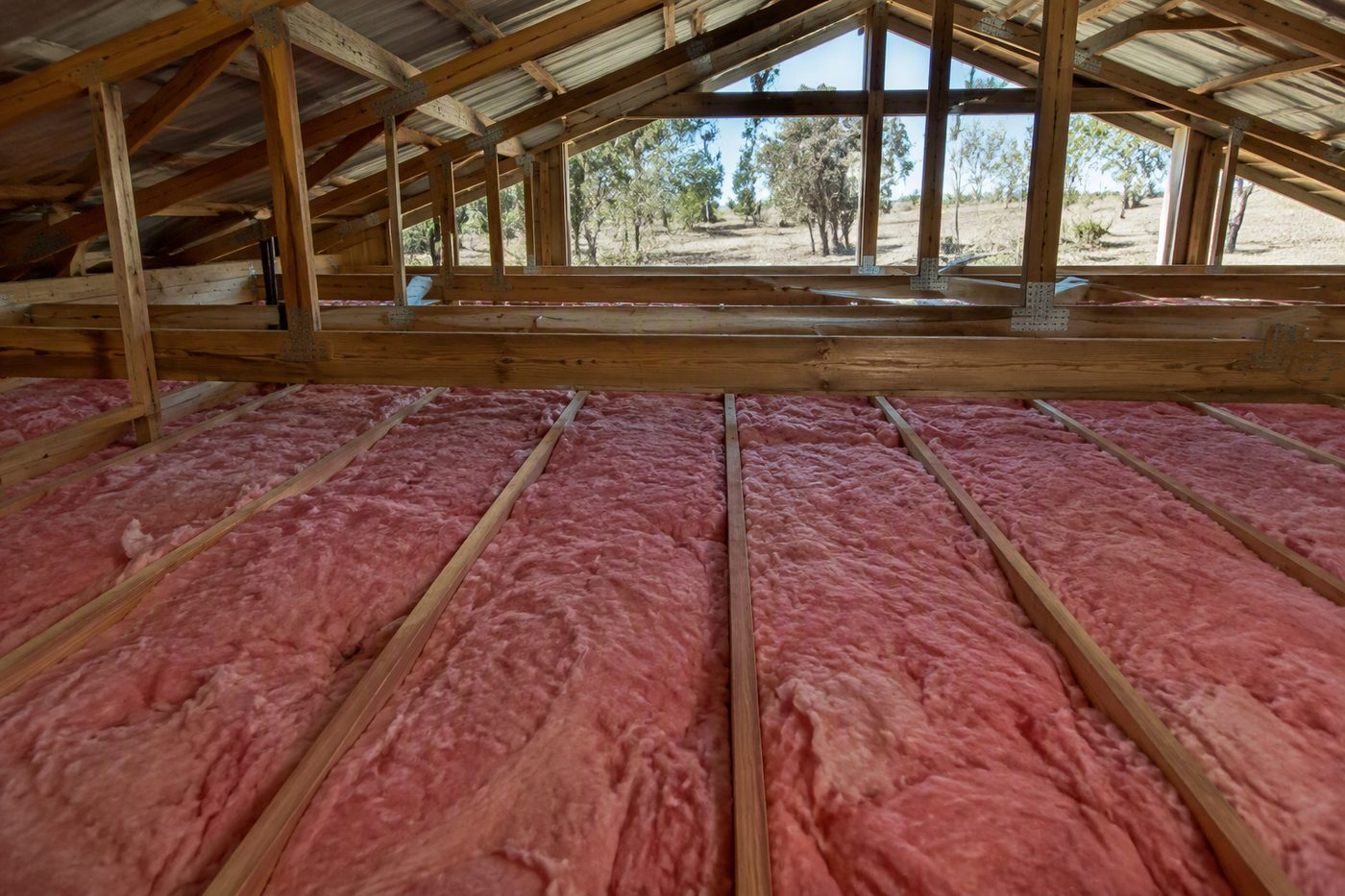
The biggest single reason a wall with high material R-value still feels hot in summer is thermal bridging through the framing.
Exterior insulation (continuous insulation, CI) is typically a layer of foam board that creates a thermal break between the interior conditioned space and the exterior environment (benjaminobdyke.com). Because it sits outside the framing, it eliminates thermal bridging that occurs where framing materials transfer heat (benjaminobdyke.com).
Two extra benefits of correctly specified continuous insulation:
Whether continuous insulation is required depends on the location's Climate Zone and the jurisdiction's adoption of the building code (benjaminobdyke.com). A useful rule of thumb: if the rigid foam layer is less than 25 mm thick, the interior side of the wall sheathing can run cold enough to push condensation and moisture-related failure into the wall cavity (benjaminobdyke.com). In a humid climate like coastal Queensland, this is not a theoretical risk.
Insulation ratings are measured in R-value per unit thickness (benjaminobdyke.com). This matters because two products at the same R-value can be very different thicknesses, and thickness drives cavity space, transport cost and installation time.
Other reference points from the verified fact sheet, useful for comparison rather than direct specification in Australia:
These are US figures and not directly applicable in Australia, but they illustrate two points: roof/ceiling always wants more R than walls, and adding a continuous sheathing layer to existing walls is a common retrofit.
A short list of recurring problems that turn a decent insulation spec into a poor outcome:
DIY insulation work is feasible for accessible ceiling spaces and wall cavities, but several situations require a licensed tradesperson:
Is higher R-value always better?
Up to a point, yes. Beyond that point, the cost per extra R-value climbs steeply and the extra thickness may not fit the cavity. The right target is the NCC minimum for your climate zone plus a sensible margin, balanced against cavity depth, framing size and budget.
Do reflective foil products add R-value?
Foil-faced products contribute to Total R-value when installed with a still-air gap against the reflective face. Without the air gap, the reflective performance is largely lost. Check the product's claimed R-value and the test conditions behind it.
Can I just add more batts on top of existing insulation?
Yes, provided the existing insulation is dry, uncompressed and free of contamination. New batts laid over old batts will deliver close to the sum of the two material R-values.
How does insulation help with sound?
Bulk insulation products are effective for both sound insulation and thermal insulation (yourhome.gov.au), which is why the same batts in shared walls or under a metal roof deliver acoustic benefits as a side effect.
Does insulation reduce condensation?
Insulation alone does not manage condensation. Properly designed and installed continuous insulation helps keep the interior side of exterior sheathing above the dew point temperature, preventing condensation (benjaminobdyke.com). Without adequate airtightness and vapour management, insulation can actually cause condensation problems.
Where should I insulate first if the budget is limited?
Prioritise the roof or ceiling first, because that is the largest heat-gain and heat-loss surface in most Australian homes. Address draught sealing at the same time, then move to walls and floor.
Worth a watch: Is R Value Relevant? · Earth Building Association of Australia - EBAA