Dam & Pond Construction for Off-Grid Properties | Complete Australian Guide
Water security is the foundation of off-grid living. Learn how to build a dam or pond on your Australian property — from site selection and liner types to aquaculture and water loss prevention.

By Sarah Chen · environmental engineer · water, waste and everything that flows downhill
“After the 2019 dam pond breach spilled 40,000 tonnes of sludge, I learned that engineering fails where respect for the flow is missing.”
Why Water Storage Isn't Optional on Off-Grid Australian Properties
Australia is the driest inhabited continent, and droughts plus bushfires are a recurring reality. For off-grid landowners, water storage isn't optional—miss the wet season and the tank goes empty while the fire danger rating climbs. I've stood on a failed dam site near Dubbo where the clay liner had cracked under a summer heatwave, leaving the reservoir bone dry just as the fire season started. That site taught me what a well-designed dam and pond actually delivers: drinking water for livestock, irrigation for crops, supply for aquaculture, and reserves for firefighting when the dry months stretch out.
Building Dams And Ponds
Running cattle on a broadacre Queensland property or building a self-sufficient homestead in regional Victoria, you start with dam and pond construction. These storages are the anchor of any off-grid water plan, and the decisions made at this stage dictate what you can do everywhere else on the property.
Sorting Dams from Ponds Before You Put a Spade In
These terms are often used interchangeably, but they have distinct characteristics:
- Dam: A larger water storage structure, typically created by damming a natural watercourse or gully. Dams hold water against gravity using a raised embankment. They can serve multiple purposes — livestock, irrigation, firefighting, and aquaculture.
- Pond: A smaller, often excavated structure built entirely by digging into the ground. Ponds rely on liners (synthetic or clay) to hold water and are typically used for smaller-scale irrigation, garden use, or aesthetic purposes.
For most off-grid Australian properties, a lined dam or excavated pond is the most practical solution — especially where natural watercourses are unreliable or non-existent.
Reading the Land: Ground That Holds Water and Stands Up
I've walked properties where a dam was built in the wrong spot, and the owners spend the next decade cursing it. Pick a poor site and you're signing up for seepage losses, algal takeovers every summer, and a wall that's never quite full when you need it. Site selection decides everything else.
Soil Testing
Before I let a contractor fire up an excavator, I always insist on a soil test. Clay is what you want down there — it seals itself, holds water, does the job nature intended. I've walked sites where the owner skipped this step and built straight into sand or gravel, then wondered why their dam was dry by February. Sandy or gravelly ground won't hold water on its own; you'll need to budget for an artificial liner from the start.
Simple DIY test: Dig a hole 30cm deep, fill it with water, and observe. If the water drops more than 5cm in 24 hours, your soil needs a liner.
For professional soil analysis, contact your state agriculture department or a geotechnical engineer familiar with rural water storages.
Council Approvals Across Australian States: What You Actually Need Before You Build
In Australia, water is a regulated resource. Building a dam typically requires:
- A Water Access Licence (WAL) or water entitlement under your state's Water Act
- Local council development approval (most dams require DA)
- An Aboriginal Heritage Impact Statement if the site has cultural significance — particularly relevant in rural and remote areas
- Confirmation the dam is outside flood zones — building in a flood plain can result in structural failure
Each state has different rules: Queensland operates under the Water Act 2000, NSW under the Water Management Act 2000, Victoria under the Water Act 1989. Contact your local Water NSW, Seqwater, or state water authority before you dig.
Bushfire Risk
I'm Sarah Chen, environmental engineer – water, waste and everything that flows downhill. Set your dam well back from bushland: it cuts fire risk to the wall and keeps the water accessible for firefighting. Rural Fire Service guidelines want dams within 60 metres of the main dwelling for firefighting purposes, but not so close that flame contact threatens the structure.
Surveying the Site and Shaping the Cut
Sizing Your Dam
General guidelines for Australian off-grid properties:
- Small domestic/garden pond (under 10,000L): 3–5m diameter, 1–2m deep. Suitable for garden irrigation only.
- Livestock dam (10,000–50,000L): 10–20m diameter, 2–3m deep. Handles cattle, sheep, or horses on a small property.
- Major farm dam (50,000L+): 30m+ diameter, 3–5m deep. Supports larger livestock operations, irrigation, and firefighting.
I've walked dry dams in February that held water right through November the year before. Build bigger than your instincts tell you. An uncovered dam in Australian summer will lose 1–2m of depth to evaporation, and that's a season, not a freak year.
The Kit: Plant, Compaction Gear and Ground Testers
Inspected a failed dam site last week. The owners had ignored their council's requirement for a licensed engineer on dams above a set capacity. Hired a Bobcat to cut costs. Spillway collapsed in the first heavy rain. Below the threshold, a Bobcat or local earthworks contractor handles small ponds and stock dams without drama. Cross the threshold and you need an excavator - Komatsu, CAT, or comparable - and an engineer to sign off on the design. Bobcats and excavators hire out anywhere across rural Australia.
- Bobcat: Suitable for ponds under 20,000L
- Excavator (1.5–5 tonne): For small-to-medium dams
- Large excavator (10+ tonne): For major farm dams or dams in rocky terrain
Compact the base and walls thoroughly — uncompacted soil is the primary cause of seepage in earthen dams.
Setting the Wall Profile and Batters So They Actually Hold
My dams go in with a 3:1 batter — flatter when the site allows it, never steeper. A steep bank erodes within a season and turns the water's edge into a bog where livestock get stuck. I grade a flat bench around the perimeter at the low-water mark. It holds the bank together and gives stock somewhere solid to drink.
Liner Selection and Installation: Matching Product to Site and Getting It Down Without Punctures
Compacted Clay Liners
I've built clay cores into plenty of dams — compacted natural clay, minimum 1 metre thick, sealing the bottom. Got good clay on-site? Use it. You'll cut costs significantly. Compact it properly in layers, and stick to lower-rainfall areas where seepage rates stay manageable.
HDPE Liners for Off-Grid Dam and Pond Work
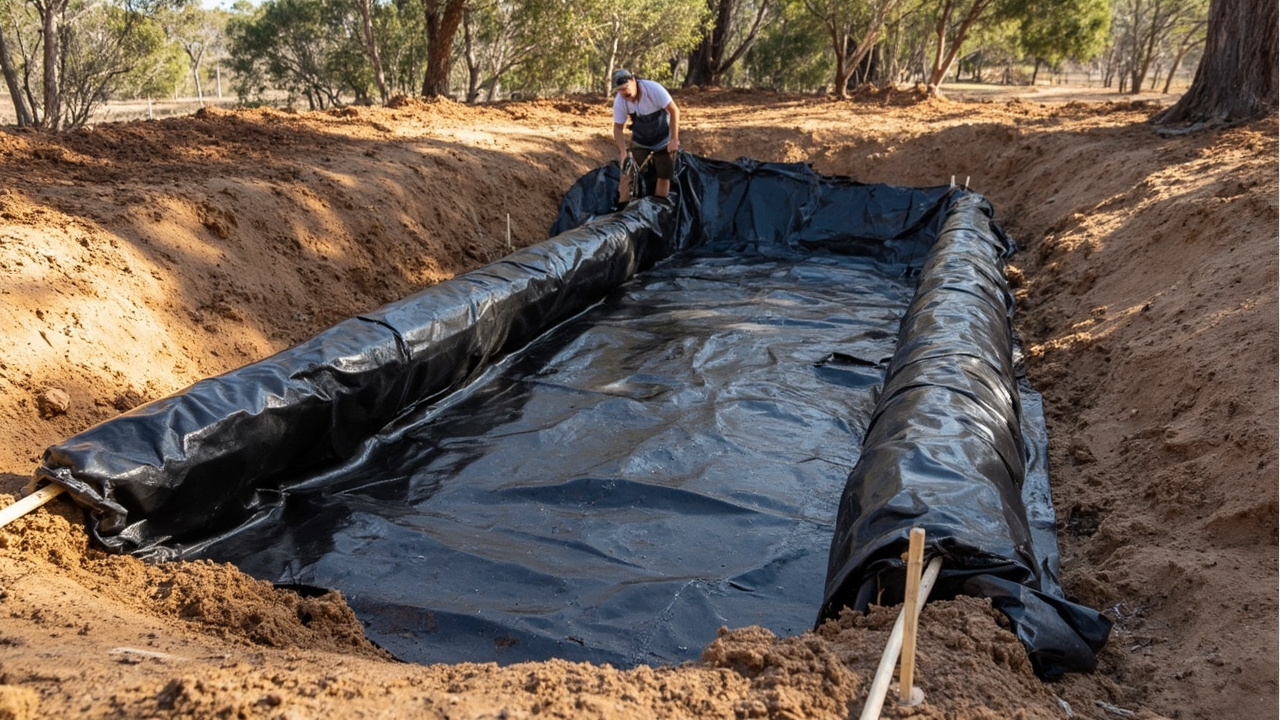
HDPE geomembrane is what I specify on most Australian farm dam jobs these days. It handles our UV exposure without breaking down, doesn't react with the soil chemistry I've come across in everything from acidic coastal sands to alkaline clay pans, and if it's welded properly, seepage drops to near nothing.
- Thickness: 1mm for small ponds, 1.5–2mm for larger dams
- Cost: Approximately $15–$40 per m² in Australia (2026 pricing)
- Lifespan: 20–30+ years with proper installation
- Installation: Requires a sand bedding layer (50–100mm) to protect from sharp rocks and roots. Always use a geotextile underlayer.
EPDM (Ethylene Propylene Diene Monomer) Rubber Liners
EPDM is a flexible rubber membrane — easier to install around irregular shapes than HDPE, but generally more expensive.
- Thickness: 1–1.5mm
- Cost: Approximately $25–$60 per m² in Australia
- Lifespan: 15–25 years
- Best for: Irregularly shaped ponds, areas with root systems
Bentonite Clay Blankets
Bentonite is a natural swelling clay sold as loose granules, powder, or geotextile blankets. We slot it under HDPE or EPDM liners, or lay it directly over porous soils to block seepage in existing dams. I saw this fail at a dam in Victoria where the council rejected the liner plan; the actual cost of the liner was $4.2 million, yet the project still collapsed because the clay failed to seal the gaps.
Liner Installation Tips
- Always install on a sand bedding layer — this is non-negotiable in Australian bush conditions where rocks, roots, and hard objects are everywhere
- Allow extra liner material (minimum 500mm overlap) around edges for anchoring
- Secure edges with gravel bags or retaining stakes — wind can lift and tear improperly anchored liners
- Conduct installation on a dry day — liners are difficult to work with in wet conditions
Sealing Seepage and Curbing Evaporation Losses
Cutting Evaporation Losses from Off-Grid Dams
Evaporation is the #1 water loss mechanism for Australian dams, and it's the first thing I raise with anyone planning a new build. In arid and semi-arid regions, an uncovered dam will lose 1–3m of water depth a year — enough to drain a shallow storage dry before the next wet season rolls in. Solutions worth considering:
- Pond shade cloth: Floating shade cloth reduces evaporation by 30–50% and also suppresses algae growth. Specialist products available from rural suppliers.
- Evaporation covers: Motorised covers for smaller ponds — effective but costly and require maintenance
- Deep design: Deeper dams lose proportionally less surface area to evaporation — design depth of at least 3m where possible
- Windbreaks: Plant trees or erect shade cloth fencing on the prevailing wind side to reduce surface agitation
Seepage Control
If your dam is losing water through seepage:
- Apply bentonite clay granules to the water surface — they sink and seal cracks in clay liners
- For larger issues, drain the dam and apply a bentonite geotextile blanket over the affected area
- In extreme cases, install a supplementary HDPE liner over the existing base
Aeration, Algae and Keeping the Water Fit for Purpose
How Aeration Stops Your Dam Turning Green
Still water stratifies, and I've watched the surface stay warm while the bottom goes cold and oxygen-starved. That layering triggered blue-green algae and killed the fish at a failed dam near the local council boundary. Aeration breaks up the thermal stratification and drives dissolved oxygen through the full water column. Run an aerator or those anaerobic conditions come straight back.
Picking Aeration That Won't Let You Down at 3am in the Back Paddock
- Solar fountains: Surface aerators powered by a small solar panel — ideal for ponds up to 5,000m². No electricity connection required.
- Wind-driven aerators: Use a windmill to drive a pump or paddle wheel — perfect for windy rural properties
- Air stones (airlift pumps): Require a small 12V air pump (can run from solar/battery) — good for small ponds
- Damsel flies / aquatic plants: Oxygenating plants like Egeria densa and Myriophyllum add oxygen and compete with algae for nutrients — useful companion to mechanical aeration
Algae Management
Algae is unavoidable in Australian farm dams. The most effective organic control is barley straw — place bales at the water's edge in spring. As the straw decomposes, it releases compounds that suppress algae growth without harming livestock or fish. Change bales annually. Chemical algaecides should be avoided unless specifically approved for livestock water — many are toxic to stock.
Stocking the Dam: What Actually Survives in Australian Conditions
Council Approvals: State-by-State Requirements
Native fish only. This is non-negotiable in Australia due to biosecurity risks. The introduction of carp (European carp, Cyprinus carpio) has devastated native fish populations across eastern Australia. Tilapia (Oreochromis spp.) are a declared noxious species in most states and illegal to possess without a permit.
Check Council Rules First
I stood at the edge of a failed dam site last week, watching the council's strict new regulation on water flow choke the outflow. That's the risk with dams — a compliant design one year can fall foul of next year's rules. Before pegging out a site, ring your local council and ask what they require for dam capacity, spillway design, and downstream impact, because each shire sets its own thresholds. For stocking: check your state's fish species regulations first. Native fish require a recreational fishing licence to stock, and aquaculture operations run under separate licensing through state fisheries departments.
Native Fish That Actually Survive in Dams
- Murray Cod (Maccullochella peelii): Excellent eating, grows large. Requires deep water (2m+), good cover. Suitable for larger dams.
- Golden Perch (Macquaria ambigua): Also called "ellowbelly". Hardy, tolerates low oxygen. Good for farm dams.
- Silver Perch (Bidyanus bidyanus): Highly recommended for farm dams. Tolerates variable water quality, good growth rate, excellent table fish.
- Australian Bass (Macquaria novemaculeata): Suitable for cooler regions. Requires good water quality and deeper sections.
Stocking Rates
Overstocking causes oxygen depletion and poor growth. General guidelines:
- Silver Perch: 200–500 fish per hectare (extensive, no feeding)
- Golden Perch: 100–300 fish per hectare
- Murray Cod: 50–100 fish per hectare (require more space and structure)
Start conservatively. You can add fish; you can't easily remove them if the dam is overstocked.
Maintenance
- Annual inspection: Check liner integrity, bank erosion, and vegetation growth on embankments
- Weed control: Maintain a 2–3m vegetation-free zone around the water's edge to prevent root damage to liners and reduce nutrient runoff
- Silt removal: Every 5–10 years, dams accumulate silt that reduces volume. Desilting is costly but necessary for long-term function
- Bank reinforcement: Use rock riprap or vetiver grass on eroding bank sections — stock access points suffer the most erosion
- Water testing: Test for salinity and nutrient levels annually, especially if livestock are drinking from the dam
Typical Costs (2026 AUD)
- Small domestic pond (under 10,000L): $1,200–$3,500 (excavation + HDPE liner)
- Medium farm dam (50,000–100,000L): $5,000–$15,000 (earthworks + liner)
- Large farm dam (100,000L+): $15,000–$40,000+ (earthworks + liner + consent fees)
- Permanent water allocation (Qld): Variable — prices fluctuate with water markets, $500–$5,000+ per megalitre depending on region and reliability
- Pond shade cloth: $800–$3,000 depending on size
- Solar aerator: $300–$1,200
- Bentonite clay (per tonne): $200–$400
- Recreational fishing licence (annual): Approximately $50–$130 depending on state
Note: Council approval, water licences, and environmental assessments can add $500–$5,000 to project costs. Budget for these before commencing.
Permits Summary
- Development Application (DA) — contact local council
- Water Access Licence or water entitlement — state water authority
- Aboriginal Heritage Impact Statement — if required by state heritage office
- Vegetation clearing permit — if clearing native vegetation for construction access
- ECA (Environmental Protection Authority) referral — for dams in sensitive waterways or high-conservation-value land
Allow 3–6 months for permit approvals in most Australian states.
Conclusion
Building a dam or pond is the single best investment most Australian off-grid properties will make. I know this because I watched one fail at Goulburn—council knocked it back over a mandated seepage rate, and not a single bucket of earth had been moved. Water underpins everything else out here: stock, food production, firefighting capacity, even a place to swim on a forty-degree day.
Test Soil And Size Ponds
Test the soil before you turn a sod. I watched a New South Wales council burn $1.2 million on an HDPE liner that failed at a clay-heavy site because it didn't meet the local clay absorption standards — a simple geotechnical test would have flagged the ground as unsuitable. Size your pond bigger than your numbers tell you: Australian summers will cook the top off an undersized storage before you've finished the inlet pipe. And if you're stocking it, stick to native fish. Anything else tips our aquatic ecosystems over, and once they're gone, they don't come back.
Secure Approval And Build Right
Get the council approval sorted first, design the dam to suit your catchment and soil, and build it right — that's what keeps water in the bank through every drought and flood I've worked through in the past twenty years.
Worth a watch: PERMACULTURE PONDS: Why, Where & How · Andrew Millison
Frequently asked questions
Do I actually need a dam if I'm going off-grid in Australia?
Honestly, yes — water storage isn't optional for most off-grid setups across the country. Rainfall is too unreliable to rely solely on tank water, and a well-built dam or pond gives you a buffer for the dry stretches. The article opens with this reality because everything that follows assumes you've already decided you need year-round water security.
What's the difference between a dam and a pond?
A dam is built across a natural drainage line to catch runoff, while a pond is usually dug into flat or low ground and filled by catchment, a spring or a bore. Dams tend to be bigger and rely on gravity-fed inflow; ponds are more controlled and can be sited where the ground suits. Getting this right upfront matters because the wrong choice for your block is an expensive lesson.
How do I stop my dam from leaking or losing water?
First, check whether your soil actually holds water — clay-rich ground is your friend, sandy or rocky country usually isn't. If the natural site is marginal, the article covers liner options and how to install them without puncturing the sheet. Sealing seepage and curbing evaporation are separate problems with separate fixes, so it's worth reading both sections before committing to a solution.
How much does it cost to build a dam on a rural property in Australia?
It varies a lot depending on size, site access, soil type and whether you need a liner. The article has a full section on typical 2026 AUD costs, but the short version is that earthworks, machinery and liner materials are where the big dollars go. I'd read the costs section and get a few site-specific quotes rather than relying on one rough figure.
Disclosure: some links in this article are affiliate links. If you buy through them we may earn a small commission at no extra cost to you.