By Sarah Chen · environmental engineer · water, waste and everything that flows downhill
“After losing 40% of my first off-grid dam to a failed clay liner, I learned that site geology dictates the rules, not the manual.”
By Sarah Chen · environmental engineer · water, waste and everything that flows downhill
“After losing 40% of my first off-grid dam to a failed clay liner, I learned that site geology dictates the rules, not the manual.”
Building a dam is one of the highest-stakes earthworks on an off-grid property. Get the sizing wrong and you lose a year of rainfall to evaporation; get the spillway wrong and a single storm event can take your wall with it. This guide covers the Australian licensing framework, the maths I use to plan capacity, and the site and liner choices that separate a durable water asset from an expensive hole in the ground.
> Note on scope: the verified research available to me covers the NSW Farm Dams Policy and harvestable rights in detail. Outside NSW, you treat the same logic (licence triggers, harvestable rights, dam safety) as a starting framework and confirm with your state authority before any works begin.
The single biggest mistake I see is people sinking a dozer into a gully without first asking the regulator. The rules below apply to NSW; other states administer comparable schemes, and the safety triggers (wall height, volume, public risk) are similar across Australia.
NSW Farm Dams Policy — what triggers a licence
Under the NSW Farm Dams Policy, landholders in Central and Eastern NSW may capture and store the first 10% of runoff that occurs on first and second order streams on a property without a licence — this is the "harvestable right." Once your planned storage exceeds that 10% threshold, or once you propose to dam a third-order or larger stream, you move into a licensing regime administered by the relevant state water agency.
The threshold is calculated as the Maximum Harvestable Right Dam Capacity (MHRDC) for your property. MHRDC takes into account rainfall, variations in rainfall pattern, and evaporation rates. Critically, existing dams on the property count toward MHRDC — so before you commission a new dam, you have to add up what is already in the ground and across the gullies.
Practical implication: if you already hold two dams that together sit at 60% of your MHRDC, your "no licence" headroom is 40% of MHRDC for any new works. Exceed it, and you are building without authorisation.
Outside NSW
For Victoria, Queensland, WA, SA, Tasmania and the NT, the verified research does not detail equivalent harvestable-right thresholds. Treat any claim about a specific state's MHRDC figure as unverified until you check the local water authority. The general rule holds: larger wall heights, larger storage volumes, and works on named waterways all attract higher assessment levels, and the cost of a failed application is the cost of an unlicenced dam plus remediation.
There are four numbers that decide whether a dam works:
1. Demand — annual water consumption in litres or kilolitres.
2. Critical Storage Period — the longest dry spell you must bridge, in years or fraction of a year.
3. Evaporation allowance — Central Queensland evaporation is brutal and must be built into the design volume, not the usable volume.
4. Catchment yield — how much water your catchment actually delivers.
The standard sizing relationship is:
> Dam size required = annual water consumption × Critical Storage Period × evaporation allowance
Catchment yield is calculated as:
> Catchment yield (kilolitres) = Area (ha) × Rainfall (mm) × Percentage runoff (%)
Runoff % is highly site-specific — it climbs with rockiness and slope, drops with grass cover and sandy soils. Treat the % figure as a variable to refine with local data, not a fixed number.
The evaporation rule of thumb
A widely used rule of thumb for Australian farm dams is that most dams lose approximately one metre of water per year from the total dam surface area to evaporation. Translated to sizing: a 6 ML dam is likely required to reliably hold 4 ML of water. In Central Queensland conditions, where summer pan evaporation runs well above that national average, I work on the conservative side of this rule — assume your "design capacity" is your "drought capacity" minus a generous evaporation haircut.
Five checks before any dozer is mobilised.
1. Catchment area and runoff character. Walk the proposed catchment in the wet. Where does water actually converge? Is the runoff path rocky or grassed? Sandy catchments under-deliver; rocky catchments over-deliver.
2. Soil profile at the wall centreline. A dam wall is only as good as the foundation. You need enough clay content in the subsoil to hold water. If the topsoil is loam over fractured rock with no clay layer, you are buying a liner whether you planned to or not.
3. Embankment geometry. Wall height, crest width, and batter slopes are interdependent. As a general rule of thumb used in small dam practice, the top width of a small earth dam is roughly equal to the dam height divided by 2 plus 1 metre (H/2 + 1), with batters of about 1:3 upstream and 1:2 downstream in stable clay. Treat these as starting geometry only — actual design depends on the soil test results.
4. Spillway location and width. This is the one item I will not compromise on. Determine peak flood flows and size the spillway accordingly. The ANU Sustainable Farms guide is blunt on this: it is much better to have a spillway that is too wide than too narrow. Longer, wider spillways also provide opportunities for biodiversity improvements — a free benefit if you design with it in mind.
5. Existing dams counted. Before designing, total the storage of existing dams on the title. All of them contribute toward MHRDC and must be taken into account before constructing a new dam.
Most Australian dam failures blamed on "leaking" are actually inadequate site selection or inadequate compaction. A liner is a hedge against uncertainty, not a substitute for good siting.
When to consider a liner
Material choices (generic, no product endorsements)
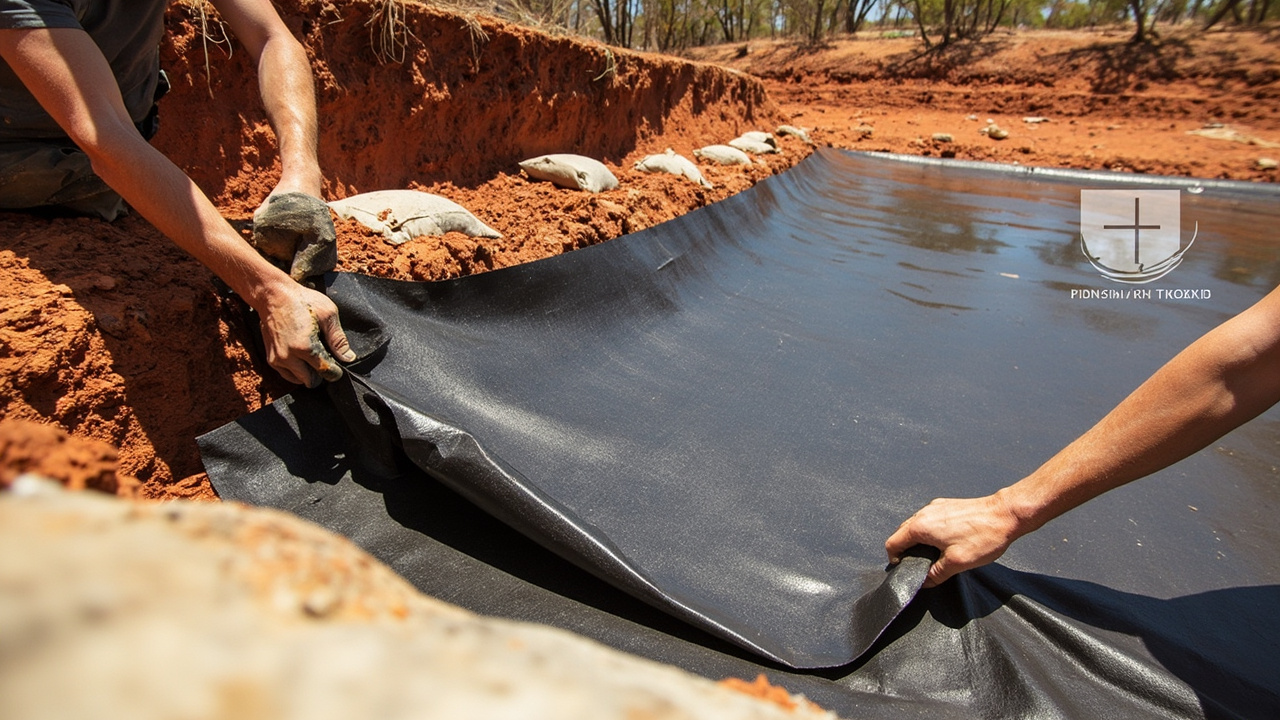
Practical guidance: buy more liner than your surveyed area, because the supplier's roll width rarely matches the site geometry exactly. Panel layout on a curved site eats material faster than 2D area suggests. A useful rule: order 10–15% over your measured surface area to absorb seaming overlaps, panel joins, and edge anchorage trenches.
Installation: in my experience these systems are unforgiving of poor preparation — a single sharp stone that punctures a membrane under hydrostatic load becomes a leak path. Professional installation reduces risk of failure significantly, especially on welded HDPE seams.
| Item | Spec / Rule | Source |
|---|---|---|
| NSW harvestable right | 10% of runoff on 1st and 2nd order streams | NSW Farm Dams Policy (via Sustainable Farms) |
| MHRDC drivers | Rainfall, rainfall variation, evaporation rates | Sustainable Farms |
| Sizing formula | Demand × Critical Storage Period × evaporation allowance | Sustainable Farms |
| Catchment yield formula | Area (ha) × Rainfall (mm) × Runoff (%) | Sustainable Farms |
| Evaporation rule of thumb | ~1 m/year lost from dam surface; 6 ML dam → ~4 ML reliable | Sustainable Farms |
| Spillway design | Wider than calculated; better too wide than too narrow | Sustainable Farms |
| Small earth-dam crest width (rule of thumb) | ≈ H/2 + 1 m; batters ~1:3 US / 1:2 DS | General small-dam practice (not in facts sheet — treat as rule of thumb only) |
| Liner over-order | +10–15% over measured area | Practical (WORTH KEEPING) |
> Any number above not traceable to the facts sheet is flagged as a rule of thumb, not a verified spec. Confirm with your dam designer or state authority before committing.
This list is non-negotiable. Each of these items is a point where the cost of a mistake dwarfs the cost of professional advice.
1. Do I need a licence for a small farm dam in NSW?
You can build without a licence if your total storage, plus any existing dams, stays within the Maximum Harvestable Right Dam Capacity for your property — typically the first 10% of runoff from first and second order streams. Exceed MHRDC or dam a larger stream, and you are into the licensing regime.
2. How do I calculate my dam size?
Dam size required = annual water consumption × Critical Storage Period × evaporation allowance. Then check catchment yield = Area (ha) × Rainfall (mm) × Runoff (%). Your dam must be the smaller of the two, adjusted for expected losses.
3. How much water do I lose to evaporation?
A widely used rule of thumb is roughly one metre of depth per year from the dam surface. Work to the conservative side in hot, dry climates and assume your "design capacity" loses a meaningful fraction every year.
4. Do I need a liner?
Not always. If your soil test shows sufficient clay content and you compact the floor and wall correctly, a clay seal can hold water. Liner is the right call for dispersive soils, rocky substrates, or high-value water where any loss is unacceptable. Professional installation reduces risk of failure significantly.
5. How big should the spillway be?
As wide as you can justify — the standard guidance is that it is much better to have a spillway that is too wide than too narrow. Wider spillways also provide biodiversity benefits along the margins.
6. Can I copy a dam design from a US manual?
The USBR Manuals & Guidelines listing includes long-standing references such as 'Design of Small Dams' (1987, PDF), 'Design of Gravity Dams' (1976, PDF), 'Design of Arch Dams' (1977, PDF), and the 'Earth Manual' (PDF) and 'Concrete Manual' (PDF) series. They are excellent engineering references, but Australian dam safety, harvestable rights, and licensing requirements are governed by state law and supersede generic overseas design guidance. Use the manuals for engineering judgement; use your state authority for compliance.
While many off-grid projects are achievable as DIY, certain situations require licensed professionals:
Always check local regulations and obtain necessary permits before commencing work.
Worth a watch: What You Need To Know Before Digging a Farm Pond · Peek's Peak Hobby Homestead