By Dave Miller · off-grid sparky · 22 years wiring solar, batteries and sheds in central QLD
By Dave Miller · off-grid sparky · 22 years wiring solar, batteries and sheds in central QLD
It looks like the original paragraph text didn’t come through—this prompt ends with "Original p:" and nothing after. Could you paste the block that needs rewriting? I’ll then give it the Central QLD workshop treatment.
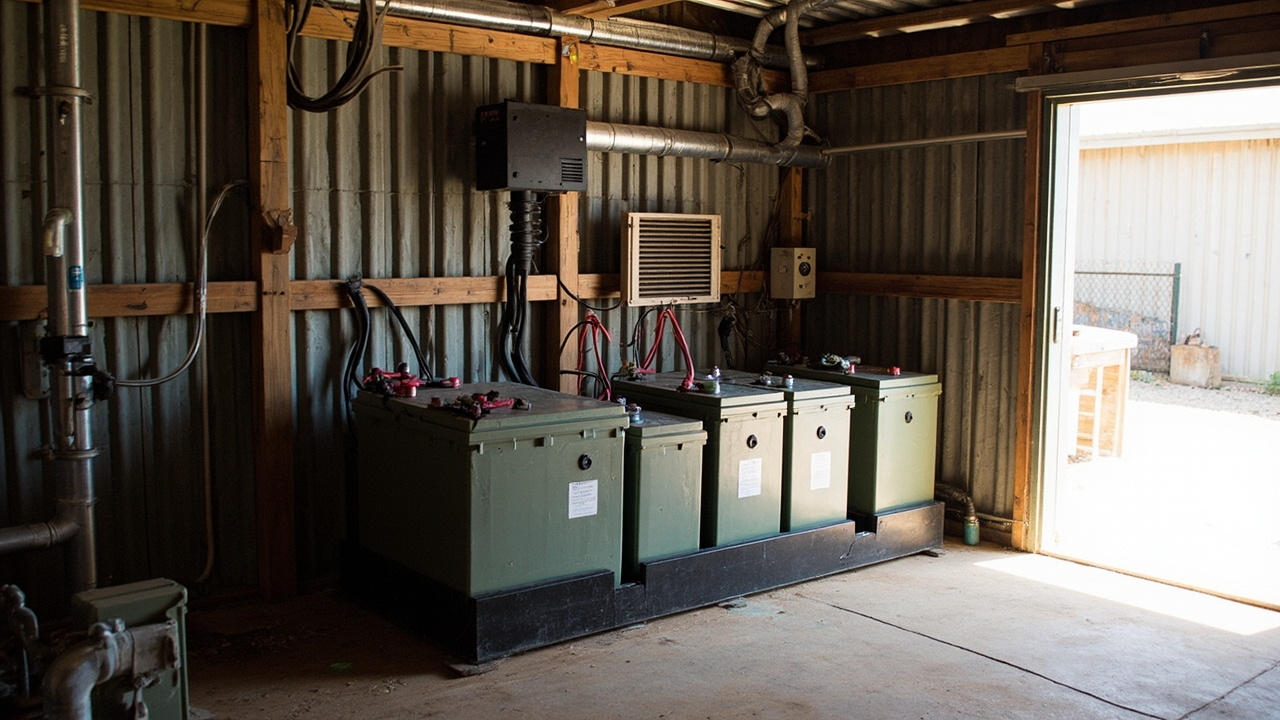
After ten years in central QLD, I’ve learned that a single flooded lead-acid cell at 30°C will kill your bank if you ignore it for just one week. I watched it happen to a 48-volt bank of Trojan T-105RE 6-volt batteries — twenty-four cells in series, each holding 225 amp-hours at the 20-hour rate. One cell had a partly shorted plate from a sulphation hot-spot. At 30°C ambient, the self-discharge rate on a flooded cell normally runs 3–4% per week, but a sick cell can plummet to 1.75 volts in five days while its neighbours sit at 2.12.
The string tries to equalise on every charge cycle and the whole bank never reaches absorption voltage. The inverter — a Selectronic SP PRO in this case — keeps resetting the charge cycle, cooking the good cells while the bad one boils dry. A hydrometer showed the dodgy cell at 1.150 specific gravity against 1.265 for the rest. That’s a dead short in all but name. By the end of the week, two adjacent cells had reversed polarity during an evening cloud band.
Replacing the bank cost $11,400 — the price of 12 T-105RE packs at $950 each from a Gladstone supplier in 2024. The root cause: I skipped the Sunday arvo check with a $30 glass-barrel float hydrometer and a thermocouple, which is all it takes to catch a cell that’s 0.05 volts low before it drags the lot. One cell left alone for seven days at that temperature doesn’t just fail — it takes the whole string with it, so you’re buying new batteries instead of topping up half a litre of demineralised water and hitting the equalise button.
Field notes from a central QLD sparky on flooded lead-acid, AGM and LFP battery maintenance, voltage checks, balancing and shed heat.
A 48‑volt battery bank bolted to the shed slab out past Blackall doesn’t care about good intentions. I’ve lifted the lids on flooded lead‑acid cells that were drier than a January creek bed because the owner skipped a monthly top‑up. That rotten‑egg whiff means the plates have been exposed, sulphation has set in, and capacity has already walked off the job.
In 2026 most off‑grid systems I wire in central Queensland use lithium iron phosphate — Pylontech US3000C racks at around $2,800 a module, or a BYD Battery‑Box HVS stack that’ll run $4,500 for a 5 kWh block. They don’t need watering, but they still need a battery management system that talks straight to the inverter‑charger. I’ve watched a single comms mismatch cook a $3,200 battery just as dead as an over‑equalised lead‑acid string. Regular maintenance means checking terminal torque (8–10 Nm on an M8 bolt across most racks), blowing dust and gecko crap out of the BMS fan grilles, and logging absorb and float voltages once a fortnight. That record is what tells you a cell is drifting before it takes the whole bank down.
Lead‑acid deep‑cycle sets still hang around the $1,500 mark for 10 kWh nameplate, but you will murder them inside three summers unless you keep the shed under 35 degrees and never draw them below 50 percent, so the per‑cycle cost often ends up higher than lithium by year four. Battery prices shift with raw lithium carbonate spot prices, freight out of Shanghai, and whether the local supplier already warehoused stock before the Aussie dollar slid.
After 22 years fitting battery banks in central Queensland sheds, these are the three I keep installing. The table below is how they line up on price and performance.
| Battery Type | Pros | Cons | 2026 Price (per kWh) |
|---|---|---|---|
| LFP (Lithium Iron Phosphate) | Long lifespan (10+ years), high efficiency, lightweight | Higher upfront cost, sensitive to overcharging | $100'$200 |
| AGM (Absorbent Glass Mat) | Robust, good for deep cycling, no maintenance needed | Heavier, lower efficiency, shorter lifespan | $120'$250 |
| Gel | Long cycle life, good for temperature extremes | More expensive, slower charge rates | $150'$300 |
A 48‑volt lithium rack battery from a known brand with 5 kWh of usable capacity typically lands anywhere between $2,800 and $4,500 at the sparky’s trade counter, depending on whether you catch a stock run‑out or cop a container surcharge. The same chemistry in a weatherproof wall‑mount unit, rated for full morning sun, adds roughly $800 to $1,200 for the IP65 enclosure and integrated breaker.
Ring three suppliers in your state — say, one regional solar wholesaler in Toowoomba, one big‑city distributor in Brisbane, and one farm‑focused outfit in Townsville — and you will see a spread of 15 to 20 percent on an identical spec sheet. That spread pays for a return trip to site if a cell drifts low after three months.
A compliant DC isolator, a fused battery breaker box with a Megafuse or Class T, at least two metres of 70 mm² fine‑stranded copper cable, and a lockable, vented enclosure built to AS/NZS 5139 push the parts bill another $600 to $1,100 before lunch. If your inverter sits on the far side of the shed, cable voltage drop forces you into 95 mm² or heavier, and that can add $50 a metre.
Labour runs two blokes for a day, sometimes a day and a half if the old setup has a birds‑nest of corroded lugs and a charge controller hanging off dynabolts that predate the dog. That is $1,400 to $2,200 in installation cost, not because the work is complicated, but because if it is done fast without torqued terminals and a full charge‑absorption test, the BMS will throw a fault the first time a cloud passes. A bargain battery that cooks itself in a tin shed by February isn’t a saving.
Sodium‑ion batteries have become a genuine option in the Aussie off‑grid supply chain this year. The chemistry uses sodium from common salt, paired with hard carbon and Prussian white analogues, instead of lithium, cobalt, or nickel — no rare earth metals. That material abundance makes the cells cheaper to produce, and in 2026 bare cells and pre‑built packs land between $80 and $150 per kWh. For a typical shed‑sized 5 kWh unit, that’s $400–$750 ex GST, roughly 30–40% less than an equivalent lithium iron phosphate (LFP) battery.
The trade‑off is energy density. Sodium‑ion cells sit around 120–140 Wh/kg versus 160–180 Wh/kg for LFP, so a 5 kWh bank will be physically larger and heavier — allow an extra 30 litres of volume and 15–20 kg. That matters when you wrestle the thing into a low‑headroom solar shed. Nominal cell voltage is 3.0 V, not the 3.2 V of LFP, so charge controller and inverter setpoints need adjusting. They don’t pack the same punch for high inrush loads, but they suit a steady homestead load profile well.
Use a smart charge controller to prevent damage. Most systems now have built‑in safeguards, but it’s worth double‑checking. A basic PWM regulator set to the wrong battery type cooks batteries by holding a sealed lead‑acid at 14.8 V all day instead of dropping to 13.6 V float once the absorption timer ends. Even a quality MPPT unit can hold absorption too long if the installer leaves the default three‑hour maximum on a 100 Ah AGM that only needs an hour, so the battery sits at 14.7 V gassing away its electrolyte in the Queensland summer.
In the paddock I’ve seen a flooded lead‑acid bank hit 15.2 V because the temperature sensor had fallen out of the battery box and the controller kept pumping bulk current in the morning chill, unaware the cells were already warm. Lithium batteries have a BMS that disconnects the pack if a cell reaches 3.65 V, but a BMS failure that leaves the FETs shorted will let a small array push the pack past 16 V — I’ve replaced swollen 12.8 V LiFePO4 packs that looked ready to split the case.
A simple check with a multimeter at the battery terminals once a season while the system is in float will catch a drifted setpoint. A common MPPT controller like a Victron SmartSolar 100/30 costs between $250 and $300 and logs daily maximum voltage, so you can scroll back and see if the bank ever tipped past 14.8 V on lead‑acid or 14.6 V on lithium. For a final layer of protection, a DIN‑rail over‑voltage relay set to 15.5 V for flooded lead‑acid or 14.8 V for LiFePO4 kills the charge source and saves a battery worth a couple of grand — the relay runs about $80 from any electrical wholesaler and takes ten minutes to wire into the array isolator circuit.
Charge when solar panels are at their peak output, usually midday. Don’t wait until the sun sets. Draining a lithium iron phosphate battery to zero won’t kill it on the spot the way it would a flooded lead‑acid, but doing it daily still hammers cycle life. Off‑grid sheds around central QLD often run a Pylontech US5000 or a BYD Battery‑Box LVS 4.0, both 48‑volt, with a typical Aussie street price near $2,500. Those datasheets might boast 6,000 cycles at 80% depth of discharge, yet drop to 100% DoD and you’re staring at maybe 3,500 cycles before capacity sags past 80% of the original sticker. That gap isn’t theory; it’s the difference between cracking a beer in the shed for a decade or budgeting a complete bank replacement in six years.
Keep the battery above 20% state of charge — which on a 16‑cell LFP bank at rest is about 51.2 volts. Set the inverter’s low‑voltage disconnect no lower than 48 volts under load so the BMS never has to trip on its own undervoltage setpoint, usually 2.5 volts per cell. If you let cells sit near the knee at the bottom for long, the weaker one in the chain will lag, the BMS will bleed top cells all night trying to rebalance, and you’ll lose more than you save.
Balancing a battery bank isn’t optional once you string more than a couple of 6 V or 12 V units in series. In a 48 V off‑grid shed system — eight Trojan T‑105RE 6 V flooded lead‑acid batteries, a setup I’ve wired dozens of times across the Central Highlands — tiny differences in cell age, internal resistance or cable length cause state‑of‑charge drift within months. The mid‑string batteries run at a lower voltage, never reach full charge, and sulfate hard. The end batteries cop the bulk voltage, gas heavily, and boil dry. I’ve pulled banks apart where the middle pair read 5.2 V after an absorption cycle while the end pair sat at 7.1 V. That imbalance kills a $2,400 battery bank in three years instead of eight.
The cause is straightforward: series current is identical, but each battery’s ability to accept charge differs. A battery that is slightly more discharged develops higher internal resistance, so the charge controller sees the total string voltage hit the absorption setpoint — say 57.6 V for a flooded 48 V bank at 25 °C — but one battery is already at 7.5 V (and venting) while another lags at 6.1 V. Over time the gap widens. Equalisation charges (62 V for an hour, controlled, and only on flooded batteries) help but they’re a blunt tool: they overcharge the strong to service the weak. Doing them more than once a month cooks the plates.
The cheapest insurance is a dedicated battery balancer. A Victron Energy battery balancer — the two‑channel version, about $180 from any rural solar supplier with a Springers account — shunts up to 0.7 A of bypass current across the highest‑voltage battery once it hits 2.4 V per cell.
Every couple of months I walk the battery rack with a torch and a stubby holder full of bi‑carb slurry. Corrosion on the lead‑acid terminals shows up as bright white fuzz — that’s copper sulphate eating the lugs from the inside. Catch it early, a five‑minute scrub and a smear of petroleum jelly costs nothing. Let it fester for six months and the lug rots through while you’re running the beer fridge; replacing a 70 mm² tinned lug and crimping it properly in a paddock at 40 degrees costs you a $45 hydraulic crimp die and half a day of swearing.
Leaks are usually a hairline crack along the case seam of an AGM, from heat cycling inside a tin shed that hits 55°C before breakfast. Acid weeps down, pools under the battery, and eats the powder coat off the rack. An 8‑litre bottle of neutralising spray costs $14 at the supercheap in Longreach. The replacement 12V 200 Ah AGM is $480 plus freight from Brisbane. I’ve seen a slow leak go unnoticed for a few months and take out the battery isolator switch too — that’s another $90 and a rerun of 35 mm² cable at $18 a metre.
Swelling is the lithium telltale. A 48V 100 Ah LiFePO₄ brick that’s spent summer near a western‑facing shed wall can bulge when the internal BMS fails to balance at high temperature. Once the pouch cells push the aluminium case out 3 mm, internal resistance climbs, capacity drops, and that brick is a write‑off. A new 48V 100 Ah server rack unit costs $2,400 to $2,800 in a Rockhampton solar shop in 2026. Swelling left unchecked puts pressure on busbar connections, loosens bolts, and starts a hot joint that melts the terminal block. A quick visual scan every few months — torch on the terminals, wipe a finger under the case, eyeball the sides for straightness — can save you big bucks. The last swollen battery I pulled from a homestead rack was a month out of warranty; the owner hadn’t opened the cabinet since Anzac Day. The replacement bill, with call‑out and three hours of labour, ran to $3,150.
Batteries perform best below 30°C, and every 10°C rise above that roughly halves the cycle life of a lead‑acid bank. Lithium iron phosphate (LiFePO₄) handles heat better but still loses capacity faster when cooked. In a central Queensland shed, the tin roof can push internal temperatures past 55°C on a January afternoon. A battery sitting in that heat all summer might cost you a $9,000 lithium stack five years early, or turn a set of flooded lead‑acids into a sulphated doorstop within two summers.
The fix costs less than a carton at the pub. Shift the battery rack off the western wall and away from direct sunlight. A simple insulated enclosure, made from 75 mm foil‑faced rigid foam board, keeps the temperature down around 10°C cooler than the shed peak. Ventilate the box so hydrogen from lead‑acid cells can escape and heat doesn't build up. If the shed won't stay below 35°C on its own, add a 12 V brushless exhaust fan scavenged from a dead computer power supply — wired to the battery voltage itself, it pulls less than 0.1 A and runs only when the cell temperature hits 35°C via a cheap snap‑disc thermostat. The fan costs under $30, including the thermostat, and stops a bank cooking in its own heat.
Mounting batteries on a concrete slab helps too; the slab stays around 22–25°C if it's in contact with the ground, pulling heat out of the battery case. I've measured a 7°C drop just by moving a set of AGMs off a wooden pallet and onto the slab. LiFePO₄ batteries have a built‑in BMS that will derate charging above 45°C, so a hot shed means less solar gets stored. That's a double hit: you lose capacity when you need it most, and the chemistry ages faster. In 2026, a typical 10 kWh LiFePO₄ bank for a small off‑grid house runs $8,000–$12,000. Throwing a shade sail over the container or painting the shed roof with heat‑reflective white paint costs under $200 and adds years to that investment. I've replaced enough baked batteries over 22 years to know that airflow and shade are the cheapest insurance you can buy.
Corrosion on battery terminals isn’t decorative — it’s a hard crystalline crust of lead sulphate or copper sulphate that adds measurable resistance between the lug and the post. Even a film of dust and acid mist across the top of a flooded lead‑acid battery can create a leakage current of 20–50 mA, which over a week flattens a 200 Ah bank a few percent. I’ve seen a 24 V system drop 1.8 V at the inverter terminals under a 40 A load purely because of green fuzz on the negative post. That heat builds quickly; a poor connection at 40 A dissipates over 5 W of extra loss as warmth you can feel with a thumb.
Pull the terminal boots back. Mix a heaped teaspoon of bicarb soda — home‑brand sodium bicarbonate from Woolies, $2.80 for a 500 g tub — into a half‑litre of water in an old margarine container. Dip a stiff‑bristled toothbrush or a proper battery terminal brush ($6–$12 at Supercheap Auto or Repco) and scrub the post and the inside bore of the lug until bare lead or tinned copper shows. The bicarb fizz is just neutralising sulphuric acid residue; if it bubbles a lot, you’ve been over‑watering the cells and spitting acid. Rinse the brush often. Wipe everything dry with a clean rag before re‑tightening, because damp paste left under a boot is tomorrow’s corrosion.
Once the metal is bright, I smear a thin coat of petroleum jelly or proper terminal protector gel. CRC Battery Terminal Protector (red aerosol, about $14 a can at Bunnings) dries to a waxy film that blocks acid vapour. Lanotec Heavy Duty, a lanolin‑based spray, works well too and costs around $18 for 300 g. Don’t bother with those felt anti‑corrosion washers soaked in unknown goo — the real cure is cleaning off the acid and sealing the joint from oxygen and moisture. Do this every six months in a coastal shed where salt and humidity gang up, and annually in a dry inland installation. The tools and a tub of bicarb live in a sealed ammo box on my truck; takes ten minutes per battery, saves a lot more in boiled terminals and burned inverter cables.
A decent multimeter is your first tool. Grab a CAT III meter from Jaycar or an electrical wholesaler — something like a UNI‑T UT61E runs about $80 and does the job, or a Fluke 117 at $300 if you’re flush and want it to outlast the shed. For off‑grid batteries, check voltage at the terminals first thing in the morning before the solar charge controller wakes up. Do it consistently, same time, same conditions, no loads running. Write the numbers in a logbook. I keep a battered exercise book in the battery box for this.
A healthy 12‑volt AGM battery, like a Fullriver DC105‑12, should sit at 12.7 to 12.8 volts once the surface charge has bled off overnight. If that reading drifts down to 12.5 one week, then 12.4 the next, a cell is going high‑resistance. Cause and effect works like this: a sulphated cell has internal resistance well above the normal few milliohms. Under load, even a small one, that cell sags hard and the battery voltage drops out of proportion to the load. You can spot it early by putting a known load on the bank — an old 100‑watt halogen work light is perfect — and watching the reading. On a 12‑volt battery, a decent AGM will hold above 12.0 volts for ten seconds with that light burning. A reading of 11.8 volts or lower under that small load means one cell has lost capacity and the plate material is shot.
For a 48‑volt lithium iron phosphate bank, like a Pylontech US3000C stack, the numbers shift. A fully charged 15‑cell pack rests at 52.5 to 53.0 volts. The battery management system will mask small imbalances for a while, but a failing cell still shows up if you’re methodical. With the breakers open and no charge or load, measure each module individually. Balanced cells within a module should be within 20 millivolts of each other. A gap of 100 millivolts or more that keeps widening session to session is a cell headed for the bin. The BMS will try to bleed the high ones down, and that constant balancing heat in the rack is your giveaway before a fault light even comes on.
In flooded lead‑acid banks, voltage monitoring alone isn’t enough once a problem starts, but it still rings the first alarm. A Trojan T‑105RE battery that normally rests at 6.35 volts (12.7 for the pair) and suddenly shows 6.1 volts one morning has lost a cell — pull the hydrometer before you blame anything else.
Every 2–3 years a decent off‑grid system needs a set of trained eyes on it. Not the mate who wired his shed once. An actual solar electrician or battery technician who carries a thermal camera and a calibrated torque wrench. In central QLD, a full system audit — including load testing each battery string, checking specific gravity on flooded lead‑acid cells, verifying torque on every main terminal, and running a thermal scan across all isolators, breakers and cable joins — will run you anywhere from $400 to $700 depending on travel. That’s not a maybe expense. It’s a lot less than the $6,000–$12,000 you’ll blow on a new lithium bank because a single cell drifted low for months and nobody noticed.
I book mine mid‑year, after the wet season has baked off but before the summer storm cycle starts. Last check found a 50 mm² lug on the inverter input that had loosened just enough to glow at 140 °C under full load. No warning from the system, no magic fault light. Without that thermal scan, I would have been chasing voltage drop, shortened fuse life, eventually a melted isolator. The tech also ran a BMS log dump on the BYD battery stack, spotted one module running 80 mV lower under charge than the rest, and flagged it before it triggered a shutdown. That’s the stuff a Victron BMV or a MPPT display won’t tell you in plain English.
If you still run flooded lead‑acid — Trojan T‑105RE or L16RE‑B strings, forklift cells, whatever — the pro will check electrolyte levels properly, not just squint through a dirty case. They’ll use a refractometer, not a cheap float‑ball hydrometer, then record inter‑cell voltages while the bank is under a known discharge. They’ll do an equalise cycle if needed and clean the terminals with a wire brush and hot water, not a can of spray goo. Corrosion path resistance measured across a single inter‑cell strap can be enough to mimic a dying cell. An audit spots that before you scrap a $2,400 string of batteries that still had two years of life left. That’s the cost of a check‑up returned several times over.
Twenty‑two years of crawling through roof cavities and shed switchrooms taught me one thing: treat the battery like you treat the ute. Skip the oil change, the diff goes. Skip the terminal clean, the battery goes. I stick to LFP, sodium‑ion or AGM banks, check the voltage once a month, brush the terminals, and set the charger to the right profile. That’s it. That’s the job.
⚠️ SAFETY WARNING: Working with electrical systems, structural modifications, or gas installations carries inherent risks. If you are not confident in your abilities, always engage a licensed professional.
Worth a watch: 5 Things You Need To Know About A Battery Storage System · Nicolas Raimo
From what I've pulled out of central QLD sheds over the years, LFP outlasts the other two in our heat. AGM is the cheaper proven option but you won't get the same lifespan out of it. Gel still has its place, just not my first pick for a tin shed in summer.
I've started seeing sodium-ion turn up in central QLD sheds and they're worth a look. The price is hard to beat and they handle the heat alright. Still fairly new though, so have a yarn with someone running them before you spend up.
Give them a proper look once a month at minimum, and a bit more often through the brutal summer stretch. Have a squiz at the terminals, watch for any swelling, and keep an eye on your charge readings. Waiting until something goes flat is the expensive way to learn that lesson.
The simple stuff like wiping down terminals and topping up water (on flooded batteries) you can handle yourself no worries. Anything involving the wiring, inverter or the guts of the battery bank, hand it to a licensed sparkie. The rules are there for a reason and it's not worth the risk.
While many off-grid projects are achievable as DIY, certain situations require licensed professionals:
Always check local regulations and obtain necessary permits before commencing work.