By Dave Miller · off-grid sparky · 22 years wiring solar, batteries and sheds in central QLD
That summer in the shed out past Biloela, the thermometer nailed 45°C by eleven and stayed there. A bank of eight 6-volt, 260 amp-hour flooded lead-acid batteries—$4,000 on the invoice from the local supplier—sat on concrete with a voltmeter reading a rested 12.7 volts per pair. The multimeter swore they were fine. By sundown, the inverter shut off under a load that should have been trivial. Voltage alone lies while temperature kills.
Heat Accelerates Lead-Acid Failure
A lead-acid cell at 45°C permanently sheds capacity roughly three times faster than at 25°C; the rule of thumb is that lifespan halves for every 8°C rise above 25°C. The plates corroded, the grids grew high-resistance sulphation locked in by heat, and the electrolyte stratified even after equalising. The voltmeter never dropped below 12.6 open-circuit, right to the moment the bank failed a 20-hour capacity test at half its nameplate amp-hours. The money didn’t vanish on the day the thermometer peaked. It bled away over eighteen months of 40-plus-degree afternoons I ignored because the float voltage looked healthy.
An off-grid battery bank in central Queensland doesn’t fail politely. It dies on a 40-degree afternoon when the fridge is full of barra fillets, or at 2 a.m. when the inverter low-voltage alarm shrieks like a scalded galah. The fix is never cheap. A half-decent 24-volt flooded lead-acid set—say, 12 x 2-volt 1000 Ah cells—runs north of $6000 at current Brisbane trade pricing, more once freight and GST hit. Test them properly before they strand you with cold nights, dead phones, and a very expensive lesson. First, stop believing the inverter’s voltage display.
Rest The Bank For Accurate Readings
It tells you about surface charge, not what’s left in the tank. Rest the bank—no load, no charge—for at least three hours. I aim for four if the shed isn’t stinking hot. A 24-volt bank after a full absorption charge and proper rest should sit around 25.4–25.6 volts for flooded lead-acid. If it’s reading 24.8, you’ve already lost capacity. Specific gravity tells the truth. A decent glass-float hydrometer costs $15–$25 from any auto sparky or rural supplier like Repco or NAPA.
Measuring Battery State Of Charge
Digital refractometers are faster and more accurate—$50–$80 from a homebrew shop or eBay seller shipping out of Melbourne—but a tradie-grade float hydrometer does the job. In a healthy Trojan T105 or similar flooded cell, fully charged electrolyte measures 1.277 at 25°C. Every 0.025 drop below that, temperature-corrected, equates to about 10% discharged. More importantly, if one cell in a string consistently reads 1.225 while its neighbour sits at 1.265, you have a weak cell. It will boil dry during equalisation while the others barely bubble, and it will drag the whole bank down. Load testing separates wishful thinking from reality.
Test Battery Load Capacity
Borrow or hire a carbon-pile load tester—auto electricians in Rockhampton or Townsville will hire one for $30–$50 a day, or you can buy a basic 500-amp unit from a tool shop for around $180. Apply a load equal to half the bank’s rated amp-hour capacity for 15 seconds. A 400 Ah bank at 24 volts gets a 200-amp load. Voltage should not drop below 24.0 during those 15 seconds. If it plunges past 23.5, sulphate crystals have hardened on the plates; capacity is permanently gone.
Battery Load Test Results
A real paddock example: a 24-volt bank of eight 6-volt 260 Ah AGM batteries, four years old, running a small homestead west of Emerald. Owner complained the generator ran six hours a day. Rested voltage was 24.9, which looked fair. Specific gravity is irrelevant for AGM, so I placed a 130-amp load with a borrowed carbon pile. Within ten seconds, terminal voltage sagged to 23.2 and a single 6-volt monobloc in the series string was four degrees hotter than the others on the infrared thermometer—internal short forming.
Test Results Belong In A Notebook
That one battery, $420 delivered from a supplier in Toowoomba, had dragged the whole string into chronic undercharging. Replacing it and the parallel mate as a pair cost a shade over $800 and dropped generator run-time to three hours. Miss the test, and you buy diesel for another year. Write test results in a notebook, not on the back of a beer carton. Date, rested voltage, highest and lowest SG readings, load test voltage, and stagger the readings across seasons. Trends kill batteries, not one-off numbers. A hydrometer and a load test take thirty minutes.
A new bank swapped in a panic on a Saturday costs double what you’d pay in town on a Tuesday.
Battery capacity test wiring: battery bank through an amp shunt into a known load bank, with four-step test procedure.
Discharge Testing: The Only Way That Matters
Measuring real capacity
You want a real capacity figure, not a sticker. I drain the battery completely while logging amp-hours on a cheap inline meter. For a 100 amp-hour AGM that’s been baking in a shed out past Emerald, I’ll rig a constant-current load at 5 amps — the standard 20-hour discharge rate — and let it run. A healthy battery hangs above 10.5 volts for the full 20 hours, pushing out close to its nameplate amp-hours before the knee drops. If the voltage crashes to 10.5 after only 11 hours, you’ve got 55 amp-hours of usable grunt, not 100.
Battery discharge test under natural daylight
Test Battery Health Properly
That’s the difference between a battery that keeps the bar fridge humming through three overcast days and one that quits halfway through the second. No short cuts. A five-minute impedance tester or a voltmeter across the terminals tells you nothing about how much lead is actually left on the plates. Hydrometer readings can still look even in a flooded cell that’s lost a third of its paste. Under sustained discharge, weak cells turn into heat while the terminal voltage keels over early.
Build A Cheap DC Load Bank
The load can be four old 50-watt halogen downlights paralleled through a shunt, a bench power resistor, or a second-hand DC load bank from a Telstra auction. Works out to about forty bucks in bits if you scrounge. The time it takes is the only real cost, and it’s cheaper than swapping dead batteries halfway through a muster.
Test Load For Depth Of Discharge
Hook a known load to the battery and let it chew away until the terminal voltage under load tells you the battery has dropped to 50% depth of discharge (DoD). Out in the paddock I use a 12-volt 100-watt quartz-halogen worklight clamped to a steel dropper – it pulls a steady 8.3 amps from a full battery and sheds enough heat to keep the crows off. A better way, and what I use when a customer’s shed is on the line, is a constant-current DC electronic load.
Calculating Battery Capacity
Jaycar sell a basic 150-watt unit that sits around the $80 mark and won’t set fire to your bench. You set it and forget it. Capacity is simply Amps × Hours. If that 8.3-amp light runs for 7 hours before the battery is down to 50% DoD, you’ve pulled 58 amp-hours. Double that and the battery’s true capacity is about 116 amp-hours. Last dry season I ran the exact test on a two-year-old 130-amp-hour AGM that had been living in a canopy camper.
Battery Degradation From Poor Charging
The electric load pulled 10 amps steady, voltage sagged to the 50% DoD knee at 11.95 volts after 4 hours and 40 minutes. That’s 46.7 amp-hours removed, so 93 amp-hours total – it had lost nearly a third of its sticker rating. The owner had been charging it with a cheap 15-amp solar regulator that never held an absorption voltage long enough, causing chronic undercharge and sulphation.
Use A Proper Discharge Tester
Don’t use your fridge or lights as a load. A compressor kicking in and out gives you a jumpy current draw, and a 12V LED circuit tells you nothing about real capacity under sustained load. You’ll get a false reading every time. Spend $200–$400 on a proper discharge tester. A Victron BMV-712 paired with a known DC load will do it — it logs amp-hours drawn against voltage, so you’re not standing in the shed with a notepad for six hours. The alternative is a cheap 12V resistor bank.
Paddock Method For Testing
Any auto sparky or off-grid supplier sells a basic 100–150A resistive load tester for $80–$160. If you’re ten minutes out of town with a dead AGM on the bench, a $20 second-hand electric kettle element submerged in a bucket of water works too, but it’s messy and you need to babysit it. Here’s the paddock method. Grab a fully charged 100Ah AGM, note the rested voltage — 12.8V or better at 25°C. Clamp on the tester, pull a steady 10A constant load (C/10 rate). Start a stopwatch. The moment the battery sags to 10.5V under load, that’s your cutoff.
Test Your Battery Capacity Annually
A healthy battery delivers 10A for 600 minutes — 100Ah. If it hits 10.5V in 480 minutes, you’ve got 80Ah left. That’s exactly 80% of original capacity. Below that, the clock runs out on you fast in a real off-grid system: the internal resistance climbs, the battery robs your solar window just trying to get to float, and a single cloudy day puts you on generator backup. Test once a year, same time of year, on a day over 20°C. Temperature skews capacity; doing it in July in a cold shed gives you a lie.
Replace Tired Batteries Immediately
Write the result on the battery with a paint pen. If it’s below 80% of original capacity, replace it. No excuses. A tired battery forces your MPPT to cook itself trying to push amps into a brick, and a sulphated cell dragging down a series string will kill the rest within six months. A new battery is cheaper than a fried inverter and a busted weekend.
Real talk: If your battery says "100Ah" but only gives 70Ah after testing, it's dead. Don't believe the marketing. Australian conditions (heat, dust, salt air) kill batteries fast. Test or get screwed.
Impedance Spectroscopy: Mostly Bullshit
Tools and alternatives
Some fancy $1,000+ tools claim to "test" batteries without draining them. They measure internal resistance. Sounds smart. In reality? It's a guess. It tells you if a battery is dying, but not by how much.
When to use it: only if you’re working through a 100+ battery bank, like a solar installer’s pre-commissioning walk-through or a remote mine camp where you’ve got two racks of 2-volt cells and a plane to catch. A conductance meter will read a 2-volt flooded cell in under 30 seconds — internal resistance, voltage, a quick state-of-health number on the LCD. That’s real value when you need to flag the two or three dodgy jars out of 160 without dragging a load bank halfway across the paddock.
Test Under Load Not Just Voltage
A cell with internal resistance 25 percent above the bank average will collapse under heavy discharge long before the rest. The catch is the number on the screen is just a snapshot, not a runtime guarantee. After a couple of seasons in the heat west of Longreach I’ve seen batteries with acceptable conductance scores still sag 30 minutes into a proper discharge. A full load-bank test that pulls the rated amp-hours over 10 or 20 hours shows exactly where the bottom is; a quick probe shows where you might start looking.
Hire A Load Bank Instead
If a supplier pushes this as “full testing” they’re trying to sell you a $500 tool you don’t need. You can hire a 48-volt load bank for a day for about the same money and get an answer that won’t bite you later.
Price reality: Victron's built-in impedance check is free with their monitors. Don't pay extra for it. If you're paying $300+ for a standalone impedance tester? Waste of money. Stick to discharge testing.
Capacity Verification: The Annual Check You Can't Skip
Logging and maintenance
A full year of monthly voltage and load checks, scribbled in a shed logbook, tells you more than any one-off workshop test. Pencil and paper cost nothing. A half-decent DC clamp meter that reads down to 0.1 A runs $80–130 at any Jaycar or similar electronics counter. If you want continuous shunt-based coulomb counting, a monitor with a 500 A shunt goes for $150–250 at the same solar wholesalers who sell you cable and lugs. Here’s how it plays out on a typical 48 V, 200 Ah flooded lead-acid bank in central Queensland.
Initial And Yearly Load Testing
When new, after a full absorb and a four-hour rest, each cell sits at 2.12–2.13 V (50.8 V to 51.0 V bank total). Under a steady 20 A load — a chest freezer and a bar fridge — the voltage stays above 48.0 V for ten hours before hitting the 50% depth-of-discharge knee. Log that behaviour in March and again in September. Twelve months on, the same 20 A load pulls the bank down to 48.0 V in eight hours, and the rested full-charge voltage has sagged to 50.2 V.
Catch Sulphate Hardening Early
That gap isn’t temperature drift; it’s sulphate hardening on the plates. The bank’s real usable capacity has shrunk from around 10 kWh to 7.5 kWh. Catch it at the eight-month mark instead of waiting for the inverter to trip on a cloudy Tuesday, and you can equalise the cells before permanent damage sets in. Batteries don’t fail with a bang; they fade like a ute’s headlights on a corrugated road.
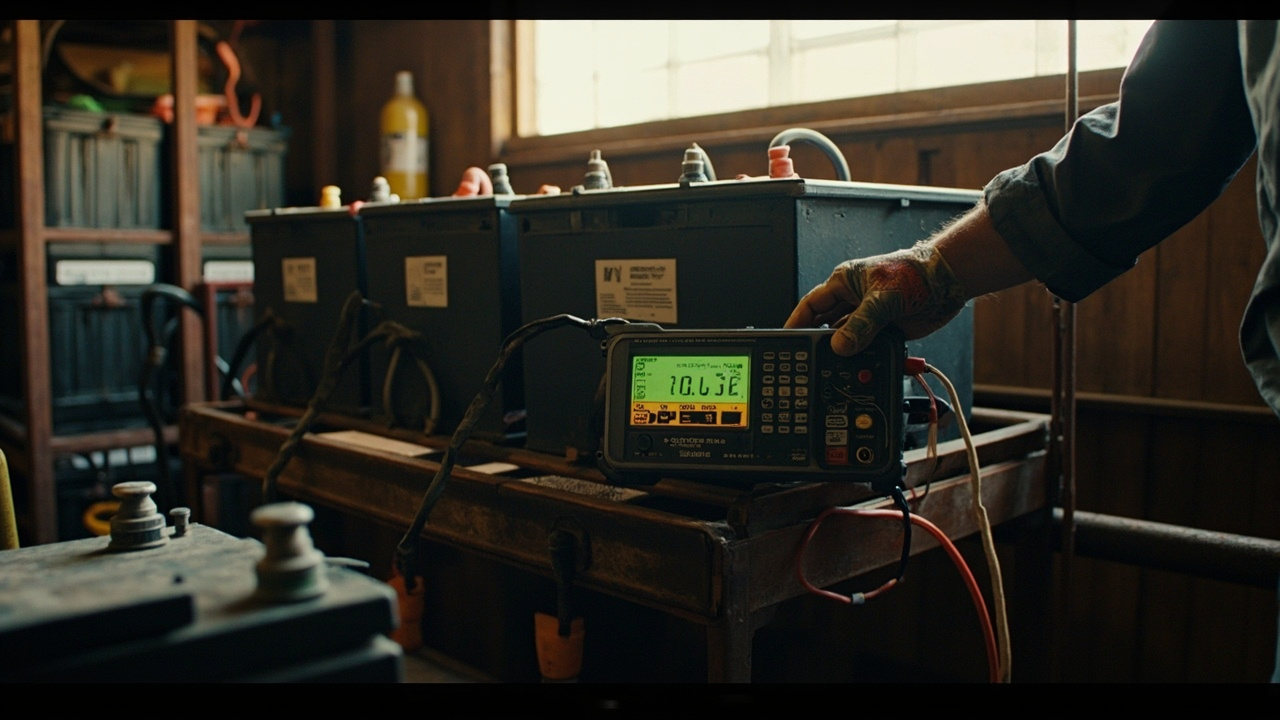
Capacity verification with battery analyzer in shed
How to do it: Every 6 months, run a full discharge test (see above). Record the capacity. Compare to your first test. If it's dropping 10%+ per year? Your batteries are toast. Time to replace.
Australian tips
Australian tip: In Queensland and WA, heat accelerates battery death. Test more often. If your battery bank is over 2 years old, test every 3 months. Don't wait for the power to die.
Australian suppliers (no fluff):
• Renogy: $250 for basic discharge resistors (e.g., 12V 100W).
• Victron: $350 for BMV-712 (measures capacity, voltage, current).
• Solar Hub: $150 for a 12V 50A discharge load (used by many installers). Price note: Don't buy cheap Chinese testers. They're inaccurate. Stick to Victron or Renogy.
Final Word
Discharge testing is non-negotiable. Impedance spectroscopy is a distraction. Capacity verification is your annual reality check. If you skip this, you'll end up paying $2k for new batteries when you could've saved $200 on a test.
Conclusion
I’ve watched too many blokes nurse a battery bank along on little more than blind faith in a glossy spec sheet. The sticker on the case might promise 10 years, but I’ve swapped out forklift cells 14 months after install because nobody put a meter on them. A basic temperature-compensating hydrometer from any rural supplier or Battery World runs $25–$40. A DC clamp meter that reads up to 400 A without blowing its internal fuse costs $150–$250 at an auto sparky or online.
Monitor Flooded Lead-Acid Cells
That two-minute spend is small beer next to the $2,500 flooded lead-acid forklift block that becomes a boat anchor a year early. In the paddock, I pull specific gravity every three months on flooded cells. At 25°C, anything reading 1.225 is already at 50% depth of discharge and losing winter headroom. A cell that sits 30 points below its neighbours has an internal soft short bleeding power every night—ignore it, and the generator will be screaming at 2 a.m. when the whole string sags to inverter cutoff. For sealed batteries, I log the rested voltage after four hours off charge.
Check AGM Health Before Winter
A 12-volt AGM bank that settles at 12.5 instead of 12.8 has chewed through about 20% of its useful life, even if the terminal voltage looks okay straight off the charger. No lab coat needed, just a notebook and the habit of checking before the first cold snap hits.
⚠️ SAFETY WARNING: Working with electrical systems, structural modifications, or gas installations carries inherent risks. If you are not confident in your abilities, always engage a licensed professional.
He breaks down the spec‑sheet tricks that manufacturers use to inflate capacity numbers, which is exactly the type of claim you can verify with the battery testing steps in the guide. Watch the segment where he reads cycle‑life graphs to expose inflated cycle counts.— Dave Miller
Frequently asked questions
How do I test my off-grid battery bank myself?
Grab a bulb-type hydrometer from Repco or Supercheap Auto — about fourteen bucks. Pull each vent cap, draw some electrolyte, and read the specific gravity. Don't just check the first cell, because one dud in the string drags the rest of the bank down with it.
What specific gravity reading should I be looking for?
For a flooded lead-acid battery at 25 degrees Celsius, a healthy full charge sits between 1.265 and 1.285. If you're getting a reading around 1.225 on a cell in a 12-volt battery, that cell's on its way out and the rest of the string will follow it down. That's how a good bank ends up as a plastic box full of scrap lead.
How often should I be testing my off-grid batteries?
Do a proper capacity check once a year — that's the one you can't afford to skip. A quick hydrometer sweep across all cells should be part of your regular maintenance, especially on a big setup like a 48-volt forklift bank. I've seen blokes near Longreach go two years without checking and lose the whole string.
When should I call a professional instead of testing it myself?
If the bank's sagging hard under load, like dropping from 48 volts down to 44, the problem's usually past a hydrometer fix. Same goes if cells are boiling dry or plates are buckled — that's when you need someone with proper load-testing gear to tell you straight whether it's salvageable or scrap. Don't keep pumping amps into a cooked battery hoping it'll bounce back.
When to Call a Professional
While many off-grid projects are achievable as DIY, certain situations require licensed professionals:
Professional technician inspecting off‑grid battery bank
Electrical work beyond basic 12V DC additions — requires a licensed electrician
Structural modifications to buildings or load-bearing elements
Gas line installation or modification
Solar array installations above safe voltage thresholds
Any work that affects the structural integrity of your property
Always check local regulations and obtain necessary permits before commencing work.