Battery Chemistry Types Explained for Off-Grid
Twenty-two years wiring off-grid systems in central Queensland, and battery chemistry is still the call that decides whether the system works. I've pulled apart enough dead banks in 40-degree sheds to know the gap between what the brochures say and what actually cooks by February. This guide covers lead-acid, lithium LiFePO4, and the newer chemistries worth your time – the rest is marketing.

By Dave Miller · off-grid sparky · 22 years wiring solar, batteries and sheds in central QLD
“I've replaced three lead-acid banks in my shed since 2010, learning that lithium's 4000 cycles beat their 500 when the Central Queensland heat hits 45 degrees.”
Introduction
Every component in an off-grid rig pulls its weight, but the battery bank is where the maths either works or it doesn't. I've pulled up to too many jobs where the panels were premium, the inverter was oversized, and the battery choice was a punt off a forum thread.
Twenty-two years of wiring these systems around central Queensland has taught me one simple thing: the chemistry you pick decides how much of that harvested sun you actually claw back, how long the bank lasts before capacity drops, whether it survives a tin shed through summer, and what the true cost looks like once you count the replacements. Pick wrong on day one and you're paying for it every month the system runs.
Challenges Of Australian Off-Grid Living
Twenty-two years wiring solar, batteries and sheds across central Queensland, and the heat still catches me out. Summer days push past 45°C; winter nights drop below freezing. Along the coast and up into northern NSW, you add salt air and humidity to the punishment. Most rural properties sit hours from the nearest supplier, so a dead battery isn't an inconvenience — it's a logistics problem. I learnt that lesson the hard way. A run of lithium iron phosphate batteries cooked during a Queensland heatwave: three days without power and $3,200 spent on replacements. No theory here, just what holds up and what fails, so you don't end up paying for my mistakes.
Key Considerations
Flooded Lead-Acid (FLA): Traditional flooded lead-acid batteries use liquid electrolyte that freely roars between lead plates. They are the original rechargeable battery technology and remain relevant for large, budget-conscious installations. Advantages include low upfront cost (AUD $150–$300 per 100Ah 12V cell), wide availability, and proven technology over 150 years of use.
Disadvantages are significant: they require regular maintenance (topping up with distilled water every 1–3 months), must be kept upright to prevent electrolyte leakage, release hydrogen gas during charging (requiring ventilation), have a low depth of discharge (typically 50% DoD for long cycle life), and have a shorter cycle life (300–800 cycles at 50% DoD). Flooded lead-acid is most appropriate for large stationary installations where maintenance access is easy and the budget is constrained.
Sealed Lead-Acid Battery Options
Sealed Lead-Acid: AGM and Gel: Sealed lead-acid batteries address some of FLA's drawbacks. AGM (Absorbed Glass Mat) batteries hold the electrolyte in a fibreglass mat, making them spill-proof and mountable in any orientation. Gel batteries add silica to the electrolyte to form a thick gel. Both are valve-regulated (VRLA) — they recombine gas internally and require no maintenance. AGM batteries have good high-current performance and are relatively fast to charge. Gel batteries excel in deep-cycle applications and have better temperature tolerance. Both have moderate cycle life (500–1,000 cycles at 50% DoD) and cost more than flooded (AUD $250–$500 per 100Ah 12V). Neither tolerates overcharging well, and both have lower round-trip efficiency than lithium (~75–80% vs 90–95% for LiFePO4).
Battery Performance
Lithium LiFePO4: Lithium Iron Phosphate (LiFePO4 or LFP) is the dominant chemistry for new off-grid installations in Australia. Advantages are compelling: 3,000–6,000 cycle life at 80% depth of discharge, 95–98% round-trip efficiency, no maintenance, no gassing, ability to be mounted in any orientation, consistent voltage throughout the discharge cycle, and low self-discharge rate (2–3% per month). The main disadvantage is upfront cost (AUD $600–$1,200 per 100Ah 12V pack), though lifecycle cost per kWh stored is lower than lead-acid. LiFePO4 is the recommended chemistry for most Australian off-grid installations, particularly those in remote locations where maintenance visits are costly and reliability is paramount.
Battery Depth Of Discharge Limits
Depth of Discharge (DoD): This is the percentage of total capacity that can be used before the battery suffers permanent damage or drastically reduced lifespan. A flooded lead-acid battery used to 80% DoD will fail within months — 50% is the practical limit. LiFePO4 can routinely be discharged to 80–100% DoD with no degradation. This means a 100Ah LiFePO4 battery effectively stores 80–100Ah of usable energy, while a 100Ah flooded lead-acid at 50% DoD only delivers 50Ah of usable energy. When comparing prices, always compare on a cost-per-Usable-kWh basis.
Lithium Batteries Offer Superior Cycle Life
Cycle Life: A cycle is one complete charge and discharge. Cycle life tells you how many cycles a battery can endure before its capacity falls below 80% of original. Lithium batteries' superior cycle life often makes them cheaper over a 10-year period despite higher upfront cost. A LiFePO4 battery with 4,000 cycles at 80% DoD provides the equivalent of 3,200 full cycles of usable energy — more than 8 years at one cycle per day. A flooded lead-acid battery at 500 cycles and 50% DoD delivers only 250 equivalent full cycles.
Battery Temperature Limits
Temperature Range: Australian conditions push batteries hard. Flooded lead-acid performs reasonably in moderate temperatures but loses significant capacity below 0°C and above 40°C. LiFePO4 has a wider operating range (-20°C to 55°C) but charges poorly below 0°C without a low-temperature charging protection feature — a critical consideration for alpine and highland Australian properties. Many LiFePO4 batteries sold in Australia include built-in low-temperature cutoffs that prevent charging when cells are below freezing.
Sizing & Efficiency
Round-Trip Efficiency: This is the ratio of energy taken out vs energy put in. LiFePO4 achieves 95–98%, meaning very little energy is lost during charge-discharge cycling. Flooded lead-acid typically achieves 75–85% — a significant difference that compounds daily. Over a year of daily cycling, a lead-acid bank will waste substantially more of your solar generation as heat, effectively requiring more solar panels to achieve the same usable storage.
How Big A Bank Do You Actually Need
Assessing Your Energy Needs: Before selecting chemistry, calculate your daily energy consumption in kilowatt-hours. Review your electricity bills or use a monitoring device over 2–4 weeks. A typical Australian off-grid household uses 15–30 kWh per day, though efficient tiny homes can manage on 5–10 kWh. Size your battery bank to provide 2–5 days of autonomy (how long the bank can carry your loads without solar input) depending on your location's seasonal solar availability. In northern Australia, two days of autonomy may suffice; in Tasmania or southern VIC during winter, you may need four or five days.
Calculate Required Battery Capacity
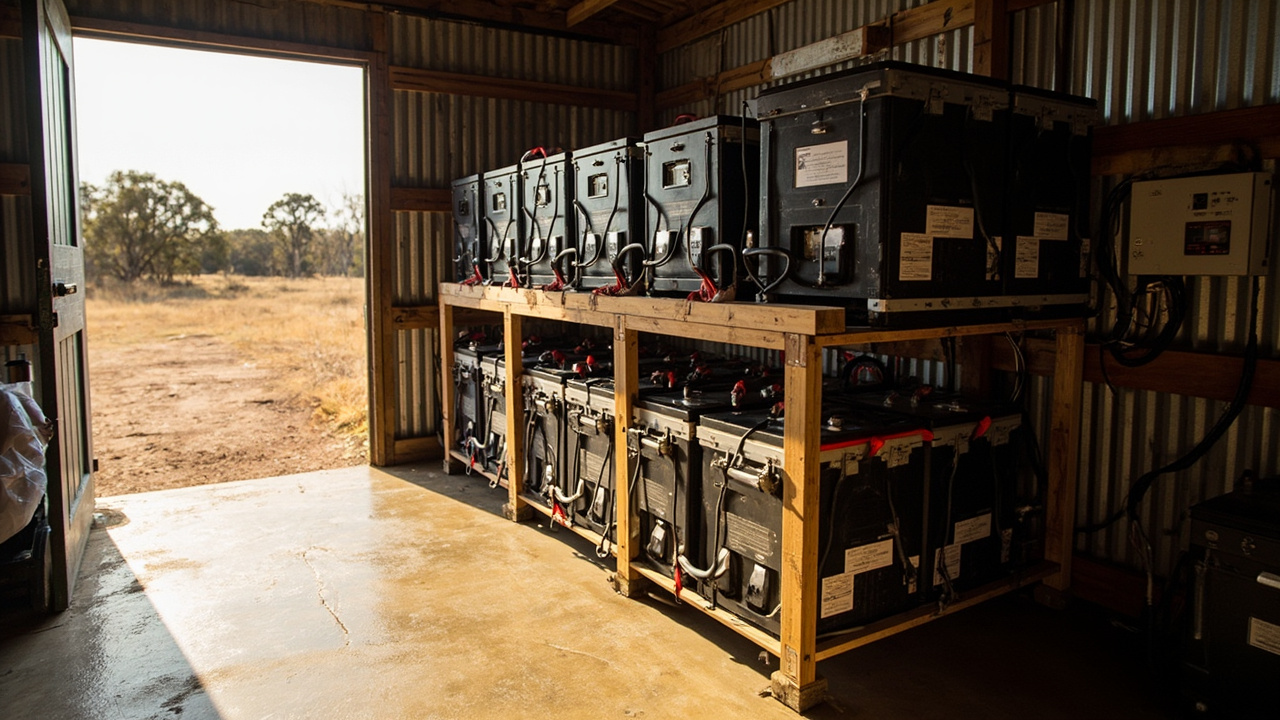
Sizing Calculations: Once you know your daily usage and desired autonomy days, calculate required storage capacity. Example: 20 kWh/day usage, 3-day autonomy = 60 kWh usable storage needed. If using LiFePO4 at 80% DoD, you need 75 kWh nominal capacity. If using flooded lead-acid at 50% DoD, you need 120 kWh nominal capacity. Note that the lead-acid system is significantly larger, heavier, and requires more space. Then factor in your inverter voltage: 24V systems are most common for medium installations (5–15 kWh); 48V systems are preferred for larger installations (15+ kWh) to minimise current and cable losses.
Choose Battery Chemistry By System Size
Matching Chemistry to System Size: For small systems under 5 kWh (tiny homes, basic cabins), the price difference between lead-acid and LiFePO4 is modest — spend the extra on lithium. For medium systems 5–20 kWh, LiFePO4's lifecycle advantage usually justifies the extra upfront cost. For large systems above 20 kWh, flooded lead-acid can make financial sense if the property has easy maintenance access and the owner is technically comfortable with regular maintenance. For any system where reliability is critical (remote medical equipment, communication systems), lithium is the clear choice.
Costs and Considerations
Cost, Warranty & Disposal
Cost Per kWh Lifecycle: When comparing batteries, calculate lifecycle cost not upfront cost. LiFePO4 at AUD $800 per 100Ah 12V (1.28 kWh) = AUD $625/kWh nominal, AUD $780/kWh usable (at 80% DoD), with 4,000 cycle life = AUD $0.20/kWh through the battery's life. Flooded lead-acid at AUD $200 per 100Ah 12V = AUD $400/kWh nominal, AUD $800/kWh usable (at 50% DoD), with 500 cycle life = AUD $1.60/kWh through the battery's life. Even at optimistic estimates, lithium is 4–5 times cheaper per kilowatt-hour of delivered energy over the battery's lifetime.
Choose Brands With Australian Support
Warranty: LiFePO4 batteries typically come with 5–10 year warranties, though warranty terms vary widely — some are "swap" warranties, some cover capacity, some are pro-rata. Read the fine print carefully. Brand names with strong Australian presence (Enerdrive, BMS Lithium, Revolution Power, Big Battery) typically offer better support than grey-import Chinese batteries despite similar prices. Flooded lead-acid batteries usually have shorter warranties (1–3 years) and are pro-rata based on rated capacity.
Responsible Battery Disposal In Australia
Disposal in Australia: All battery chemistries must be disposed of responsibly. Lead-acid batteries have an established recycling stream — most rural battery suppliers and council transfer stations accept them, and recycling rates exceed 95%. LiFePO4 batteries are more complex — the lithium content requires specific recycling processing. Australian recycling infrastructure for lithium batteries is developing but not yet widespread. Reclaim Technologies and Envirostream are two operators with collection programs. Check with your local council for available drop-off points. Never send lithium batteries to landfill — they present fire risks and contain valuable materials that should be recovered.
Recommended Products
- LiFePO4 Battery (100Ah 12V): Enerdrive 100Ah LiFePO4 on Amazon — Australian brand, 5-year warranty, Bluetooth monitoring, built-in BMS with low-temp charging protection.
- Budget LiFePO4 (200Ah 24V): BMS Lithium 200Ah 24V pack on Amazon — excellent value, CAN-bus compatible, 5-year warranty.
- Flooded Lead-Acid (2V 500Ah cells): Trojan T-105 6V 225Ah golf cart batteries — proven deep-cycle FLA, widely available, 1-year warranty. Wire in series/parallel for 24V or 48V banks.
- Quality LiFePO4 Charger: Victron Energy Blue Smart IP65 12V/15A charger — compatible with LiFePO4, Bluetooth monitoring, adaptive charging algorithm.
- Battery Monitor: Victron Energy SmartShunt 500A — tracks state of charge, current, voltage, amp-hours, integrates with Victron app, essential for any serious off-grid system.
Shop on Amazon: View on Amazon
Conclusion
I've spent 22 years wiring solar, batteries and sheds across central QLD, and for the vast majority of Australian off-grid property owners in 2026, LiFePO4 is the right battery chemistry. The upfront cost is higher, but the lifecycle economics are decisively superior, and the performance characteristics — no maintenance, high efficiency, deep discharge capability, wide temperature tolerance — are ideally suited to Australian conditions and the reality of remote off-grid living. Flooded lead-acid still has a role for very large, budget-constrained, maintenance-accessible installations, but that niche is narrowing every year as lithium prices continue to fall.
Make the investment in quality LiFePO4, size it properly for your needs and autonomy requirements, and you'll have a battery bank that delivers reliable, maintenance-free service for a decade or more.
Worth a watch: Lithium vs AGM Batteries: What's Best For Off-Grid Solar Power Systems? Comparison & Breakdown · ShopSolar
Disclosure: some links in this article are affiliate links. If you buy through them we may earn a small commission at no extra cost to you.