
A backup battery that ran the house through February can drop out by June. The cause is almost always one of three things: the battery was undersized for winter night-time demand, the chemistry hit a low-temperature limit, or the supporting system (cabling, BMS, inverter, transfer switch) was never matched to the load. This article runs through the verified numbers behind each failure mode, the spec table that drives correct sizing, and the safety boundaries a homeowner must respect.
The winter problem, stated plainly
Off-grid batteries must be sized to daily use and checked against winter conditions, not just summer peak sun. In Australia, "winter conditions" means shorter solar days, lower panel yield per kW installed, longer nights pulling from storage, and — in many regions — overnight temperatures near or below 0 °C where LiFePO4 batteries live. None of these effects show up on a summer spec sheet.
Five numbers drive every sizing decision: daily kWh, overnight kWh, peak kW, surge kW, and days of autonomy. If any one of those five is wrong for winter, the bank fails when it matters most.
Specs and requirements table
| Parameter | What it measures | Winter-specific rule |
|---|---|---|
| Daily kWh | Total energy used in 24 h | Use the worst-week estimate, not the annual average |
| Overnight kWh | Energy used from sundown to sunrise | This is the figure that sizes the battery, not daily kWh |
| Peak kW | Highest simultaneous running load | Add workshop tools, pumps, multiple air-conditioners |
| Surge kW | Motor starting transient (compressors, pumps) | Often 3–7× running watts; must be inside inverter spec |
| Days of autonomy | How many cloudy days the bank must cover alone | 2–3 days is the usual Australian off-grid target |
| Battery capacity (kWh) | Overnight kWh × autonomy days ÷ DoD | Adjust usable DoD down in cold conditions |
| Solar array (kW) | Daily kWh ÷ worst-month yield (kWh/kW/day) | Winter yield in southern regions is roughly 30–45% of summer |
| Inverter/charger (kW) | Peak kW + Surge kW | Continuous rating ≠ surge rating — read both |
| Low-temp charge limit (°C) | Minimum cell temperature for charging | 0 °C for standard LiFePO4 unless self-heating or BMS-protected |
| Generator derating | Continuous load ÷ 0.8 | Plan for 80% of nameplate, plus surge headroom |
How undersizing actually fails in winter
The battery was sized for summer nights
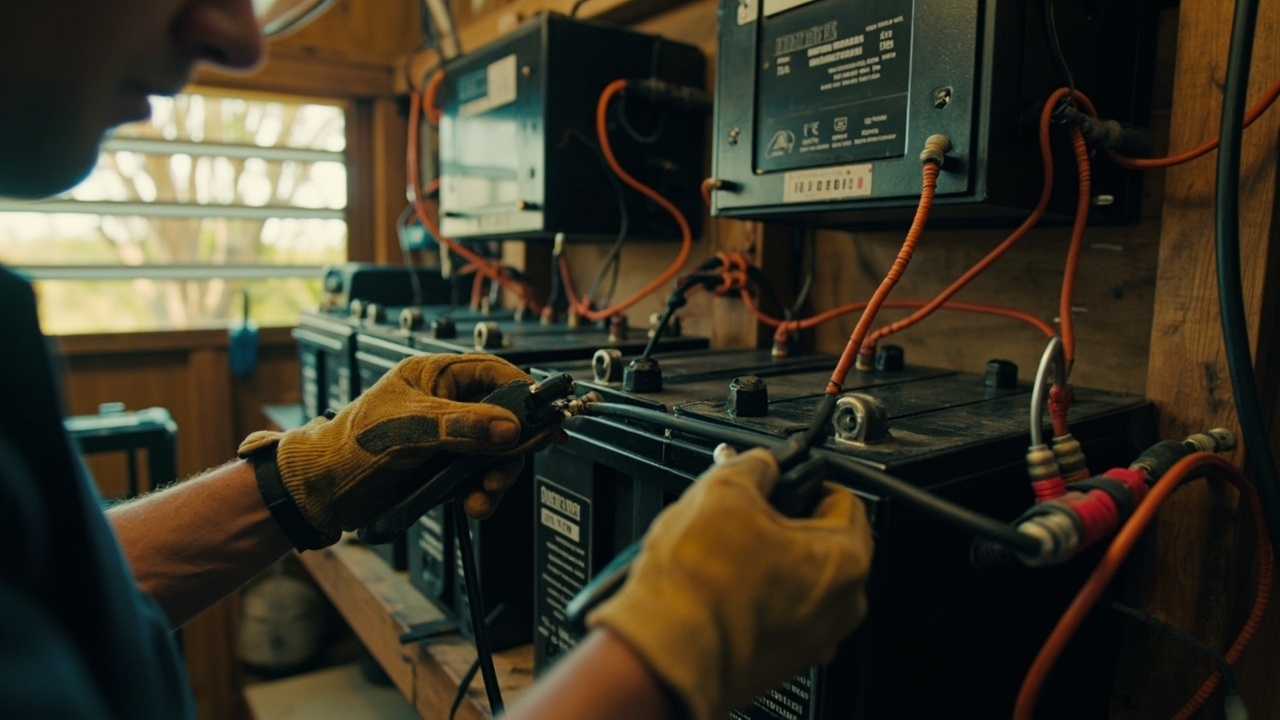
The fastest way to size battery storage is to start with overnight demand and decide what must keep running no matter what. Typical essential overnight loads are fridge and freezer, lights and power points, internet/phones/laptops, water pressure pumps, and medical equipment. Add those watt-hours, multiply by the autonomy days, then divide by usable depth of discharge.
Battery size is calculated as overnight kWh multiplied by autonomy days, adjusted for usable depth of discharge (DoD) and winter conditions. Cold cells deliver slightly less usable capacity than warm ones. If the original sizing assumed a 90% DoD at 25 °C, the same bank at 5 °C will hand back less energy before the BMS disconnects — and the house will go dark earlier than the calendar suggests.
The solar array was sized for summer yield
Solar array size depends on daily kWh, worst-month solar yield, and recovery needs after cloudy days. Winter sun hours drop, panel efficiency drops with temperature coefficients in reverse (panels like cold clear skies, but daylight hours shrink), and a run of overcast days stacks the disadvantage. A bank that recovered fully by 2 pm in January may not recover until the next clear day in July, and the autonomy margin disappears.
The inverter was sized without surge
Inverter size is determined by peak kW plus surge kW, plus any workshop tools, pumps, or multiple air conditioners. Intermittent loads such as pumps that run sometimes often trigger inverter trips because the inrush current appears at random and the inverter has no thermal budget to spare. Winter concentrates motor starts (fridge and freezer compressors cycle more often in a cold shed), so what tripped occasionally in summer becomes a nightly event.
The chemistry hit a low-temperature cut-off
LiFePO4 cells must not be charged below 0 °C without low-temperature charge protection or self-heating. Charging a frozen LiFePO4 cell plates lithium and permanently damages it. In many Australian elevated and southern sites overnight winter temperatures dip below that threshold. Self-heating LiFePO4 batteries (e.g. Renogy 48V 50Ah listed) do mitigate cold-charge issues by warming the cells before the BMS allows charge current — but only where the BMS is wired and configured to use that function. Standard cells without the heater will simply refuse charge on a cold morning, and the bank will not refill even though the panels are running.
The matched-system rule
An off-grid battery setup is part of a matched power system typically called a Battery Energy Storage System (BESS), which includes battery, inverter/charger, controls, and monitoring. Typical off-grid system components are: solar panels, battery storage, inverter/charger, MPPT solar charge controller, battery management system (BMS), generator backup, and switchboard/circuit design. If any single component of an off-grid system is undersized, the whole system can feel unreliable.
Battery bank considerations are capacity (kWh), depth of discharge (DoD), and cycle life. LiFePO4 batteries last roughly 3x longer than lead-acid and handle deeper discharges — useful when winter cycling is deep and frequent — but only when cycle counts are quoted at matched DoD. A 6,000-cycle LiFePO4 spec at 80% DoD is not the same animal as a 1,200-cycle lead-acid spec at 50% DoD.
DC battery banks require appropriately gauged cabling, fusing within 150 mm of the battery, and a BMS rated to inverter charge/discharge current. A BMS rated below the inverter's max charge current will throttle charging on cold mornings exactly when the array is producing well — another way a "big enough" array fails to refill a "big enough" bank.
Off-grid vs hybrid: why the safety bar matters
True off-grid means not connected to the electricity network; hybrid means grid-connected using solar and battery to reduce bills and provide backup. A grid-connected home with solar and battery can self-consume solar, store excess generation, ride through some outages, and still use network electricity when needed; an off-grid home cannot lean on any of that backup. Once off-grid, every shortfall becomes the homeowner's responsibility, including winter dips in solar production, battery replacement cycles, inverter issues, and backup-generation decisions.
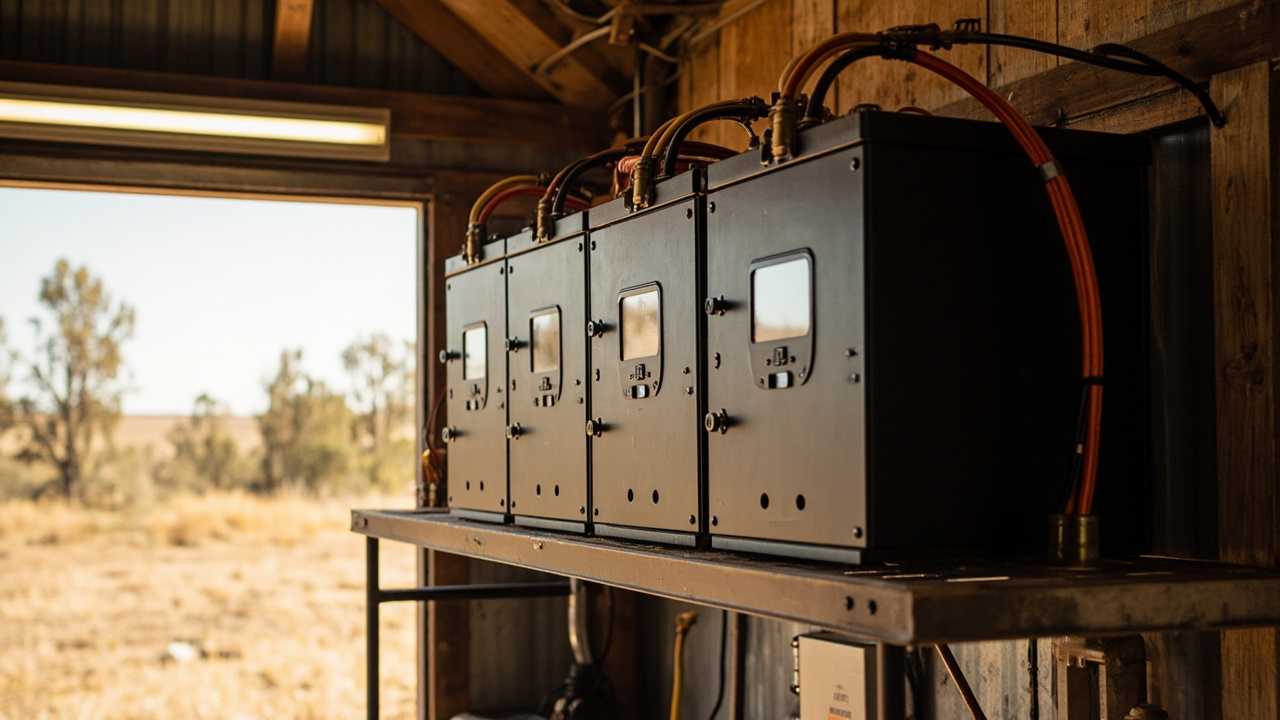
Off-grid power is a standalone energy system with several moving parts: generation assets, storage, power conversion (inverters/control hardware), backup supply (often a generator), and load management.
Generators as winter backstop
Generators should be derated to ~80% of nameplate for continuous load, with starting surge factored in separately. Petrol generators can gum up the carburettor after a few months sitting idle, which is why a winter-tested system needs a monthly exercise run. LPG requires compliant cylinders, a proper regulator, and venting room if there is a leak.
Transfer switches are required to prevent dangerous back-feeding into utility lines and to allow safe power transitions between grid and generator. Even on a true off-grid site, a transfer switch between inverter output, generator output, and the house wiring is the safe way to bring a generator online without back-feeding the inverter.
A UPS unit is appropriate for short-bridge protection of sensitive electronics — routers, computers, modems — but not for sustained loads or anything with a motor. Treating a UPS as a small off-grid battery is a common winter-failure path.
When to call a licensed professional
Off-grid installations in Australia still need to meet Australian electrical expectations including protection, cabling, earthing, isolation, labelling, and commissioning. Systems connecting to the grid or operating in grid-interactive mode may need inverters and settings aligned with AS/NZS 4777.2. Many buyers use CEC-accredited installers as a practical compliance checkpoint.
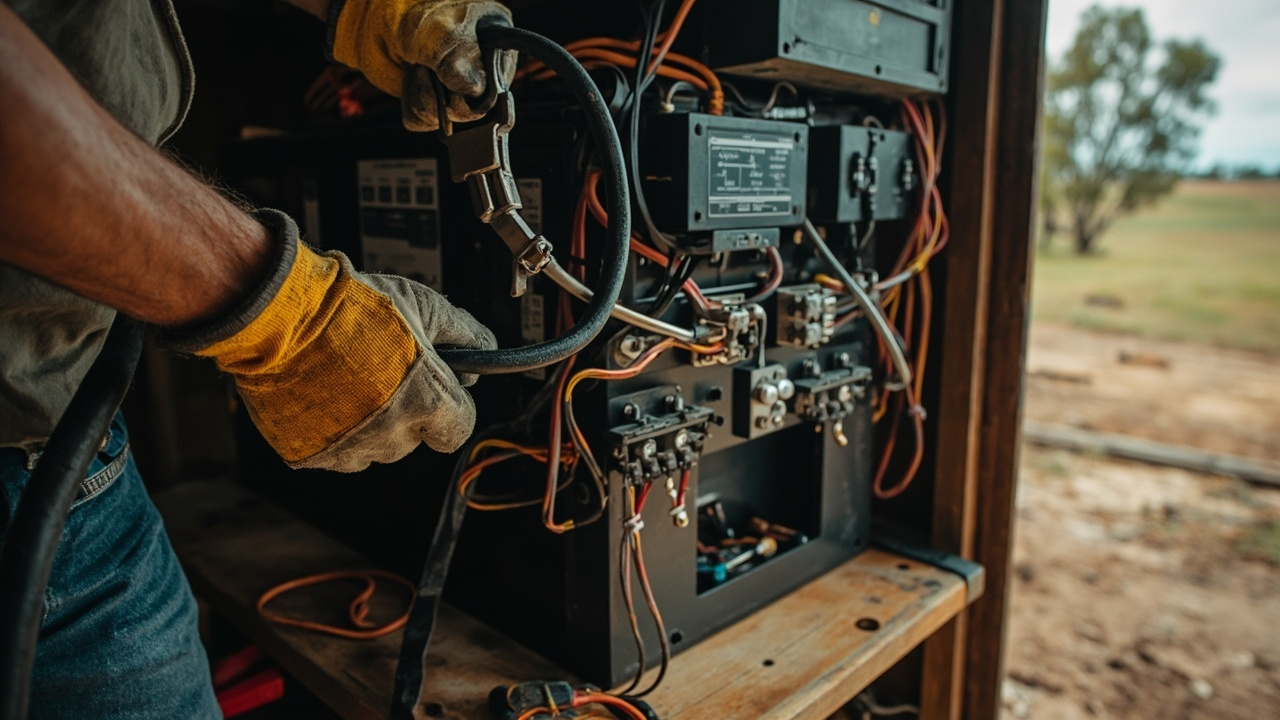
Call a licensed electrician or CEC-accredited off-grid installer if any of the following applies:
- The battery bank, inverter, or solar array is being installed, replaced, or re-wired.
- A transfer switch is being added between inverter, generator, and house wiring.
- LPG cylinders, regulators, or pipework are being sized, installed, or vented.
- The switchboard needs RCD/MCB protection brought up to current Australian expectations.
- The BMS, charge controller, or inverter settings need to be programmed for low-temperature operation.
- Any sign of cell swelling, sulphation, acid residue, or repeated low-voltage cut-outs.
A person can do their own battery maintenance (terminal checks, torque retension to spec, state-of-charge logs) but must not open a lithium battery, modify BMS firmware, or alter fixed wiring without the appropriate licence.
FAQ
Why does my battery die at night in winter but not summer?
The combination of longer nights, lower overnight temperatures reducing usable DoD, and a solar array sized for summer yield leaves the bank under-filled by sunset. The autonomy margin disappears first.
Do I need a self-heating LiFePO4 battery in Australia?
If the install site regularly drops below 0 °C overnight in winter — many elevated, southern, and alpine-Australian sites will — then a standard LiFePO4 cell will refuse charge until it warms. Self-heating cells with low-temperature charge protection, or a heated battery enclosure, are the practical fix.
How many days of autonomy should I plan for?
Two to three days is the usual Australian target. Less than two and a single overcast run of weather will brown out the house.
What is the minimum spec I should check on a LiFePO4 datasheet?
Cycle life at the DoD you will actually use, continuous charge and discharge current relative to inverter size, low-temperature charge cut-off, and BMS rating.
Can I use a small UPS instead of building a battery bank?
No. A UPS is built for short-bridge protection of sensitive electronics, not for sustained household loads or motor inrush.
Do I still need an electrician if my system is fully off-grid?
Yes. Off-grid wiring still falls under the same Australian electrical expectations for protection, earthing, isolation, and labelling. Many owners use a CEC-accredited installer as a practical compliance checkpoint.
Sources
- https://freedomenergysolutions.com.au/off-grid-batteries-australia-guide/
- https://www.highflowenergy.com.au/off-grid-power/
- https://offgridmasterplan.com/article-archive/backup
Worth a watch: Go OFF-GRID with This 6kW Solar Setup! (Full Hybrid System Guide + ATS Explained) #hybridsolarsystem · Ak Electric DIY
Disclosure: some links in this article are affiliate links. If you buy through them we may earn a small commission at no extra cost to you.