By Dave Miller· off-grid sparky · 22 years wiring solar, batteries and sheds in central QLD
I had a 120-metre run from the panels down by the creek up to the tank on the ridge, and for six months I tried to get away with a 12 V pump and two different so-called heavy‑duty PWM controllers—a generic 30 A unit from a rural supply shop ($95) and later a supposedly better Epver Triron 40 A ($230). Both cooked inside a fortnight when the ambient temperature sat above 40°C day after day.
Switching To A 24 Volt System
The wiring alone was 16 mm² copper, and voltage drop at 12 V across 120 metres with a pump pulling 13 A was enough that the controller tried to compensate by pushing current even harder during the midday heat, baking the MOSFETs. That destroyed three controllers in total before I stopped being stubborn. The fix was a 24 V system. I put two 12 V 250 W panels in series, swapped the pump to a 24 V helical‑rotor model (a Grundfos SQFlex 3 SQF‑2 cost $1750), and fitted a Morningstar ProStar MPPT 40 A controller at $345.
Switch To 24V For Long Runs
Running the same 120 metres at 24 V halved the current to about 6.5 A, which turned the voltage drop from a crippling 25% down to a manageable 6%. The controller now sits inside a ventilated steel box on a south‑facing wall and never touches its absorption cutoff even in central Queensland’s January heat. I didn’t lose another component. The only sane choice for pumping uphill here is 24 V, full stop.
Solar Pump Controller: Off-Grid Water Without the Headaches
Surviving The Heat And The Stranding
A solar pump controller that cooks itself on a January afternoon isn’t a nuisance — it’s a dry trough and a mob of cattle breaking a fence to find a dam. I’ve unbolted enough burnt-out power boards from the side of a bore to know the difference between a box that survives and a box that strands you. The job isn’t complicated: take the ragged DC off a string of panels, keep the voltage inside the pump’s sweet spot, and cut out fast if the bore runs dry.
Helical Rotor Pump Costs And Risks
When it works, a helical-rotor pump runs cool at 30–48 V and pulls maybe 5–8 A through a 6 mm² twin-core down the hole, delivering 1,200 litres an hour into a poly tank 300 metres away. Screw it up and the thrust bearing welds itself because the controller never backed off the current when the water level dropped. Common hardware gives you a feel for the cost. A basic PWM unit with low-water shutoff — something like a standard Shur
A solar pump controller is the brain between your panels and your motor. Get it right and your bore runs quietly through the day, switches off when the tank fills, and protects itself when something goes wrong. Get it wrong and you burn out a submersible motor or wonder why the pump stops every time a cloud passes. This article covers what a controller actually does, how it's sized, and where the wiring has to be taken seriously.
What a Solar Pump Controller Actually Does
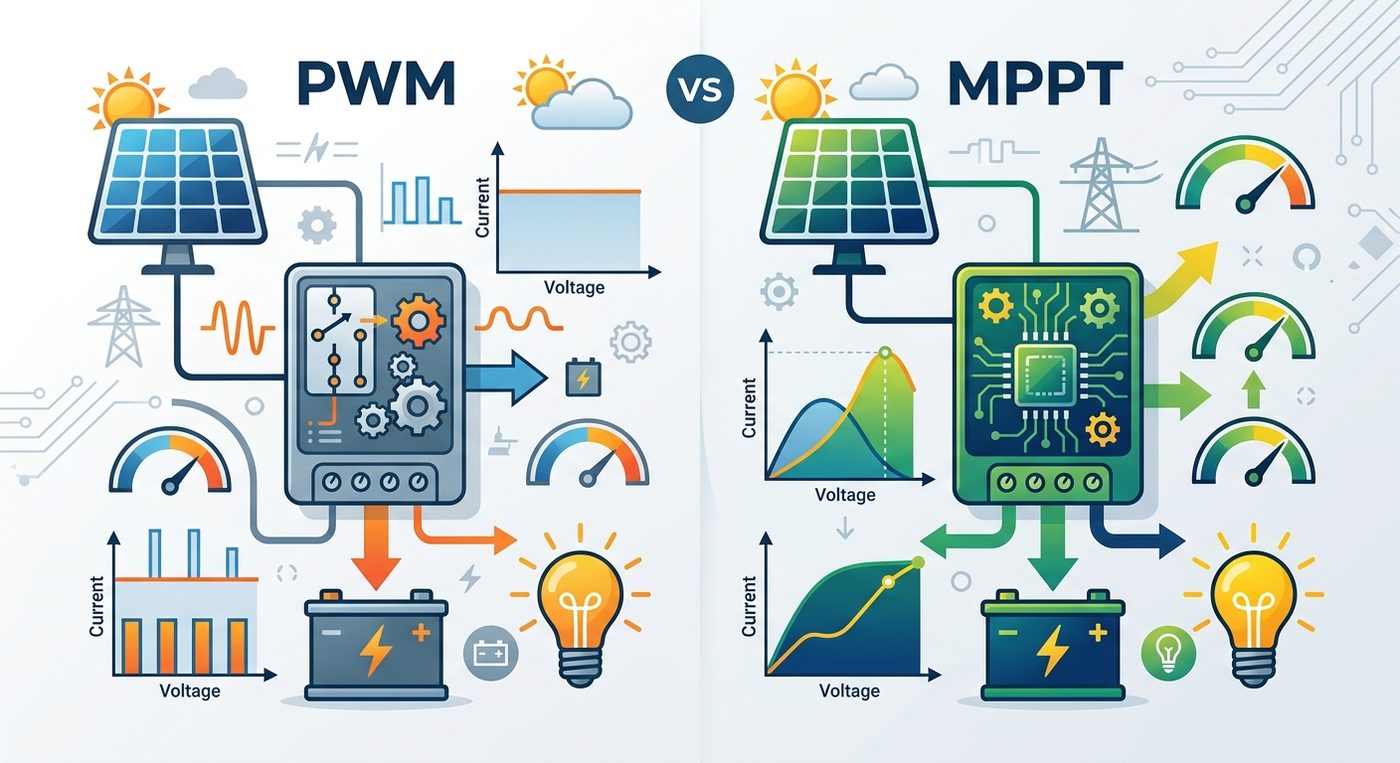
Solar panels don't put out a steady voltage — the output varies with sunlight, temperature, and load. A controller takes that variable DC and feeds the pump a stable, usable supply. In MPPT designs, it actively tracks the panel array's peak power point, so even in low light the motor still receives the maximum available wattage the panels can deliver at that instant.
Beyond power conditioning, a controller handles the safety jobs you'd otherwise wire up with relays and sensors:
Overload and over-current protection
Dry-run protection (stops the pump when water flow disappears)
Voltage fluctuation handling
Soft start to reduce inrush current on the motor
DC vs AC Pump Systems and Why the Controller Matters
Pump motors come in two flavours for solar work, and the controller sits between them.
DC pumps run directly off the solar array's DC output. They're best suited to off-grid and daytime solar operation because the controller can feed the panel output straight through with minimal conversion losses. Lower maintenance, simpler wiring, lower system cost.
AC pumps need an inverter stage to convert the panel DC into AC. They're the right call for higher-capacity systems or hybrid setups where you want to use existing AC pump infrastructure — for example, swapping a diesel-driven farm pump over to solar while keeping the three-phase motor.
Pump type
Power source
Best fit
Notes
DC
Direct solar DC
Off-grid, daytime use
Higher efficiency, lower maintenance, lower cost
AC (via inverter)
DC converted to AC
Larger or hybrid systems
Compatible with existing AC pump infrastructure
Sizing the Pump First — Then the Controller
The controller follows the pump, not the other way around. Pump selection is driven by three numbers:
1. Total vertical lift (total dynamic head) — how far the water has to be pushed up
2. Required pressure at the outlet — typically 35–70 PSI for residential use, with most homes sitting in the 45–50 PSI band
3. Total daily water demand — a reasonable planning figure is 50–100 gallons per person per day for drinking, washing, and cooking
Once those are settled, the pump type follows the duty:
Centrifugal — high flow, low to medium pressure; surface and pool work
Submersible — installed underwater for deep wells and boreholes
Positive displacement — high pressure, low flow; precise delivery such as drip irrigation
For an off-grid pressurised system, the usual pairing is a submersible or surface pump with a pressure/bladder tank. The tank takes care of short-demand peaks so the pump isn't cycling on and off every time a tap opens.
The solar array and controller are then sized to deliver the pump's running wattage through the worst part of the day you intend to operate. Monocrystalline panels are the standard choice for solar pumps because of the higher efficiency and smaller footprint per watt.
Orientation and Mounting
In the Southern Hemisphere (which includes the Australian default canon for this site), panels face north. Tilt angle is generally set close to the site's latitude. The non-negotiable rule is no shading through the day — a few hours of shade on a string can collapse output far more than the percentage of the array that's covered. Trees, water tanks, and roof vents all need to be considered across the full day arc, not just at noon.
Pump Designs at a Glance
Pump type
Strength
Typical use
Centrifugal
High flow, low–medium pressure
Surface water, pool circulation
Submersible
Pushes water from depth
Boreholes, deep wells
Positive displacement
High pressure, low flow
Drip irrigation, precise dosing
System Protection and Dry-Run Safety
Running a pump dry is the fastest way to destroy it — the motor heats up without the water that's meant to be carrying that heat away. A good solar pump controller includes dry-run protection as a standard feature: it watches current draw and/or flow, and shuts the pump down if the water disappears. Float switches (stainless steel for durability) are commonly used as a redundant cut-off in the tank.
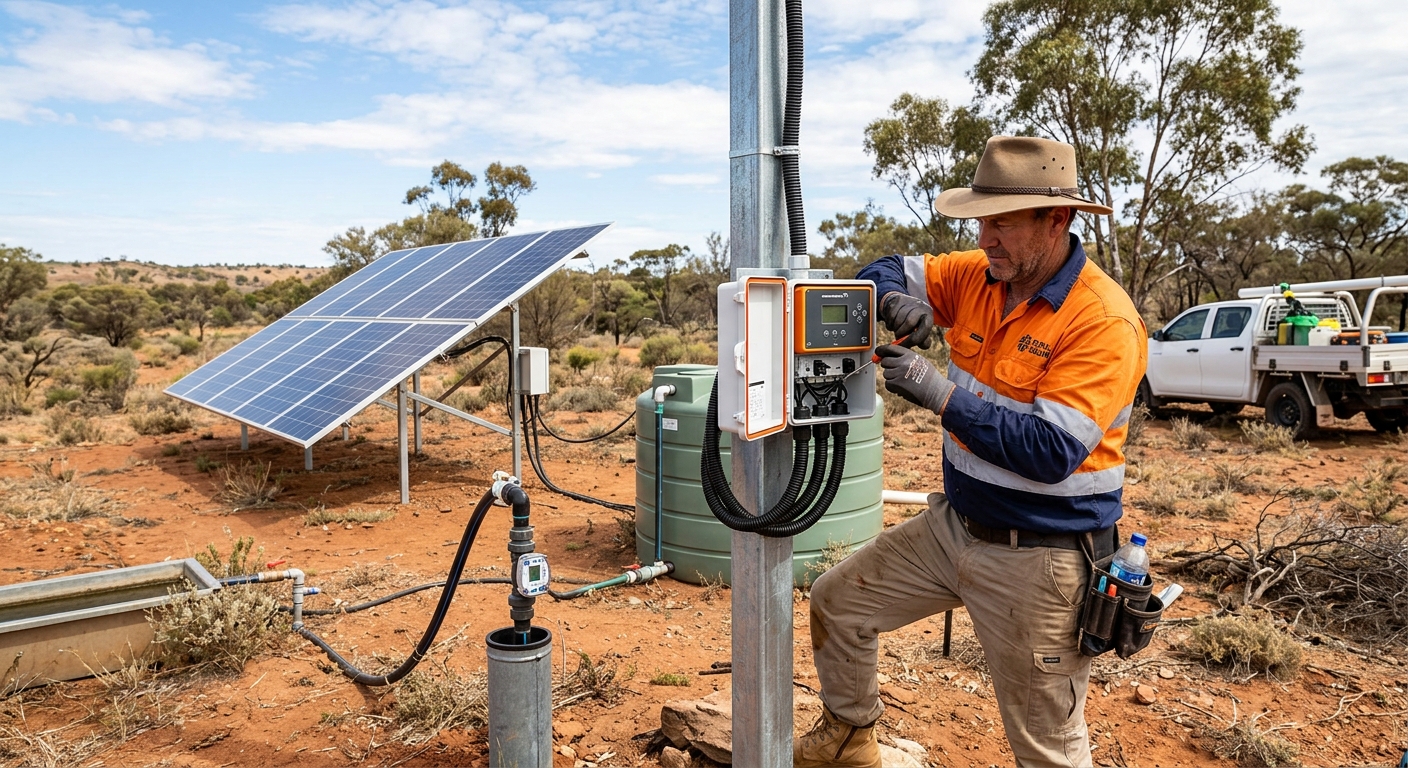
Controller hub wiring: PV in, pump out, float switch and dry-run probe as protection inputs.
Pressure tank sizing matters too. An undersized tank forces the pump to cycle rapidly, wearing the motor and the pressure switch. A properly set pressure range — typically 30/50 or 40/60 PSI for residential — protects both pump and plumbing.
Modular Growth
One of the practical advantages of a modern off-grid solar pump system is that it's modular. Additional panels can be added as water demand grows, and wind or battery inputs can be integrated. The controller is usually the part that needs to be checked for compatibility before you bolt on more capacity.
Safety Notes
Size the pump correctly based on vertical lift, required pressure, and daily demand before buying panels or controllers. Undersizing is the most common failure mode on off-grid bores.
Use a pressure/bladder tank with a properly set pressure range to protect both pump and household plumbing.
Keep panels shade-free through the full day, oriented and tilted correctly for the site.
Match the controller to the pump type (DC vs AC/via inverter) and confirm overload, dry-run, and over-voltage protection are built in.
Long cable runs between array and pump should be sized to limit voltage drop — higher-voltage array strings reduce current and therefore drop, which is why many solar pumps are wired at 48V or higher rather than 12V.
When to Call a Licensed Professional
In Australia, working on 230V/50Hz mains-connected pump systems, three-phase motors, and any wiring that ties into the household distribution board is not a DIY job. Call a licensed electrician or plumber (as appropriate to the jurisdiction and the work) when:
The pump is hard-wired to 230V mains or to an inverter that feeds the house
You're drilling into or modifying a bore/cased well — bore work is restricted in several states
You're installing or servicing a pressure tank with a charged air-side (the tank can become a stored-energy hazard)
The system is being connected to a rainwater tank, dam, or any water source that may cross with potable supply — backflow prevention rules apply
You're integrating battery storage with the pump circuit; DC battery work at relevant voltages is dangerous and regulated
FAQ
Do I need MPPT or will a basic controller do?
For solar pumps, MPPT is effectively mandatory if you want the pump to run usefully in anything less than full sun. MPPT controllers track the array's maximum power point continuously and can achieve 99% tracking efficiency, which is the difference between a pump that runs through morning and afternoon cloud and one that cuts out at the first hint of shade.
Can I run a standard AC pump on solar?
Yes, but you need an inverter stage to convert the panel DC to AC, and the controller/inverter combination has to be rated for the pump's starting surge. AC setups are typically chosen for larger systems or where an existing AC motor is being converted.
How much water do I actually need to plan for?
A reasonable planning figure is 50–100 gallons per person per day for drinking, washing, and cooking. Add garden, livestock, or fire-fighting reserves on top — these change the daily total significantly.
What pressure should I run?
Most homes run somewhere between 35 and 70 PSI, with the 45–50 PSI band being a common choice. Set the pressure tank's cut-in/cut-out range accordingly and size the tank so the pump isn't short-cycling.
Why does my pump keep cutting out in light cloud?
Usually a controller without MPPT, or a controller that hasn't been matched to the array voltage. MPPT continuously adjusts the operating point so the motor still receives maximum available wattage even during low-light conditions — without it, pump output tracks the sun directly.
Can I add batteries later?
Often yes. Off-grid solar pump systems are typically modular, allowing additional panels, wind input, and batteries to be added as needs grow. Confirm controller compatibility before buying the battery bank.
⚠️ SAFETY WARNING: Working with electrical systems, structural modifications, or gas installations carries inherent risks. If you are not confident in your abilities, always engage a licensed professional.
He walks through matching a 12 V DC submersible pump to a PWM controller and explains how a float switch prevents dry‑run, which directly backs up the controller advice in the guide.— Dave Miller
Frequently asked questions
Can I run a bore pump straight off solar panels without a controller?
You can, but you'll be throwing away most of your sunlight. A proper MPPT controller matches the pump's needs to what the panels are actually putting out, so you get more flow for the same sun. Without one, your pump either runs poorly or cooks itself, and a dead pump is an expensive lesson.
What does a float switch actually do on a solar water pump?
A float switch sits in your tank and tells the pump when to stop once the water's high enough. Without one, the pump keeps pushing water until it has nowhere to go, which burns it out fast. Pair it with dry run protection and you've got a setup that looks after itself while you're not there.
Why does my solar pump keep burning out?
Most of the time it's running dry — bore drops, tank empties, pump keeps grinding. That's what I call the silent pump killer, because you don't notice until the motor's cooked. A float switch at the tank and dry run protection at the bore will stop it happening again.
Can I install a solar pump controller myself or do I need an electrician?
Depends on what's involved. Swapping a controller on the low-voltage DC side is something a careful DIYer can handle. The moment you're touching 240V mains, a licensed sparkie isn't optional — it's the law, and your insurance won't cover a stuff-up. If you're not sure which side of the fence you're on, ask before you start pulling wires.