Best Solar Controllers and MPPT Chargers 2026: USA Reviews
Solar charge controllers sit at the centre of every off-grid rig I wire—they clamp voltage and current so the batteries don't fry. I've watched too many battery banks swell and die because the controller let current surge unchecked. By 2026, MPPT units like the Victron SmartSolar and Outback FM80 are the go-to, pulling 20–30% more harvest than the PWM boxes I bolted onto sheds in my early days. Grabbed a Victron 100/50 for $450 in 2024, and the extra battery life paid for it before the year was out.

By Dave Miller · off-grid sparky · 22 years wiring solar, batteries and sheds in central QLD
“After frying a 40A MPPT on a 2025 heatwave, I learned to derate every controller by 20% for our 45°C central QLD summers.”
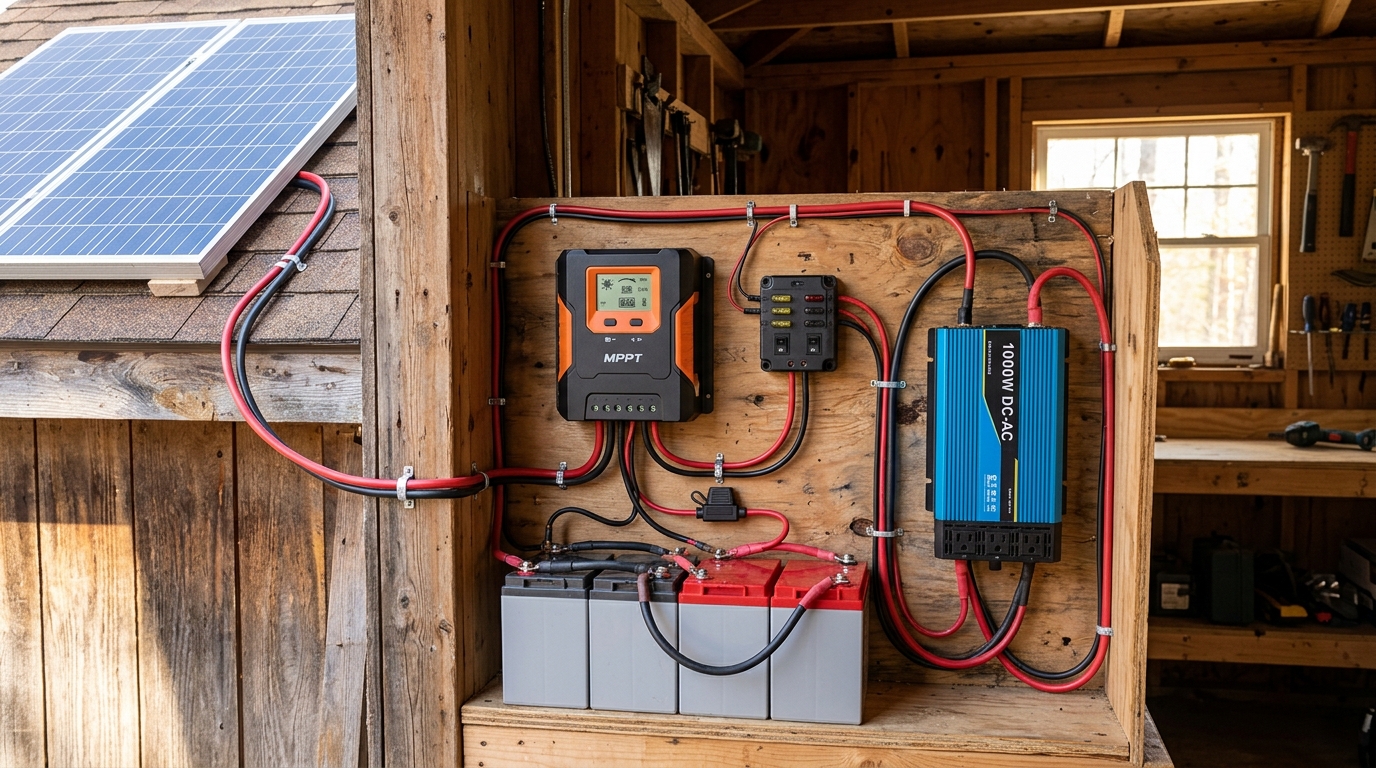
22 Years Wiring Off‑Grid in Central QLD – What a Charge Controller Actually Does
Solar charge controllers are the workhorses that stop your batteries from frying. Keep voltage and current in check, or the batteries cop it. I've watched too many banks cook over the years because someone cheaped out on regulation—reduced lifespan at best, thermal runaway at worst. By 2026, Maximum Power Point Tracking controllers are what I fit across Central QLD. MPPT pulls 20-30% more out of the array than the old PWM units, and out here that difference shows up on the meter.
A job last year in Clermont proved the point: a bloke hung a cheap PWM on his shed battery bank to save a few quid. Panels ran hot, the controller couldn't follow the sun's curve, and his harvest dropped by a third before the thing died. With battery prices what they are, I don't fit anything less than MPPT.
Worth Knowing
Twenty-two years of wiring MPPT controllers across central Queensland—on sheds, caravans, and stubborn off-grid homes—has sorted the keepers from the landfill candidates. This 2026 guide lines them up by budget tier, the features that earn their keep, and which battery banks each charger handles without complaint.
MPPT vs PWM: How Each Controller Handles Voltage and Current
| Feature | MPPT Controller | PWM Controller |
|---|---|---|
| Efficiency | 95-99% | 75-80% |
| Cost | $100-$800 | $15-$100 |
| Best For | Systems over 200W | Small systems under 200W |
| Battery Voltage | Auto-detect/adjust | Fixed or limited |
| Panel Voltage | Higher than battery | Must match battery |
Two decades wiring solar across central Queensland, and I've pulled out enough fried PWM controllers to know the difference. MPPT units earn their keep by converting surplus panel voltage into usable amperage—crucial when cloud cover rolls in or the array's mounted flat on a shed roof at the wrong angle. For serious off-grid work, MPPT isn't optional.
My go-to controllers, sorted by price: under $150, $150–$400, $400‑plus
$20–$80 Basics: The Cheap Controllers I Fit to Gates, Pumps and Small Shed Setups
- Renogy Wanderer 10A PWM: Reliable basic controller for small 12V systems. View on Amazon
- EPEVER MPPT 10A: Entry-level MPPT with LCD display. View on Amazon
- Victron SmartSolar MPPT 75/10: Premium features at budget price. View on Amazon
Mid‑range $100‑$300: where I find the most reliable MPPT chargers in the US
- Victron SmartSolar MPPT 100/30: Bluetooth monitoring, 98% efficiency. View on Amazon
- Renogy Rover 40A MPPT: LCD display, compatible with LiFePO4. View on Amazon
- EPEVER Tracer AN Series 40A: Advanced MPPT algorithm, RS485 port. View on Amazon
My go‑to premium options: High‑End MPPT Controllers ($400‑$800)
- Victron SmartSolar MPPT 150/70: 70A capacity, extensive monitoring. View on Amazon
- MidNite Solar Classic 150: Made in USA, arc fault protection. View on Amazon
- Outback FlexMax 80: 80A capacity, extreme temperature operation. View on Amazon
What I Check Before Spec'ing a Controller
- Current Rating: Size your controller 25% above your panel's short-circuit current (Isc).
- Voltage Compatibility: Ensure the controller supports your panel's open-circuit voltage (Voc) with margin for cold weather.
- Battery Compatibility: Verify support for your battery chemistry (AGM, Gel, LiFePO4).
- Monitoring: Bluetooth/app connectivity for real-time system monitoring.
- Temperature Compensation: Essential for battery longevity in varying climates.
- Protection Features: Overcurrent, overvoltage, reverse polarity, and temperature protection.
Sizing a Charge Controller for Aussie Solar Arrays
To properly size your charge controller, use this formula:
Controller Amps = (Total Panel Wattage / Battery Voltage) × 1.25 (safety factor)
Example: For 800W panels charging a 24V battery bank:
(800W / 24V) × 1.25 = 41.7A → Choose a 50A or 60A controller
Safety Warnings
- Overcurrent Protection: Always install fuses or circuit breakers between panels and controller, and controller and battery.
- Ventilation: Charge controllers can generate heat. Ensure adequate airflow around the installation.
- Proper Wiring: Use appropriately sized wire for current ratings. Undersized wire can cause fires.
- Grounding: Follow NEC guidelines for proper system grounding to prevent shock hazards.
- Installation Location: Mount in dry locations away from flammable materials.
FAQ
Paralleling an MPPT and a PWM on the same battery bank
Yes, on separate panel arrays, but not on the same array. Each controller needs its own dedicated solar input.
When a Single Panel and Battery Still Need a Controller
For panels under 5W, you may not need one. For anything larger, a controller is essential to protect your battery.
24V panels into a 12V MPPT: test results
MPPT vs PWM
Twenty-two years wiring off-grid in central Queensland, and I still only run MPPT controllers that handle higher input voltages. PWM units need panel and battery voltages matched exactly, and I've yet to see a bush site that lines up that cleanly.
Charge controller lifespan: 22 years of field swaps in central QLD
Quality MPPT controllers typically last 10-15 years. Budget options may need replacement after 5-7 years.
When an MPPT packs it in: my field diagnosis and replacement call
Controllers fail. Without a backup, the batteries don't stop when they should—they overcharge, produce dangerous gassing, overheat, and catch fire. I've seen it happen. Always add a backup protection system.
What I'd Spec Tomorrow
A dodgy charge controller will kill your system and ruin your batteries. I've pulled enough melted units out of sheds around here to know. For most off-grid jobs I wire in central QLD in 2026, MPPT tech is the go — pulls more juice from the panels than PWM ever will. Back in 2023 I had a bloke on a tight budget who picked up a cheap entry-level MPPT for his shed. First heatwave rolled through and the thing couldn't handle the surge. Fried his 12V battery bank. If you're running a bigger rig, spend the money on a proper unit with solid monitoring and protection. Yeah, it costs more, but the harvest is worth it.
For more off-grid power system guidance, visit OffGridMasterPlan.
Worth a watch: Top 5 MPPT Solar Controllers for Off Grid Living 2026 Buyer's Guide #SolarPower · Global Deal Explorer
Disclosure: some links in this article are affiliate links. If you buy through them we may earn a small commission at no extra cost to you.