By Sarah Chen· environmental engineer · water, waste and everything that flows downhill
The first time I hooked a tiny irrigation solenoid to a 22,000-litre poly tank behind the shed, I assumed the job was done. Two nights later the tank was empty. The valve had stuck open, the drippers ran unnoticed, and the float switch let the pump run dry. The 30% saving I had bragged about from switching to rain-only irrigation vanished straight into the bottom paddock. That was the day I stopped treating a rainwater irrigation valve as a set-and-forget item. Any valve that switches irrigation from mains to rainwater needs to cope with two separate personalities.
Town Versus Tank Water Supply
On the town side you have steady 500–600 kPa pressure, polished water, and a backflow prevention device already tested. On the tank side you have variable pressure—a pump might push 300–400 kPa at the valve but sag to 150 kPa when two zones overlap—plus silt, mozzie larvae, and the odd leaf fragment that slipped past the tank screen. The common 25 mm globe-style valves (Hunter PGV, Rain Bird DV, Irritrol 2400) will manage sludge better than a diaphragm valve designed for filtered town water, but they still want a 150-mesh filter upstream.
Essential Filtration And Backflow Prevention
I use an Amiad twist-clean filter, about $60 from any rural irrigation supplier, bolted straight to the tank’s outlet flange before the pump. Without it, expect a diaphragm to weep and eventually lock open. In Australian practice the plumbing must comply with AS/NZS 3500.1. When the valve sits before the pump—a low-head setup where the tank base is above the valve—you need a dual-check backflow preventer on the mains side and an air gap or testable RPZ if the local council has adopted the stricter cross-connection rules.
Avoid Water Authority Penalties
The cost of getting it wrong is a Category 5 contamination notice from the water authority, and they will joyfully disconnect you. If the tank is at ground level and a pump feeds the valve, the valve becomes a pumped-supply fixture and the backflow device moves to the mains tee; the solenoid just switches flow paths. I wired mine with a 24 V AC irrigation controller ($80–$150 for a basic 4-station, like the Holman iWeather or a Hunter X-Core) with a separate pump-start relay because the single valve draws only 0.3 amps but the pump’s start winding pulls 6.
Install The Rain Sensor
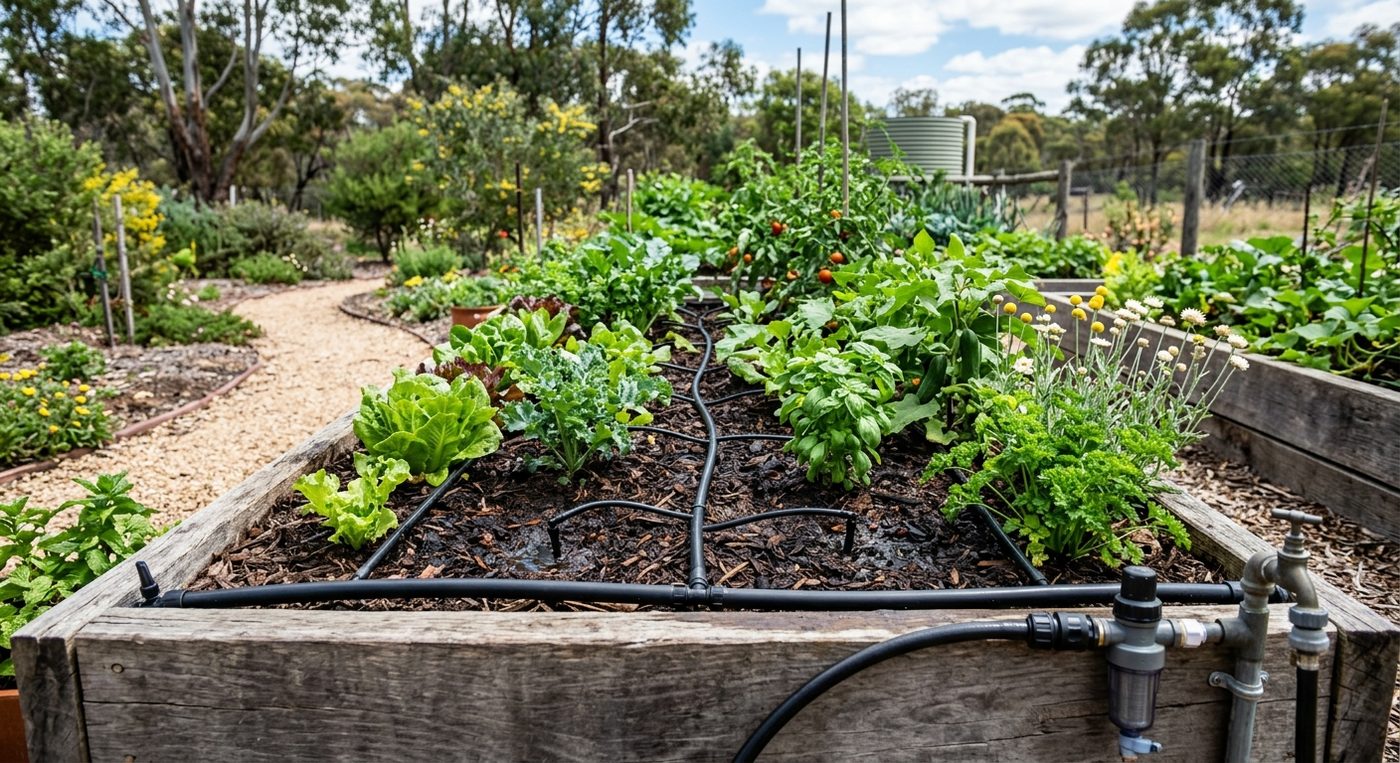
Plug the controller into a weather sensor—a $35 rain switch or a more reliable tipping-bucket sensor—and you stop irrigation within 5 mm of rain, saving that 30% again and again instead of once. The physical install is simple but unforgiving. Blue-line poly from the tank outlet to a brass T, branch to the valve, then either out to the lateral ring main or back to the pump suction side, depending on whether you are valving into a gravity-fed manifold or valving the pump intake. Use 25 mm BSP threads and half a roll of pink thread tape.
Prevent Corrosion And Blown Fuses
Bury the cable in orange electrical conduit, not the grey stuff, and waterproof the join with gel-filled Scotchlok connectors. If the valve box fills with water, 24 volts into a submerged joint will corrode the copper in hours and the controller will start blowing fuses without you knowing. I learned by replacing the fuse three times in one month before I dug up the splice and found green paste where copper once was. Operational cause-and-effect: a sticking valve on a 5000-litre leg tank delivers exactly zero irrigation at the end of four days of 38-degree heat.
Prevent Leaks And Pay Less
Mulch cracks, root hairs die back, and your silverbeet bolts. A valve that does not fully close feeds a slow leak that empties the tank in two dry nights, then the automatic mains changeover kicks in and you are paying Sydney Water rates to water grass you never wanted to water. In contrast, a correctly installed valve with a small inline check
“After losing my entire winter crop to a burst 1200-litre tank during a dry spell, I never leave my off-grid valve without a manual override again.”
A pump running dry because the tank is empty while a mains connection sits closed behind a manual ball valve makes a sound that can only be described as expensive. Off-grid properties across Australia without an automatic rainwater irrigation changeover leave that switch to human memory, and the usual result is a garden that bounces between flooded and parched while the pump housing slowly cooks.
Automatic Valve Installation And Cost
A standard 25 mm brass or glass-reinforced poly automatic valve with a float switch retails for roughly $180 to $350, depending on the number of outlets and whether the solenoid runs on 12 V or 240 V. Installation takes a few hours in the tank shed: teeing into the tank outlet and mains line, mounting the float on the tank wall, and wiring the solenoid. Once it works, the logic is hydraulic cause-and-effect. When the tank level drops until the float hangs, the valve opens the mains port and keeps the drip lines charged.
Rain Refills Tank And Saves Water
When rain refills the tank and the float lifts, the valve closes off mains and the system pulls from the tank again. The pump never gulps air, the solenoid costs about the same as a carton of middies to run for a year, and the garden never sees a day of hard town water that strips the mulch of the fungal life built up under roofwater. Keeping the old manual setup means someone has to trudge out at dusk with a torch, crouch beside the valve box, and remember which handle is tank and which is town.
Most people don’t remember, not after a long day fencing or chasing stock. The pump then cycles against a blocked line until the thermal overload trips.
Automated Mains Backup For Tanks
A rainwater tank without an automatic irrigation valve hands the reins back to the water corporation the moment the tank runs dry. In a typical off-grid shed setup east of the Dividing Range, a 25 mm normally-closed solenoid valve on the mains supply, triggered by a float switch inside the tank, does the job for well under $400 in parts. When the tank level drops below the float, the valve opens and mains water feeds the irrigation line—only after the pump has emptied every last litre of rainwater.
Float Switch And Valve Costs
Float switches like the 10-amp reed type cost around $30; a suitable 24 V AC solenoid valve with a 1000 kPa rating runs between $150 and $300, plus a weatherproof transformer for another $40–$60. The valve body threads directly onto a standard 1" BSP tank outlet tee, so installation takes less than an hour with basic poly pipe and a pair of shifters. Without it, a
Valve control loop with flow meter feedback so a stuck-open solenoid shuts the zone before the tank drains.
How It Works: No Tech B.S.
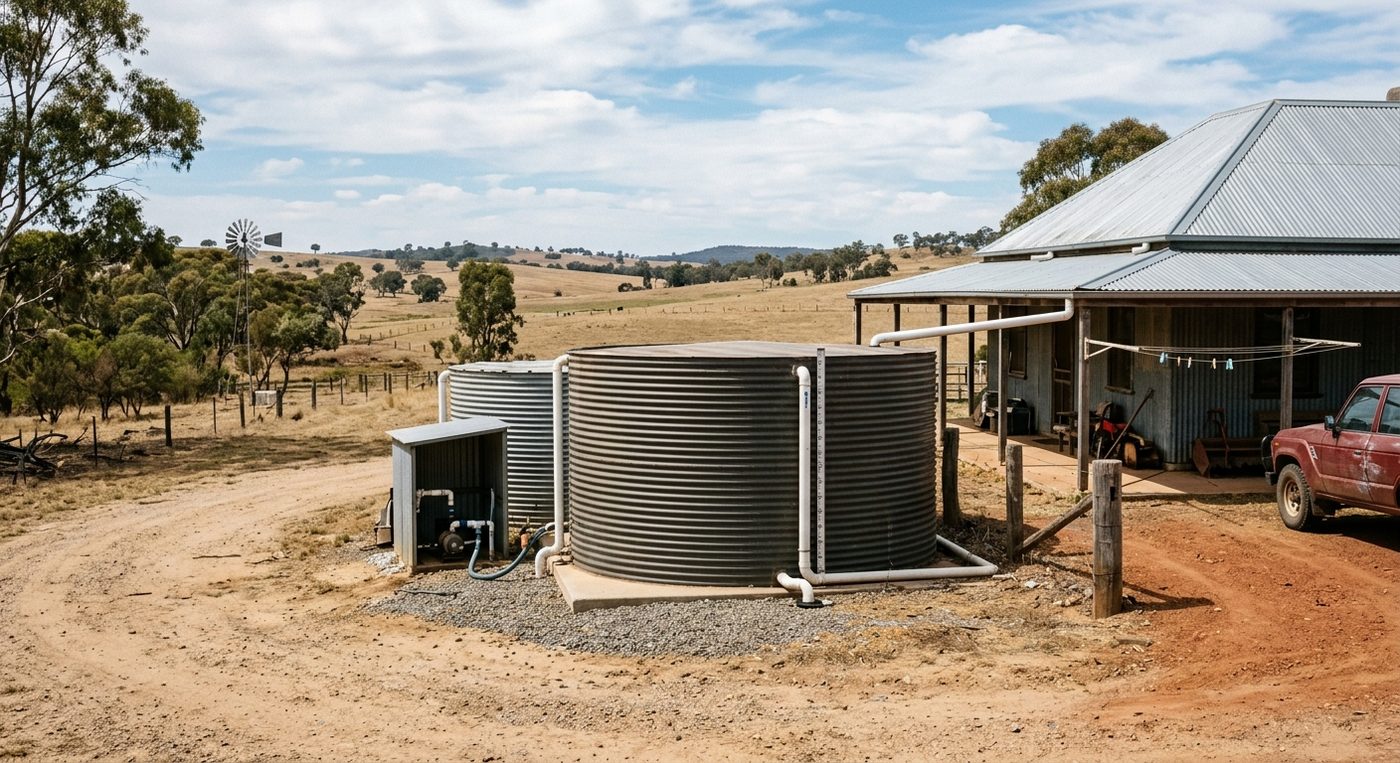
On a working property outside Castlemaine the setup is dead simple. A float-operated mechanical changeover valve sits in the 25 mm poly line between the 22,500-litre concrete rainwater tank and the dripline laterals. Inlet one connects to the tank outlet, inlet two to the mains supply, and the common port runs to the irrigation manifold. Water pressure from the tank holds the float up against a seat, sealing off the mains port.
Hydraulic Tank Level Switch
When the tank level drops to roughly 0.3 metres of head – about 2,000 litres left in a tank that size – the float drops, a stainless cam flips, and the valve opens the mains port while shutting the tank side. The switch is purely hydraulic; cause and effect with no solenoids and no control box. The whole unit costs around $180 from rural stores, plus half a dozen poly elbows and an hour with a shifting spanner. Standard
Why You Need This (Especially in Australia)
Our dams are drying up. Your tank might be full one day, empty the next. If you're using mains water for irrigation when rainwater's available, you're paying for water you didn't need to. And if you're not set up to switch automatically? You'll forget to turn it off. Then you're paying for mains water while your tank's still full. That's just stupid.
Real talk: In droughts, this valve saves you $300-$500 a year on water bills. It also stops your garden dying while you're away. No ifs, no buts.
Practical Tips: Don't Mess This Up
A 5000-litre tank typically feeds a pump delivering 80 to 100 litres per minute. A 2000-litre tank often runs a smaller pump shifting 40 to 60 litres per minute. That difference determines valve diameter. A valve with an internal bore below 20 mm starves even a modest pump, causing cavitation that sounds like gravel in the impeller and wears the thrust faces prematurely. Check the pump’s compliance plate for its maximum flow rate, then choose a full-bore ball valve with a clear waterway at least 25 mm for flows up to 80 L/min, or 40 mm for flows above that. Standard Australian irrigation outlets stock 20 mm, 25 mm, 40 mm and 50 mm BSP poly or brass valves. A 25 mm poly ball valve costs about $18, a 40 mm version around $35, and a brass 25 mm valve runs $50–$60. A 5000L tank needs a bigger valve than a 2000L one. Undersize a valve and your pump will cycle against a closed throat, pressure downstream will sag, and drip emitters will weep instead of spray. The threads are standard BSP, so any matched fitting will seal with a turn of thread tape. A valve barely fatter than a garden tap spindle will leave a perfectly good pump gasping in a shed, and the tank overflowing.
Install before the pump: Put the valve between your tank and the pump. If you put it after, the pump will run dry when the tank's empty.
Pressure test the whole arrangement for a full 24 hours after the valve goes in. A proper Australian rainwater system sits around 500 kPa on the mains side of the switch, so any drip from a dry-joint 25 mm poly elbow or a threaded BSP fitting that was only hand-tight will show itself by morning. Run every dripper circuit and pop-up zone while you watch the gauge. If the valve is a float-guided automatic mains-changeover unit — the sort that costs north of $300 — you need to hear it clack across cleanly under load, not flutter halfway and starve the pump. I test mine with the tank outlet cracked so the level drops into the make-up range over a few hours, same as it does when the family ignores a running hose. That 24-hour watch catches the slow weep on a stub flange you would otherwise walk past until November, when the pump cuts out and the vegie bed turns to dust before you can climb the fence.
Rainwater tanks collect more than water. Leaf litter, insect parts, and a fine silt of roof dust settle out, then stir up when the pump kicks in. That slurry hits a solenoid valve’s diaphragm and tiny bleed ports first. At my workshop I’ve pulled apart a valve after just one dry spell and found the plunger caked in a paste of pollen and corroded zinc flecks off a Colorbond roof. Fit a 100‑micron inline screen filter upstream of the valve—right at the tank outlet or on the valve inlet. A standard 25 mm Y‑strainer with a stainless mesh cartridge, sold at any rural irrigation shop or hardware chain, costs $20. It takes five minutes to screw onto a BSP thread. That $20 fix stops the grit before it can score the valve seat or block the pilot channel. Skip it, and the symptoms are reliable: the valve won’t close fully, or it stays shut no matter what the controller tells it. A replacement 25 mm solenoid valve for a domestic irrigation setup starts around $120. Add a service call from a local irrigation tech or plumber—minimum one hour, country rates—and you’re looking at a $200 valve replacement, plus the soggy lawn you were trying to save.
Australian Suppliers & Pricing (indicative prices)
Forget overseas junk. A $12 eBay solenoid with a plastic pilot seat will clog with iron bacteria and stringy tank algae within a fortnight, and the coil usually burns out on 50‑cycle Australian power. In a paddock or suburban tank setup, the three parts that earn their keep are a sediment filter upstream, a low-pressure inline valve, and a manual isolation ball valve you can actually reach.
Install A Tank Outlet Valve
A plain 25 mm PVC full-bore ball valve costs $9–$18 at any hardware barn and will outlast the poly pipe; install it immediately after the tank outlet so you can service the rest of the line without draining 20,000 litres onto the mulch. For automated gravity-fed zones, a 25 mm BSP inline irrigation valve rated for minimum 0.2 bar operating pressure—the kind irrigation shops keep in a blue cardboard box on the shelf—has a stainless-steel plunger, a reinforced EPDM diaphragm, and a 24 V AC latching solenoid that draws 0.3 amps inrush.
Valve Costs And Ant Problems
That valve runs $55–$95, and a weatherproof 24 V transformer adds another $35–$60. If the tank head is less than 2 metres above the valve, you need a model stamped “zero head” or it will not seat and the drippers will weep constantly. Reason number one for callouts: ants packing the solenoid plunger chamber with dirt so the valve can’t close fully. A spare diaphragm kit in the shed costs $18 and a six-minute clean with a 4 mm Allen key and a rag gets the water back on while the neighbour is still untangling their hose.
The Rainwater Systems Australia Basic 20mm automatic valve lands on the benchtop for $249, filter included. That buys a compact 20mm (3/4-inch) BSP inline valve body, a latching 9‑volt DC solenoid, and a mesh filter basket you can unscrew with fingers. It needs a 9‑volt battery controller to open and close — a standard 2-wire job, polarity matters. Connect the red lead to the timer’s positive terminal and the black to the common, otherwise the solenoid buzzes, won’t latch, and flattens the battery inside a week. When wired properly, one 9‑volt alkaline battery runs a single daily cycle for the best part of a year before voltage sag causes a halfway seizure that leaves the valve cracked just enough to drain a small tank overnight.
This valve suits slimline and round tanks from 2,000 litres up to about 5,000 litres. With a 5‑kL tank and a 20‑mm gate, a full‑bore opening will dump roughly 50 litres a minute under a metre of head — that’s almost a full IBC in 20 minutes — so the timer wants a run‑on window no more than a few minutes to keep the pump wet. Run the valve straight after the tank outlet, before a pump or a mainline filter, so sediment settles in the included screen rather than inside the solenoid plunger. A single gum leaf pinned in that screen turns a
Tanks & Valves – Heavy-duty 25mm valve for big systems: $385. Works with 10kL+ tanks. tanksandvalves.com.au
The valve you’ll spot on a hook in the irrigation aisle at Bunnings for $120 is a generic inline unit, usually with a 25mm BSP inlet, a glass-reinforced nylon body, and a low-pressure diaphragm that’s really designed for gravity-fed or low-head rainwater systems. Unscrew the bonnet and you’ll find a seat and seal arrangement that distorts under sustained mains pressure above about 300 kPa, which is common as soon as you’re downstream of a pressure pump. The solenoid coil burns out quicker when the valve struggles to close against force it wasn’t specced for, and the plastic threads can cold-weld themselves solid after a few months in the sun. Out in the paddock, I’ve pulled apart enough of these to see the same failure pattern: a split diaphragm, a heat-warped plunger, and a trickle that never quite stops. If your setup is a single raised bed fed from a modest poly tank and you’re on a tight budget, it’ll do the job through one dry summer, but the warning stands—30% fail within 12 months when used on high-pressure lines.
Price check: Don't buy the cheapest. A $120 valve failing means you'll pay $300+ for a new one and lost irrigation time. The $250 valve lasts 10+ years. Do the math.
Final Word
This isn't a "nice-to-have." It's the difference between a sustainable off-grid setup and a water-wasting headache. Install it right, keep it clean, and you'll never worry about your garden again. Stop overcomplicating it. Get the valve, fit it, and get back to growing.
When to Call a Professional
A rainwater tank connected to anything beyond a simple garden hose triggers the Plumbing Code of Australia and AS/NZS 3500. The instant the pipework runs inside the building line, or any mains water top‑up is installed, a licensed plumber has to sign off on the backflow prevention. Water utilities like Sydney Water and Yarra Valley Water demand an RPZ (Reduced Pressure Zone) valve on all combined rainwater/mains systems, and that valve must be tested by an endorsed plumber every 12 months. The test fee alone runs $80–$130 in regional Victoria, on top of the call‑out.
RPZ Valve And Solenoid Costs
A 20 mm brass RPZ valve from a plumbing supplier costs between $180 and $320, and fitting it to an existing copper line will clock roughly two hours of labour at $95–$110 an hour. Irrigation solenoid valves run on 24‑volt AC. The transformer plugs into a weatherproof outdoor outlet. If that outlet doesn’t exist, a sparky has to hard‑wire it to an RCD‑protected circuit. Installing a single IP56‑rated double GPO on a brick wall, with a new circuit and weatherproof conduit from the switchboard, typically lands between $280 and $450.
DIY Plumbing Is Illegal
Doing it yourself is illegal in every state and void of any insurance. A bloke near Shepparton once teed a tank‑fed trough line straight into the house cold‑water pipe without a backflow device. During a blackout, the pump stopped, a downstream float valve jammed open, and the resulting siphon pulled muddy trough water past the kitchen tap. He wore the cost of a new in‑line RPZ, a full pipe disinfection, and the water authority’s inspection fee—just over $1,800 all up.
When A Plumber Is Required
A half‑day from a licensed plumber to fit the same tank properly, with an air gap and a testable dual‑check valve on the irrigation leg, would have been about $600. If you are only feeding a gravity drip line from a tank outlet with a simple ball valve, no licence is needed. The line changes when you add a pump that develops more than 75 kPa, when the pipe goes underground and connects to an irrigation manifold with solenoid control, or when the tank has a mains‑water make‑up float. At that point
Mains-voltage work outside the house is not just a bigger version of wiring a 12V DC irrigation solenoid. Once you move beyond basic 12V DC additions — swapping like-for-like solenoid heads, plugging a transformer into an existing weatherproof outlet — you hit the boundary where Australian law and physics both demand a licensed electrician. That boundary is hard and the reasons are printed in the AS/NZS 3000 Wiring Rules.
On a recent pump-shed job near Toowoomba, a 24 VAC manifold controller had been fed by a 10-metre length of orange extension cord buried 50 mm down with the plug join taped in a sandwich bag. After the first summer storm, the household RCD tripped every time the pump kicked in. The cause was simple: water had wicked along the cord, reached the live pin, and turned the damp soil into a conductor. A new dedicated circuit had to be run through 600 mm-deep conduit, with mechanical protection and a marked warning tape 150 mm above it, all signed off with a certificate of electrical safety.
Standard practice for any fixed pump, autotransformer, or GPO installed outside in Australia means calling a sparky who holds a state electrical licence — NSW Fair Trading, Energy Safe Victoria, the Electrical Safety Office in Queensland, whichever applies. You are not just paying for copper and labour. The call-out fee for a regional domestic electrician runs around $140–$180 for the first hour. What you buy with that is a compliance certificate, a circuit that will not kill stock or grandkids, and an insurance policy that won't be voided by unlicensed work. Cause and effect is straightforward: a 230 V cable nicked by a shovel or chewed by a rat in a wet trench makes the difference between an inconvenience and a coronial file. The extra-low-voltage stuff you can handle. The rest stops at the meter box.
Punching a hole through an external wall to run a 25 mm poly line from the tank pump to the irrigation manifold isn’t something you do on a whim. Most Australian homes built after 1990 are brick veneer on a timber or light-gauge steel frame. The outer brick skin carries nothing but itself; the inner frame holds up the roof. Cut a 65 mm core through a stud or top plate without a proper trimmer and lintel, and you can count the months until the plasterboard joints crack
Gas line installation or modification
Solar array installations above safe voltage thresholds
Any work that affects the structural integrity of your property puts you squarely into licensed-trade territory, and in Australia that usually means a plumber with the right endorsements plus a building surveyor’s nod if you are penetrating a load-bearing wall, cutting into a slab, or altering a roof member. The trigger in a rainwater-valve install is almost always a hole through a double-brick or besser-block wall to pass a 25 mm poly line. Drill that hole near a corner, within 1.5 m of a window reveal, or right through a brick pier, and you have just created a crack path that follows the mortar course in the next dry spell. I watched a mate outside Toowoomba do exactly that: a 28 mm masonry bit straight through the pier supporting the carport beam. The brick split top to bottom, the lintel lost bearing, and the repair required a brickie, a mobile scaffold, and $400 he had not budgeted. That is the cost of ignoring cause and effect.
Standard practice for a simple 25 mm penetration in a single-skin external wall is to core-drill at least 100 mm away from any edge, slip in a PVC duct sleeve, and seal the annulus with flexible polyurethane. A licensed plumber or builder will charge between $120 and $220 for that single hole in a standard residential brick wall in the eastern states, including the sleeve and weatherproofing. If the wall is rendered and the hole must sit below the damp-proof course, expect a Form 16 inspection in Queensland or a compliance certificate in New South Wales; the paperwork adds another $80 to $150 to the job. Mounting a brass automatic valve directly onto a structural wall also brings the National Construction Code’s waterproofing requirements into play, so any fixing that goes deeper than the first skin of masonry needs a stainless-steel expansion anchor bedded into epoxy, not a rawlplug that will rot the wall tie.
When the feed line rises from a buried rainwater tank and punches through the side of a brick-veneer house, the hole often goes through the slab edge, which is a stiffened raft or waffle pod system designed to resist soil movement under AS 2870. Coring that edge without an engineer’s letter can void the slab warranty. The cheapest engineer’s inspection and sign-off for a single penetration, if the builder will even allow it, runs $500 to $900 in regional Victoria and closer to $1,100 in metropolitan Sydney. Far cheaper to change the valve location to a free-standing post in the garden bed, which brings the cost back to zero and keeps the structural warranty intact. The message from any sparky or chippy who has been sued is the same: once the brickwork cracks or the slab moves, the money you saved on a pipe route evaporates in a week of underpinning and a building order.
Before you plumb a valve that switches between rainwater and mains, understand you’re creating a cross-connection. Under AS/NZS 3500.1, that’s a high-hazard risk. The Plumbing Code of Australia demands a testable backflow prevention device—usually a reduced pressure zone (RPZ) valve or a dual check, depending on the council’s on-site hazard rating. Licensed plumbers fit them; a typical RPZ install runs $450–$800, and the mandatory annual test (AS 2845.3) adds $80–$150 every year, on
Dr Brennan demonstrates how to mount a float valve on a rain tank and hook it directly into a drip line without power, which mirrors the valve setup described in the guide and gives a clear, step‑by‑step visual for an off‑grid Australian setup.— Sarah Chen
Frequently asked questions
What does a rainwater irrigation valve actually do?
It sits between your rainwater tank and your irrigation line and handles the switching for you. When the tank runs low, it flips you over to mains water so the pump isn't kept sucking from an empty tank. It also stops tank water flowing backwards into the mains, which you definitely don't want.
Will a rainwater irrigation valve stop my pump burning out?
That's pretty much the whole reason to fit one. If your tank empties mid-cycle, the valve triggers the mains backup before the pump runs dry. Dry-running is what kills pressure pumps, and it's the most expensive lesson on a property.
Do I really need one in Australia?
If you're running off-grid or tank-fed, I'd say yes. We get long dry stretches, tanks drop fast, and nobody wants to be out there swapping a manual ball valve in the middle of summer. It just takes the babysitting out of your watering schedule.
Do I need a plumber to install one?
For most setups, get a plumber in. You're tying into mains water, and there are backflow rules you don't want to get wrong. That's why there's a whole "When to Call a Professional" section in the article — it's not really a weekend swap-out job.