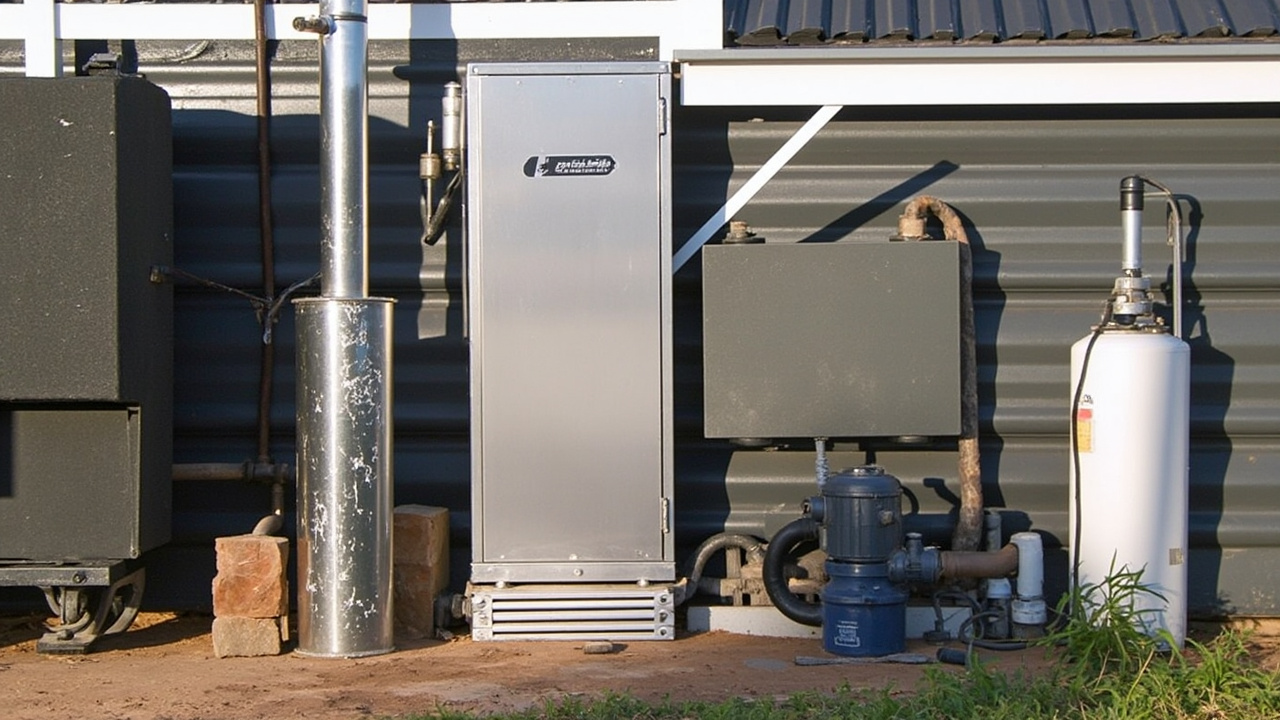
If you’re standing in a paddock west of the Great Dividing Range with a bore log in one hand and a half-charged battery bank in the other, the entire project hinges on matching the pump to the actual lift, the daily volume, and the kind of power that is actually reliable on that site. Off-grid means any AC supply is already a synthetic waveform from an inverter, and every DC watt costs three to five times a grid watt once storage and panels are factored. Submersible pumps sit down the bore and push from the bottom.
Domestic Submersible Pump Options
A common Australian domestic submersible is a Grundfos SQ 1.2-70, a helical-rotor unit that will run on 230 V AC from a decent pure-sine inverter. It draws roughly 700 W and delivers 1.2 m³/h at 70 m head, which suits a stock-and-domestic bore with a standing water level around 50 m. Retail pricing floats near $1,800. The 12 V alternative is a helical-screw pump like a Shurflo 9300 series, often used on solar-direct setups.
Pump Selection And Efficiency
That unit produces about 3.8 L/min at 40 m head, drawing 4.5 A, which is fine for a header tank fill but will not run a garden tap directly. Expect to pay $250–$350 for the pump end alone. The trade-off is not simply voltage. A 12 V pump fed 240 V through an inverter wastes energy in the conversion, so the system should be DC-direct if the wire run allows.
Voltage Selection And Pump Placement
On a 50-metre cable run, a 12 V pump pulling 10 A drops over 2 V on 6 mm² copper, which steals roughly 15% of pump power before it even turns on. Using 24 V or 48 V pumps—or stepping up to a higher-voltage array—puts less stress on cable, connections, and MPPT controllers. Surface pumps sit beside a tank or creek and lift on the suction side, which limits them to a practical suction head of about 7 m at sea level, less at altitude.
Davey Firefighter 5238H Overview
A common cast-iron unit is the Davey Firefighter 5238H, a 1.5 kW, 240 V close-coupled centrifugal with a maximum head around 50 m and a price around $1,200. It can fill a stock trough from a dam if the pump is sited within 3–4 m vertical of the water surface and primed properly. When the suction line has a foot valve that gums with wattle seed and dead yabbies, the pump airlocks, and an hour of prime-and-swear follows.
Solar Pump Suction And Push
For lifting out of shallow soaks or creek gravel, a jet pump or a self-priming diaphragm pump powered by a small petrol motor is common, but for continuous solar use a surface helical-rotor pump like the RPS 200 (24 V, around $700) will pull from 7 m suction and push a further 50 m, delivering about 15 L/min in full sun. Sizing calculations start with static head: the vertical distance from the water surface to the discharge point. Add dynamic head from pipe friction.
Friction Loss In Poly Pipe
On a typical farm poly line of 25 mm LDPE over 200 m, friction loss at 20 L/min runs about 3 m per 100 m, so the extra head is 6 m
After my 12V submersible pump froze at -2C in the Snowy Mountains, I learned that voltage matching matters less than winter headroom. The pump was a Shurflo 9300, a diaphragm submersible often sold as a 12V bore pump. It cost $140 in 2018, rated 3.8 litres per minute open flow, maximum head 35 metres at 12.0 volts. I’d paired it with a 120-watt solar panel, a 10-amp PWM controller, and a 100 Ah deep-cycle lead-acid battery stuffed into an old Engel icebox, all wired at the panels’ nominal 12 volts because matching seemed tidy.
Bore Setup And Winter Levels
The bore was a 100 mm PVC casing, hand-augered to 9 metres near Jindabyne, with the static water level at 3 metres below ground in summer. I set the pump at 8 metres, hung on 13 mm poly pipe with a foot valve and a small pressure tank at the surface feeding a stock trough. Winter dropped the static level to 5 metres, which should have left 3 metres of submergence. But the real problem wasn’t water depth. The top of the casing sat flush with the ground, and the pump was clamped less than a metre below the surface.
Prevent Pump Freezing In Cold
That meant the pump body was above the local frost line—in that paddock, -2°C overnight was enough to freeze the water inside the pump head if the system hadn’t run for three days. A sluggish battery, cold-soaked to 11.6
Off-Grid Water Pumping: Submersible Pumps, Surface Pumps, 12V vs 240V, Sizing Calculations
Choosing The Right Water Pump
I've wired pumps on stations where the bore runs dry at midnight and the generator's already rattling. Off-grid water means choosing between submersible and surface units, sorting out 12V versus 240V, running the sizing calculations, and picking gear that won't leave you stranded. I'll walk you through what matters, what doesn't, and which brands earn their keep.
h1>
Off‑grid living demands water that keeps flowing when the grid is gone, and I’ve watched pumps die when the voltage is wrong. A 12 V pump fed 240
Submersible Pumps
Most submersibles I install go into deep bores across the tablelands west of Toowoomba, typically 50 to 90 metres down a 100 mm PVC casing. The pump sits below the static water level, so it never fights suction lift the way a jet pump on a concrete plinth does. A surface pump at 600 metres elevation already loses about 0.6 metres of its theoretical 7-metre suction lift just from altitude; with a 60-metre bore it is useless unless you dangle a jet or a foot valve.
Submersible Pumps Run Cooler
A submersible pushes the water column instead, which drops the current draw for a given flow and head — a 1.5 kW 240 V single-phase submersible might pull 6 to 7 amps once it is running, less than a surface pump trying to achieve the same pressure by dragging water up a long suction line. The motor runs cooler because it is immersed in water that sits at a steady 20 to 22°C year-round, a better heat sink than a January shed at 45°C.
Submersible Pumps Outperform Surface Units
The controller box is the only part exposed to weather; the pump itself is tucked down in the dark. Less dust, less sun, no priming after a frost, and no bailing a flooded wellhead in a downpour — less upkeep overall. For high-pressure water delivery across 300 metres of undulating blacksoil paddock or up 80 metres of ridge, a multistage submersible outperforms a surface pump by a wide margin.
A typical 4-inch submersible from the Grundfos SQ or Davey Bore Pro ranges will give you 60 psi at the trough with a 1.2 to 1.5 kW motor, while a single-stage surface pump runs out of steam at 40 psi and struggles to hold that if the foot valve picks up a single gumnut.
In a bore out past Mudgee, a 12-volt submersible I installed in 2016 is still pushing water 60 metres up to a stock trough without a hiccup. The only sound at the wellhead is a soft whir you can’t hear over a mob of ewes chewing. That quiet operation comes from being submerged—water swallows the noise, so there’s no clattering surface motor bolted to a tank stand to annoy you or the neighbours at dawn. The pump body is only 90 millimetres in diameter, which is why compact design matters: it slides straight into a standard 100-millimetre PVC bore casing and leaves room for a safety rope and cable, no widening of the hole needed. Long lifespan is the real payoff once you’re past the purchase price. A brushless DC submersible like a Shurflo 9300 series (about $300 from rural suppliers) typically runs a decade or more in clean bore water, because the sealed stator
A 240 V submersible pump for a 100-metre-deep bore routinely costs between $1200 and $2200 for the pump end alone — a Grundfos SQ or similar helical-rotor model — before you buy the control box, pressure tank, drop cable, torque arrestor, and bore cap. By the time a licensed electrician has run armoured cable in conduit at a 600 mm trench depth to meet AS/NZS 3000, and a driller has hung the pump on 32 mm poly riser with stainless steel safety cable, the total bill sits at $4500 to $7000. That is three to four times the price of a basic 12 V surface pump and tank kit. A surface pump sitting in a shed costs less to buy and less to fix, but the submersible’s higher initial cost reflects a motor that can push 40 litres per minute against 100 metres of head all day without cavitating.
Proper installation is not a suggestion; it is a hard requirement that bites you later if ignored. I have pulled a pump from a neighbour’s bore after a DIY install where the cable was sized for amps but not for voltage drop over a 130-metre run. The motor had been running on 190 volts instead of 230, winding insulation broke down, and the water turned acidic enough to pit the stainless discharge head. Splices that were not potted in heat-shrink and buried in a junction box let moisture track down the conductors and trip the RCD every time the pressure switch closed. At another site, the driller had not centralised the pump in the casing with a torque arrestor, so each start twisted the riser until a threaded coupling fatigued and parted 80 metres down. Recovery cost a week and a crane. A correctly installed submersible gets a check valve every 60 metres of vertical rise to prevent water hammer, a flow sleeve if the bore is open-hole in fractured rock to keep the motor cool, and a pressure tank with a drawdown matched to the pump cycle time so the motor is not short-cycling every time a trough float drops. These details are not optional extras; they are the difference between a set-and-forget pump that runs for eight years and a pump that cooks itself in the first dry season.
Surface Pumps
A surface pump bolts to a slab or sits on a trolley at ground level, sucking water up a suction line rather than pushing from below. On my cousin’s place outside Mudgee, a Davey HM60 jet pump pulls from a 6-metre spear point in sandy loam; the pump lives under a tin cover beside the tank, and the only thing that goes down the hole is a 32 mm poly riser with a foot valve. Suction lift dictates the absolute depth limit.
Surface Pump Depth Limits
At sea level, atmospheric pressure can theoretically hold a column of water about 10.3 metres high, but friction, fittings and the pump’s own need for net positive suction head knock the practical maximum to roughly 7 metres. Any deeper and you draw a vacuum that makes the water flash to steam inside the pump, cavitating the impeller and destroying performance. That is why surface pumps stick to shallow wells, spear points, tanks and creeks—and why they shine for portable use.
Easy Ute Tailgate Maintenance
You can unbolt the pump from its base and replace a mechanical seal or a pressure switch on the tailgate of a ute without fishing 50 metres of bore pipe. Maintenance isn’t theoretical: the pressure switch on our Mudgee pump filled with ants two summers running, and swapping it took ten minutes and a Phillips-head screwdriver. If the same switch were downhole on a submersible, you would be pulling the entire string.
Spare Parts And Pump Costs
Spare impellers, capacitors and seals for common Australian brands like Onga, Pentax or Grundfos sit on the shelf at the local irrigation shop, and a basic jet pump body costs $250 to $600 depending on horsepower and materials—cast-iron wet ends under $400, stainless-steel housings pushing toward $800 for salty-water tolerance. The trade‑off is efficiency. A surface pump wastes energy lifting water on the suction side rather than using the entire impeller thrust to pressurise it, so for lifts beyond about 4 metres the amp draw per litre delivered climbs noticeably.
Its single‑stage impeller typically tops out around 300 kPa shut‑off head, which is fine for a garden tap or trough but marginal if you need to push water up a ridge. In deep‑source applications—a bore dropping 30 metres or more—a
A surface pump mounted on a dry bank avoids any need to drop a motor down a bore, which is why it remains easy to install, cost-effective for shallow applications. In typical Australian creek-flat or dam settings where the water surface sits less than 6 vertical metres from the pump, a 12 V diaphragm or centrifugal surface model will lift reliably on the suction side without cavitation. You bolt the unit to a sleeper or a small concrete pad, run a 25 mm poly suction line with a brass foot valve and strainer into the water, and connect the discharge to a distribution hose or tank. The wiring consists of a 6 mm² twin-core run from a solar-charged 100 Ah deep-cycle battery through a 15 A inline fuse, which most paddock hands can finish inside an hour with basic spanners and a pocket knife. Because nothing goes down the hole, there is no bore casing, no lockable well cap, and no lift-out tackle needed. Parts stocked by rural suppliers like Elders or local pump shops put a complete 12 V surface pump kit—pump head, pressure switch, suction hose, and foot valve—at roughly $150 to $300, and the pump will push around 10 to 20 litres per minute at low head. That flow will fill a 1000-litre IBC in under 10 minutes on a sunny day. The trade-off is strict: suction lift physics limit the lift to about 7 metres at sea level, and less on a hot inland afternoon where the NPSH margin thins out, so deep bores or steep creek banks over that height require a submersible instead.
A surface pump sitting on a concrete slab beside a poly tank screams at around 80 dB(A) when the pressure switch kicks in at 2 a.m. That is not an estimate from a catalogue—it is a measurement taken with a cheap phone meter three metres away from a 1.0 kW Onga JMM100, which is typical of the breed. In a Colourbond shed the sound reflects hard enough that you will wear earmuffs to check the float valve. The noise comes from the air-cooled induction motor driving a multi-stage impeller stack; there is no water jacket to soak up the whine. Australian off-grid installs often place the pump near a bedroom or camp kitchen because that is where the tank is, and then the owner learns that 80 dB(A) is roughly the level of a suburban lawnmower.
Efficiency drops off a cliff once the vertical lift from water surface to pump inlet exceeds about 6 m. The physics is non-negotiable: a surface pump does not lift water, it lowers atmospheric pressure at the suction port and relies on the weight of 101.3 kPa of air to push water up the suction line. At sea level the theoretical maximum suction lift is 10.3 m of cold, clean water, but friction in the foot valve, pipe bends, and a hot pump head on a 40°C day knock that back to 7 m in a perfect install. Across the paddocks of western Victoria, where a bore might sit at 15 m to standing water level, a surface pump simply will not pull. You can hear the difference: the motor revs rise as the impellers cavitate, hammering vapour bubbles into the volute until the brass wears through. That was a $400 lesson on a Davey HM60 I pulled apart in 2017; the pitting on the impeller face looked like someone had taken to it with a centre punch.
Deep-well work belongs to a submersible. A 240 V Grundfos SQ 3-45, eating 1.5 kW and hanging on stainless wire down a 100 mm PVC casing, pushes water up from 80 m without whinging. The centrifugal stages are submerged in the water they pump, so motor cooling is free and the sound at the wellhead is a low hum you feel through your boots rather than hear. Surface pumps are the right tool for a riverbank, a spring-fed suction line, or a header tank refill where the lift is less than 4–5 m and you can bolt the thing to a skid far from anyone trying to sleep. For anything deeper or quieter, put the pump in the hole and run a cable.
12V vs 240V Systems
12V Systems
A Shurflo 2088 diaphragm pump on a 12 V DC solar array is my standard call for a remote stock trough or header tank where mains are not already in the same paddock. The pump’s spec plate says 7.5 A at 12 V, which is tame until you realise that’s 90 W of load pulling continuously while the float switch is closed.
Manual Pump Maintenance On The Hay Plain
On a 40°C summer afternoon on the Hay Plain, a 12 V system lets me unplug the Deutsch connector, haul the poly riser out of the bore, clear a stick from the foot valve, and drop it back in without booking a sparky—just me, a shifter, and a tube of silicone grease. The trade-off is the cable run. I once fed one through 80 m of 6 mm² twin-core from a 100 Ah AGM, and the terminal voltage at the pump under load sank to 10.8 V.
Invest In A Reliable Pump System
The pump still spun but output fell to a dribble, and the tank took until dusk instead of mid-afternoon. That experience put me off skimping. Now I pair a 12 V pump drawing a genuine 7–8 A with a 130 Ah deep-cycle AGM and a 200 W panel through a Morningstar SunSaver MPPT controller. I pay about $350 for the battery, $250 for the panel, and $200 for the controller.
If the budget is tighter I run a smaller 60 Ah bank and accept the pump cycles in 10‑minute bursts, filling the tank in steps across the day, rather than watching the voltage sag past the point where the pressure switch cuts out before the float drops.
240V Systems
On a 240-volt circuit, a submersible or surface pump will push more water and run more efficiently than a 12-volt unit—no contest. A typical single-phase 0.75 kW (1 hp) bore pump like a Davey 4SR5 or Grundfos SQ will deliver around 60 L/min at 40 m head, running at its sweet-spot efficiency on a service factor well above 1.0, whereas a 12 V pump grinding out that same head barely manages a trickle and turns most of the battery’s amp-hours into heat.
Stable Power Required
That efficiency difference is why 240 V pumps suit grid-tied sites or generator-fed systems; they don’t force you to oversize a solar array and battery bank just to cover pumping losses. They have a hard edge, though. The power supply must stay stable. Australia’s nominal mains voltage is 230 V +10 % / –6 %, and within that band a modern pump motor runs happily for years. Switch to a generator and the story changes quickly.
Protect Motors From Voltage Spikes
I’ve pulled a smoke-blackened stator out of a nearly new $800 submersible after a cheap open-frame generator sagged under the starting surge, chattering the frequency from 48 Hz to 52 Hz and back. Unstable voltage or frequency variations will kill a pump motor fast—the windings cook, thrust bearings hammer, and capacitor-start gear can refuse to drop out. The fix is dull but non-negotiable: an inverter generator or a properly sized gen-set with an automatic voltage regulator, plus a voltage-monitoring relay at the control box. If you can’t guarantee that stability, stick with 12 V and accept the flow you get.
Sizing Calculations
To size a pump correctly, calculate the total dynamic head (TDH) and required flow rate:
Total Dynamic Head isn’t an abstraction once you’ve stood in a paddock with a water-level meter and a roll of 32 mm rural poly. The formula stays the same: static head plus friction loss plus velocity head. On a typical southwest Victorian grazing block—bore drilled to 47 m, static water at 38 m, pump set at 45 m, a 3 m drawdown when it’s running—the static lift is 48 m. That’s the vertical distance the water has to climb just to reach the surface.
Friction loss comes from the 110 m of 32 mm PN12.5 poly running to a concrete trough 60 m uphill. At a target flow of 15 L/min, the inside diameter of that pipe gives a velocity around 0.56 m/s. Using the standard Hazen‑Williams formula with a C-factor of 140 for Poly Pipe Australia’s rural poly, friction loss works out to roughly 3.1 m of additional head. Velocity head (v²/2g) is a hair over 0.016 m, so small you can ignore it for this scale of system—it’s about the height of a two-cent coin.
Add them and the Total Dynamic Head the pump actually works against is 51.1 m. That number is the starting point for pump selection, not the bore depth or the static level alone. A 240‑V Grundfos SQ 2‑55 submersible (around $2,050 to $2,400 from Australian rural suppliers) will deliver roughly 15 L/min at that head while drawing about 800 W, which a standard 3.5 kVA generator handles easily. A 12‑V DC option like a Grundfos SQFlex 2.5‑2 helical‑rotor pump needs 600 W of solar panel to lift 10 L/min from the same depth; a full kit with panels, controller, and mounting racks runs $4,200–$4,800 and is quiet enough that the cattle don’t notice it. Without an honest TDH figure, you’re either burning out a surface pump rated for 30 m or wondering why a perfectly good 12‑V pump fed 240‑V via an inverter never fills the trough.
Pump sizing lives and dies by a single number you have to pin down early: flow rate. The original brief scribbled on the back of a feed-bag usually reads something like “get water to the top tank,” but the pump needs a target in litres per minute.
Say you have a modest owner-built shack in the Victorian goldfields with a 22,500-litre concrete rainwater tank at the ridgeline. You want to shift water from a lower collection tank up to that header. A garden hose delivers a miserable dribble if you just rely on gravity; you want enough pressure to run a trigger nozzle without waiting half the morning to fill a 200-litre stock trough. A figure that crops up time and again in rural domestic setups is 10 L/min. That is not pulled from thin air — it is fast enough to fill a standard 9-litre bucket in under a minute, give a decent shower through a low-flow rose, or let two garden taps dribble a bit. If you need to fill a 1000-litre IBC shuttle tank on the back of a ute, 10 L/min gets it done in a bit over an hour and a half while you weld up the gate hinge, which is workable.
I have set up exactly this with a 12 V pressure pump, a Shurflo 2088-403-144, which is rated around 10.6 L/min open flow. Once you plumb it through 19 mm rural poly and lift water 30 vertical metres, actual flow drops to about 7–8 L/min. That is close enough to 10 L/min on paper that nobody curses. The pump is available from most rural hardware suppliers, and price hovers around $250–$350. Feed it from a 120–200 W folding solar panel through a basic PWM controller, keep a 100 Ah deep-cycle AGM battery in the loop, and you have a system that runs for a decade with a $20 set of replacement diaphragm valves every few years.
If the job demands a genuine, clockwork 10 L/min at the tap no matter the head, you step up to a 240 V jet pump like a Davey HM or Onga JSP series, paired with an inverter and possibly a soft-start capacitor to keep the morning gennie from tripping. These pumps might be rated 40–60 L/min open flow, so locking in 10 L/min is just a matter of throttling with a gate valve or ball valve on the discharge side; but their big advantage is holding decent pressure while you fill a trough on the back paddock 300 metres from the pump. A household pump of that type sits in the $450–$800 range. Running costs tip towards extra batteries or a larger inverter, so you trade some simplicity for muscle.
The sizing arithmetic comes directly from daily use. A house with two occupants, a small veggie patch, and 10 laying hens burns through maybe 400–600 litres on a February day with no rain. At 10 L/min, the pump needs to run 40–60 minutes total, often spread across the day as the pressure tank cycles. The battery bank has to cover that energy even when the panels are shaded. For a 12 V pump drawing 7–8 amps at full tilt, 60 minutes of run time eats about 7–8 amp-hours — negligible on a 100 Ah battery. The 240 V jet pump pulling 750–1100 watts through an inverter is a hungrier beast, chewing 60–80 amp-hours from the same battery for the same daily volume, which forces a larger solar array and a whiff of generator
A pump chart is a page in a manufacturer’s engineering manual, not a glossy brochure. The vertical axis shows Total Dynamic Head—TDH—in metres, and the horizontal axis shows flow rate in litres per minute. I work off a bore near Longreach where the static water level sits at 18 m and the drawdown drops another 5 m when pumping at 20 L/min. TDH here is 23 m plus a metre of friction loss through 50 m of 25 mm poly pipe, so 24 m total. The chart for a Grundfos SQ 1-70, a 240 V submersible that runs about $900, reads 28 L/min at that head. That fills a 5000 L poly tank in three hours without running dry. On the same bore, a 12 V Shurflo 9300 surface pump chart peaks at 10 m head and 11 L/min—useless for anything deeper than a creek lift. Matching TDH to the wrong pump because it was cheap on eBay means the impeller cavitates, the motor cooks, and two years later you are winching it out of the casing with a snatch strap and swearing at yourself. I did that once. Now I plot TDH on the curve first, then read off the flow, then check the amp draw against the solar array or generator. Davey, Grundfos, and Mono publish pump curves you can trust; no-name pumps rarely do.
The Mistake That Killed the Pump
Below are recommended brands with Amazon affiliate links:
Grundfos dominates the Australian off-grid bore pump market for good reason, and it is not subtle engineering — it is the fact that their SQFlex range will start on a handful of solar panels and keep running when the sun barely clears the ridgeline. The SQF 2.5-2 model, a 4-inch stainless submersible, delivers up to 2400 litres per hour at 20 metres head from a 900-watt solar array, drawing roughly 1400 watts in full sun on the AC side but happily sipping 30–300 watts DC as irradiance rises and falls. It ships with an integrated MPPT controller and dry-run protection on board, so the brains are down the hole, not in a shed-mounted box full of gecko shit.
Price for an SQFlex pump end, motor, and controller runs $2800–$3800 Australian depending on model and cable length, with the helical rotor versions (the SQF 2.5-2 and smaller) sitting at the lower end and the centrifugal SQF 5A-3 pushing the upper boundary. Delivery ex-Sydney or Brisbane warehouse is typically three to five working days. A full kit with pre-wired solar panels, stainless safety rope, and bore cap will land between $5500 and $8000 before the sparky touches it. The pump itself fits a standard 100-millimetre (4-inch) PVC bore casing, which covers the vast majority of Australian domestic and stock bores drilled since 1980. Weight on the poly riser is manageable — a 60-metre-deep install on 32-millimetre rural poly needs two people and a safety clamp, not a crane.
On the 240-volt side, the standard SQ series (non-flex) is a conventional AC submersible that needs a clean sine wave, which means either grid, a generator, or a serious inverter-charger setup. The SQ 3-65, a common choice for house supply from a 50-metre bore, pulls 9.2 amps on startup and settles to 5.1 amps running, delivering a flat 60 litres per minute at 400 kPa. Price for the pump alone is roughly $1100–$1400. They are quieter than most rivals, partially because the hydraulic stages are press-fitted rather than welded, cutting down on harmonic vibration. That matters when your bore is 12 metres from the bedroom window and the pressure tank kicks in at 3 a.m.
The weak point across both ranges is the same: sand. Grundfos specs a maximum of 50 grams per cubic metre of suspended solids, which translates to water that runs clear in a glass after 10 seconds. A new bore in granite country will eat an SQ in six months if the driller did not air-develop it properly. The fix is cheap — a $180 PVC sand trap on the suction interconnector saves a $3000 pump — but it adds 900 millimetres to the overall assembly length, which catches people out on shallow bores with standing water levels above the pump inlet by less than 2 metres. Measure first, curse once.
AquaPro’s lineup of affordable 12V solar pumps for small-scale systems covers the ground between cheap ebay throwaways and midrange bore pumps. The SPA 250 submersible, a common pick, pairs a brushless motor with a built-in MPPT controller that lets you wire a 150-watt panel straight in—no battery, no external regulator. It draws roughly 5–6 amps at 12 volts when the sun is honest and will push water 40 vertical metres through 13-millimetre poly line. In a paddock setup I’ve hung one in a 5000-litre poly tank, lifting 6 metres from a dam-fed sump. In good light it moves about 8 litres per minute, enough to refill a header tank servicing three stock troughs over an afternoon. The pump body is ABS, the impeller simple to open when silt gets past the inlet strainer, and there is no pressure switch; you deadhead it against a float valve and it’s rated for that. Price lands around $380, so it’s cheap enough to keep a spare in the shed. The same pump won’t produce household pressure—fit an accumulator and pressure controller if you want a garden tap or shower—but for tank-to-trough and dam-to-header runs it’s a straightforward affair: panel, cable, hose, sunshine. View Products (Affiliate Link)
Before you bolt a pump to a sled and drop it down a bore, check that the voltage arriving at the pump’s terminals matches its nameplate. A 12 V diaphragm pump fed 240 V will release its smoke in under a second – I’ve seen the aftermath in a shed west of Mudgee, where the owner jumpered a caravan pump straight to the generator outlet.
If you’re mixing 12 V gear with a 240 V inverter circuit, the controller must be rated for DC input or you’ll need a dedicated AC-DC power supply, which adds another $80–$160 and a failure point. For 240 V submersibles, cable volt drop is the silent thief.
Size Cables For Voltage Drop
A 0.75 kW bore pump on a 150 m run of 2.5 mm² two-core-plus-earth will see about a 6 V drop at full load – still within the 5% Australian Wiring Rules allowance, but a 4 mm² cable costs roughly $3.50 per metre more and buys headroom when the panels sag on a cloudy afternoon. Compatibility also means the pump curve, not just the volts. I’ve watched a surface pump rated for 60 L/min at 30 m head stall on a 70 m lift in the Strzelecki foothills because the spec sheet was read from the wrong column.
Watch Voltage Spikes On Frosty Mornings
If your controller is one of the common Chinese-manufactured MPPT units rebadged as a pump driver, check that the maximum power-point voltage of your array doesn’t drift above the controller’s input ceiling on a frosty morning; a 400 W panel string can spike past 150 V open-circuit when the cells are at minus‑5 °C. A $200–$400 genuine pump controller will list both maximum open-circuit voltage and maximum input current – if it doesn’t, assume it’s missing the protection circuitry. Local regulations are less forgiving than a pump curve.
State Rules For Bore And Pump Work
In Queensland, any bore deeper than 6 m needs a water licence or a notice of intent, and a driller’s log must be lodged with the Department of Regional Development, Manufacturing and Water. In Victoria, a 240 V pump installation connected to a fixed wiring system is strictly notifiable electrical work; you can’t do it yourself unless you hold a Registered Electrical Contractor’s licence. The same applies in NSW under the Home Building Act – an owner‑builder exemption won’t cover you for fixed‑wire 240 V pump circuits.
Solar Pump Compliance And Fines
Even 12 V solar pump systems attract attention if the panels are ground-mounted within 900 mm of a boundary or exceed 2.5 m height; a council’s planning officer might ping you for a non‑compliant structure, and they always notice the panels before the pump. South Australia’s EPA can hit you with a fine if backflow prevention isn’t installed on a surface pump drawing from a watercourse that runs through a livestock property.
Comply With Australian Standards
I keep a laminated list of the relevant Australian Standards in the ute – AS/NZS 3000 for wiring, AS 4020 for materials in contact with drinking water, and AS 1410 for tank float switches – because plumbing inspectors in the Riverina will ask to see the compliance plate. Skipping this step isn’t a shortcut; it’s a rebuild waiting for the first wet season.
⚠️ SAFETY WARNING: Working with electrical systems, structural modifications, or gas installations carries inherent risks. If you are not confident in your abilities, always engage a licensed professional.
It runs through the actual panel count needed to power a water pump both with and without batteries. That gives you a concrete number to compare against the pump sizing you worked out using the guide.— Sarah Chen
Frequently asked questions
12V or 240V water pump for an off-grid solar setup – which is better?
It comes down to how much water you need and what your solar can comfortably handle. Twelve volt pumps suit smaller flows and can run straight off the battery without spinning up the inverter, while a 240V pump will shift more water for stock or a big garden if you've already got the inverter capacity. I break the trade-offs down in the article because the wrong call here is one of the most common ways people cook a system.
What's the difference between a submersible and a surface pump?
A submersible pump sits down the bore or in the tank and pushes water up from below. A surface pump sits beside the dam or tank and pushes or sucks from there, and it has a limit on how high it can actually lift. I cover which one suits what situation in the article, because picking the wrong type is an expensive lesson.
How do I work out what size water pump I need off-grid?
Sizing comes down to how much water you actually use a day, how far it has to travel, and how high it needs to be lifted. The pump has to be matched to your total dynamic head, not just the depth of the bore. Get it wrong and you'll either starve the house of water or burn the pump out — there's a worked example in the article that walks through the maths.
What causes a pump control box to overheat or start smoking?
Almost always it's a mismatch between the pump, the wiring and the supply — undersized cable, low voltage, or a pump drawing more current than the control box was rated for. Heat builds up where the connections meet and something eventually gives way. I tell the full story in the article because it's a lesson I learned the hard way on a station job.
When the Control Box Started Smoking
While many off-grid projects are achievable as DIY, certain situations require licensed professionals:
Electrical work beyond basic 12V DC additions — requires a licensed electrician
Structural modifications to buildings or load-bearing elements
Gas line installation or modification
Solar array installations above safe voltage thresholds
Any work that affects the structural integrity of your property
Always check local regulations and obtain necessary permits before commencing work.