Off-Grid Water Pumping: Solar Pumps, DC Options, and Gravity Systems
I'll say it plainly: off-grid living means water supply can't fail. City folk flip a switch and forget. I had to size my pump against actual solar output. Standard well pumps draw 1,000-2,500W—more power than most modest off-grid systems provide continuously.

By Sarah Chen · environmental engineer · water, waste and everything that flows downhill
“After five years of watching my 12-volt solar pump drown in dust, I finally learned that no off-grid system works without a backup plan for the droughts.”
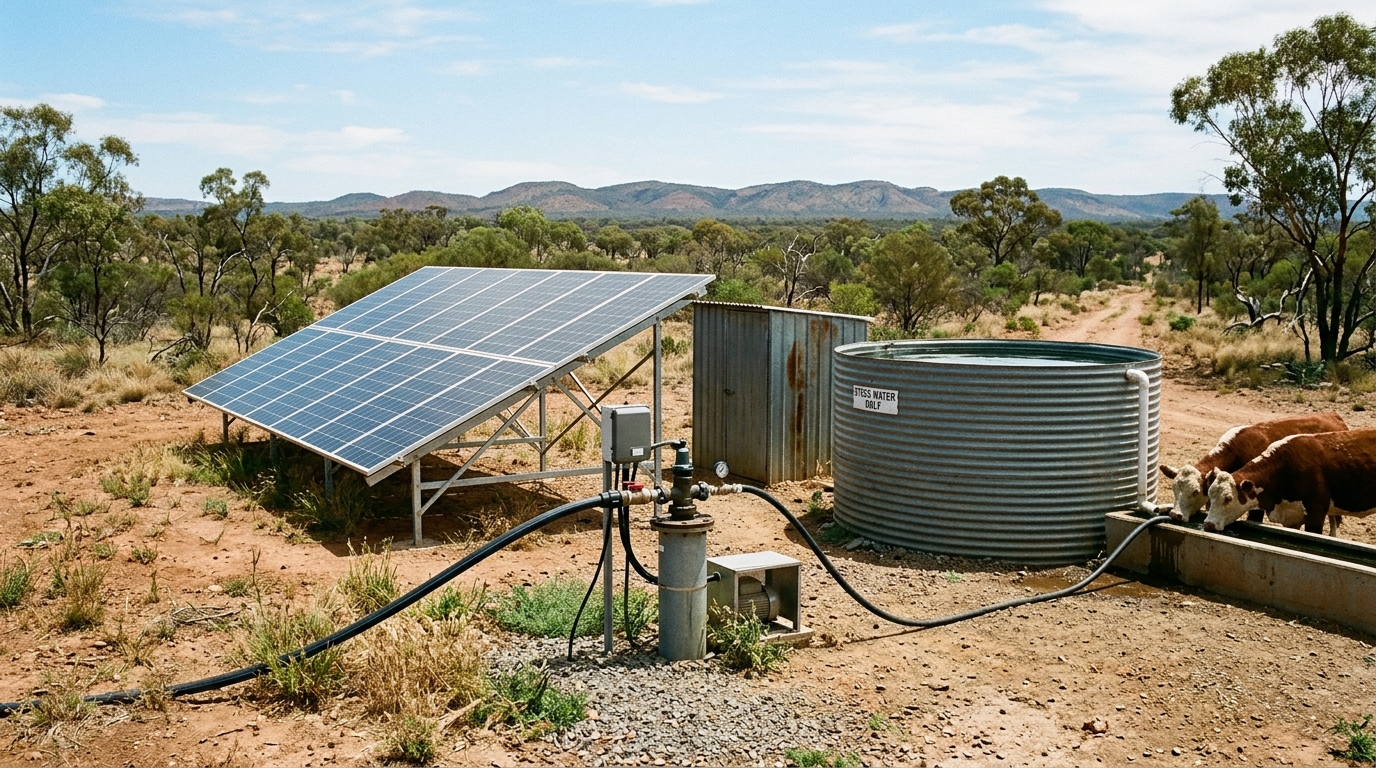
Off-Grid Water Pumping: The Problems I Actually See on Remote Sites
Off‑grid living demands reliable water access—there's no wiggle room. Grid‑tied properties can draw unlimited power; off‑grid homes must match water demand with solar output or other sources. A typical well pump draws 1,000‑2,500 W, more than many small off‑grid systems can continuously provide. On a remote outback property I visited, a pump failed to start, leaving the site dry. The culprit was a voltage sag during the motor’s high‑inrush start‑up, which collapsed the solar inverter output and tripped the controller. The failure cost the owner $4,200 in wasted equipment and a second installation trip. Council rules forced a compliance certificate, delaying the repair by three weeks and adding $1,850 to the bill.
I set out solar‑direct pumps, battery‑fed DC pumps and gravity‑fed systems so you can keep drawing water when there’s no mains power.
Solar-Direct Submersible Pumps
I run solar‑direct pumps that have no batteries, pulling DC straight from the panels. I find them ideal for filling elevated storage tanks while the sun is up.
| Model | Depth | Flow Rate | Power | Price |
|---|---|---|---|---|
| Grundfos SQFlex 3 SQF-2 | 600 ft | 2-5 GPM | 100-400W | $2,200 |
| Grundfos SQFlex 11 SQF-5 | 800 ft | 5-15 GPM | 300-1,400W | $3,500 |
| Lorentz PS2-100 | 330 ft | 1-3 GPM | 100W | $1,800 |
| Lorentz PS600 HR-07 | 1,000 ft | 3-8 GPM | 600W | $3,200 |
| Dankoff SolarForce 3040 | 240 ft | 4-10 GPM | 300W | $1,600 |
| Shurflo 9300 | 230 ft | 1-2 GPM | 90W | $550 |
Solar‑direct pumping: how sunlight directly drives the pump
- Solar panels (typically 2-4 modules) provide variable DC power
- Controller optimizes voltage/current for pump motor
- Pump runs at variable speed based on available sunlight
- Storage tank fills throughout the day
- Gravity or pressure pump delivers water to house
Pros
- No batteries required
- Extremely reliable (simple system)
- Long pump life (brushless motors)
- Works in any sunny climate
Cons
- Only pumps during daylight
- Requires elevated storage tank
- Higher upfront cost
- Complex sizing calculations
Battery-Powered DC Pumps: What Works in the Field
DC pumps running from your battery bank offer on-demand water access with lower power draw than AC alternatives.
| Pump Type | Voltage | Draw | Best Use | Price |
|---|---|---|---|---|
| Shurflo 2088 | 12V | 7A | Pressure/boost | $150 |
| Shurflo 4008 | 12V | 6A | RV/cabin | $120 |
| Flojet 03526 | 12V | 8A | Transfer/demand | $200 |
| Rule 3700 | 24V | 15A | High flow | $350 |
| Grundfos MQ 3-45 | 120V AC | 8A | Whole house | $600 |
How I Size Solar Power for an Off‑Grid Pump
Typical daily water use for 2 people: 100 gallons
- DC pump: 7A × 12V = 84W × 30 min runtime = 42 Wh/day
- AC submersible: 10A × 120V = 1,200W × 10 min = 200 Wh/day
- Solar-direct: 0 Wh/day (runs from dedicated panels)
How I Use Gravity to Move Water Off‑Grid
Gravity systems rely on elevation to generate water pressure—no pumps involved. When your site has sufficient head, this approach rarely lets you down. No power consumption, no mechanical failures, no ongoing costs.
How elevation head translates to water pressure
Water pressure = 0.433 psi per foot of elevation
| Tank Height | Static Pressure | Notes |
|---|---|---|
| 20 ft | 8.7 psi | Minimal—adequate for gravity flow only |
| 40 ft | 17.3 psi | Low pressure—compatible fixtures needed |
| 60 ft | 26 psi | Adequate for most household use |
| 100 ft | 43.3 psi | Good pressure—similar to municipal |
| 150 ft | 65 psi | High pressure—pressure reducing valve needed |
Tank Sizing
- Minimum: 3 days of storage (power outages, cloudy weather)
- Recommended: 7-14 days for seasonal water sources
- Example: 2 people × 50 gal/day × 7 days = 700 gallon minimum
Tank Options
| Type | Cost/Gallon | Lifespan | Pros/Cons |
|---|---|---|---|
| Polyethylene (plastic) | $0.50-1.00 | 20+ years | Lightweight, UV resistant, limited sizes |
| Steel (galvanized) | $1.50-3.00 | 30+ years | Durable, can be raised on towers, rust risk |
| Concrete | $2.00-4.00 | 50+ years | Permanent, can be buried, expensive |
| Wood (cistern) | $1.00-2.00 | 15-25 years | Traditional, requires maintenance |
My site‑by‑site checklist for sizing a pump
Choosing a pump for a weekend‑only shack
Recommended: DC pressure pump + small tank
- Shurflo 4008 (12V) for on-demand pressure
- 40-gallon pressure tank
- Manual or simple well pump backup
- Power draw: ~50 Wh/day
I Live Off-Grid Full Time: What I Pump
Recommended: Solar-direct submersible + gravity storage
- Grundfos SQFlex or Lorentz pump
- 1,000-2,000 gallon elevated tank
- DC booster pump for house pressure
- No battery impact for well pumping
Homestead with Irrigation
Recommended: Large solar-direct + multiple tanks
- High-capacity pump (15+ GPM)
- Separate irrigation and domestic tanks
- Generator backup for extended cloudy periods
Drawing Water from a Remote Spring or Creek
Recommended: Ram pump or gravity
- Ram pump (no power needed) for elevation gain
- Or intake above house elevation for pure gravity
- Simplest, most reliable option
What I Paid for Installed Solar, DC, and Gravity Pumps
| System Type | Upfront Cost | Operating Cost | Reliability | Best For |
|---|---|---|---|---|
| Solar-direct submersible | $4,000-8,000 | $0 | Excellent | Deep wells, full-time |
| DC pressure pump | $500-1,500 | $20-50/yr* | Good | Shallow wells, small use |
| AC pump + inverter | $1,500-3,000 | $50-100/yr* | Good | Existing pumps, grid backup |
| Gravity (elevated source) | $500-2,000 | $0 | Excellent | Hilly properties, springs |
| Ram pump | $300-800 | $0 | Excellent | Flowing water source |
| Hand pump | $200-600 | $0 | Excellent | Backup, emergency |
*Battery wear cost allocated for DC/AC pump systems
Worth a watch: EASY Off Grid Water Storage System- With on Demand Pump · Triple T Acres
Disclosure: some links in this article are affiliate links. If you buy through them we may earn a small commission at no extra cost to you.