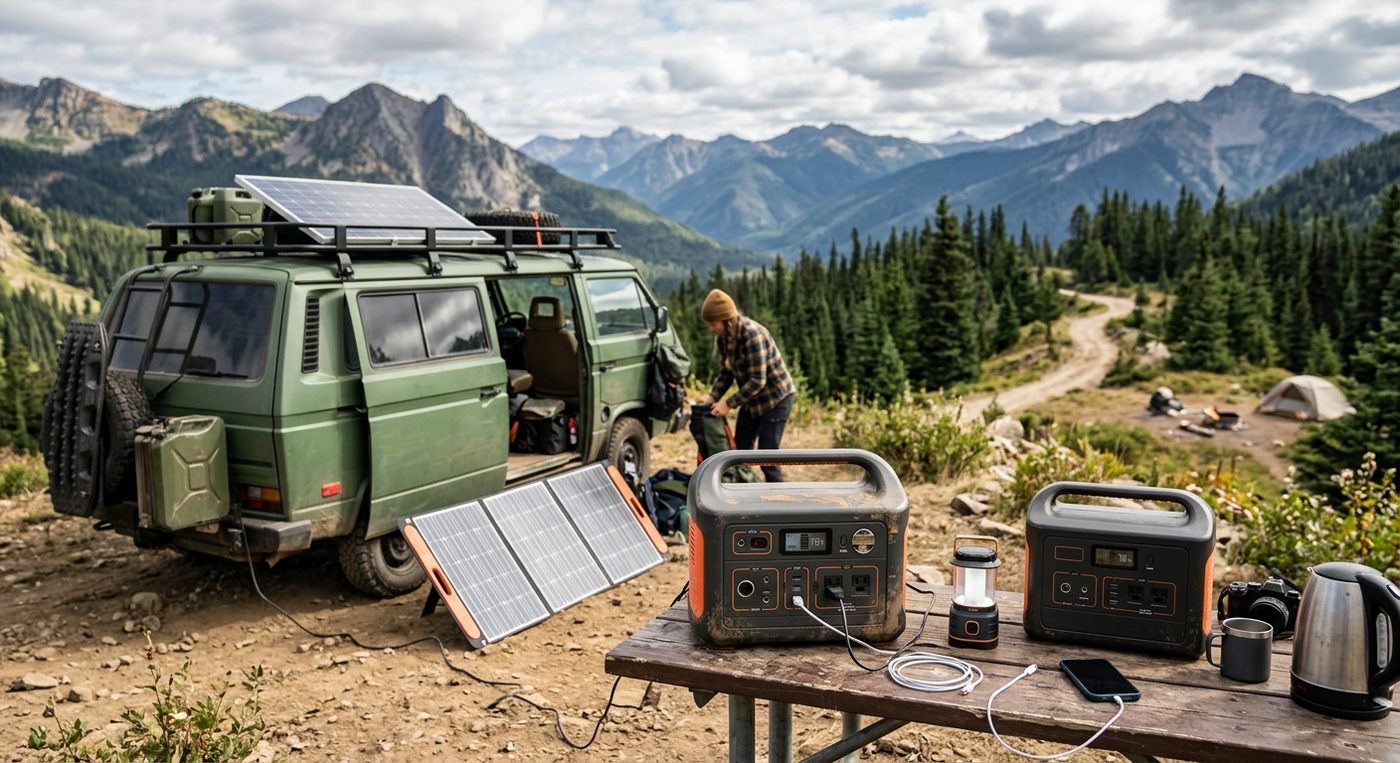
You want to film your off-grid life? Good. But without the grid, you're on your own. Here's how to do it without burning through batteries or losing your footage.
An off-grid video production loop: plan, shoot in daylight, transfer to SSD, edit during peak sun, export overnight, upload when bandwidth allows.
Camera: Get Rugged, Not Fancy
Don't waste money on a $1,500 cinema camera. You need something tough, low-power, and simple. The GoPro Hero 12 is your best bet. It's waterproof, shoots 4K, and the battery lasts 1.5 hours on a single charge (1080p mode). No point in fancy gear if it dies in the bush.
Alternative: DJI Osmo Action 4. Same deal, slightly better battery life. Both are $550-$600. Get it from Bunnings or Kogan. No need for a $2000 Sony ZV-1. It'll die before you finish your morning tea.
Tip: Film in 1080p, not 4K. Saves 40% battery. You're not making Netflix. Just capture the moment.
Batteries: Don't Be That Person
Running out of juice in the middle of filming? That's not "adventure," that's stupid. You need spares. Always.
GoPro Hero 12 battery: $100 (Bunnings or online). Get two. That's $200. Non-negotiable.
Power bank: Get a 20,000mAh USB-C PD one. Anker PowerCore 20000 PD is $75 at JB Hi-Fi. Pair it with a $40 20W solar panel (Solaris or Amazon AU). Total: $115. Charge it while you're bushwalking.
Australian suppliers: Solaris (solaris.com.au) for solar panels. $40 for a 20W panel. Bunnings for GoPro batteries. No need to overpay.
Tip: Keep your camera in a case. No one needs a soggy GoPro after a rainstorm. And turn off the screen when not filming. That's 30% battery saved.
Editing: No Grid? No Problem
You don't need a $3,000 laptop. Use a used MacBook Air M1 (around $700 on eBay Australia) or a Dell Latitude (from $500). Install DaVinci Resolve — it's free, runs on anything, and edits 1080p footage without choking.
Editing on the go? Don't. Just trim the worst bits (10 minutes max) while you're still powered up. Full edit happens when you're back at your solar setup. No point draining your power bank for a 5-minute clip.
Tip: Keep footage in MP4 format. H.264. Every camera does it. Don't waste time with fancy codecs. You're not a pro.
Real Talk: The Only Gear You Need
GoPro Hero 12: $580 (Bunnings)
GoPro battery (x2): $200
Anker power bank: $75
20W solar panel: $40
Total: $895
That's it. No $1,000 power station. No "must-have" drone. Just film your life, not a movie. If you're spending more than $1,000, you're doing it wrong.
⚠️ SAFETY WARNING: Working with electrical systems, structural modifications, or gas installations carries inherent risks. If you are not confident in your abilities, always engage a licensed professional.
They walk through the exact camera and power setup they use on their remote property, showing how they keep shooting even when the grid is miles away. The video also covers the editing workflow they use to cut the footage without a reliable internet connection.— Jenny Mills
When to Call a Professional
While many off-grid projects are achievable as DIY, certain situations require licensed professionals:
Electrical work beyond basic 12V DC additions — requires a licensed electrician
Structural modifications to buildings or load-bearing elements
Gas line installation or modification
Solar array installations above safe voltage thresholds
Any work that affects the structural integrity of your property
Always check local regulations and obtain necessary permits before commencing work.