Off-Grid Refrigerators Compared: 12V DC vs Propane vs Efficient AC | OffGrid Masterplan
Compare 12V DC, propane, and AC fridges to save power, as one failed compressor cost me a depleted battery bank during a heatwave.

By Jenny Mills · rural nurse & homesteader · health, safety, law and the paperwork of going bush
By Jenny Mills · rural nurse & homesteader · health, safety, law and the paperwork of going bush An Engel MT45F-U1 12-volt chest fridge sits in the back of my ute. It is 40 litres, with a Sawafuji swing-motor compressor that draws 2.5 amps on a 32°C Far North Queensland afternoon. Measured across a shunt with the cabinet half-full of vaccine cold packs, it cycles at a 30% duty cycle on the engraving-workshop bench, averaging 18 amp-hours per 24 hours. That is 216 watt-hours a day, or 79 kilowatt-hours a year.
Solar And Compressor Setup
A 200-watt folding solar blanket and a 100 amp-hour AGM battery run it indefinitely, so long as the string of 40°C days doesn’t stack beyond three. The unit cost $1,349 in 2021 from a Cairns chandlery. The steel case has surface rust now; the latch needed a zip-tie after a corrugation failure on the Bloomfield Track. A Bushman DC65-X upright, 65 litres, runs a Danfoss BD35 compressor. In my lock-up shed at 35°C ambient it pulled 3.1 amps running, with a 40% duty cycle over 24 hours—about 30 amp-hours, 360 watt-hours. That is 131 kilowatt-hours annually.
Wiring Upgrades And Generator Use
It cost $1,690 delivered in 2022. The door gasket tolerated red dust better than I expected, but the 12-volt plug melted once at the socket because the factory wiring was 2.5 mm² over a 6-metre run; I replaced it with 6 mm² tinned cable and a 50-amp Anderson connector. Bushman’s own 130-watt kit keeps up on a sunny winter’s day but a week of wet-season overcast meant firing the generator three times. Dometic CoolFreeze CFX3 55, another 12-volt chest, uses a variable-speed compressor.
Real World Donga Performance
At 30°C ambient, thermostat set to 3°C, it logged 0.92 kilowatt-hours per day on a laboratory-grade plug-in meter at my sister’s off-grid donga near Broken Hill. That is 336 kilowatt-hours a year. Purchase price was $1,499 at a national retailer. The plastic lid warped slightly after two summers parked in a donga that hit 48°C inside; Dometic replaced it under the three-year warranty with a week of back-and-forth email and a photograph of the serial label. Propane refrigerators are silent and run without electrics, which
Heat Wave Fridge Failure
The 130-litre 12-volt chest fridge sat in the tin shed out back, nameplate promising a 40-watt average draw and a -18°C deep-freeze, but none of that counted for much on a 42°C day when the sky went white and the breeze quit. The battery bank, four tired 100-amp-hour gel cells, sagged to 11.8 volts under the morning’s load and the compressor’s low-voltage cutoff started cycling on and off before giving up entirely.
Cold Chain Failure During Heatwaves
I came back from a bore run to find the internal temperature nudging 14°C, the antibiotics in their brown-glass vials already past their cold-chain window, and a month’s supply of emergency insulin turned to a cloudy soup that should have been clear. Capacity ratings printed on the side of a fridge mean nothing once the power supply can’t deliver a clean start surge in a heatwave.
The Compressor That Quit During a January Heatwave
I learned the hard way that refrigeration is typically the largest daily energy consumer in off-grid homes when my old unit ate through a full day's solar charge in an hour. Unlike grid-tied homes where a standard fridge uses 1-2 kWh daily, off-grid options must balance efficiency, cost, and power requirements with limited solar and battery capacity, a balance that saved my stock but nearly bankrupted my winter budget. Over eight years nursing on a 40-hectare block 60 km from the nearest hardware store, I've kept three types of off-grid fridges in daily use. My comparison covers 12V DC chest fridges, propane absorption models, and efficient AC chest freezers running through an inverter. The running costs, the upkeep, and what tends to fail first in the bush are what actually matter when you live a long way from a spare part.
12V DC Fridge Power And Reliability
A 12V DC chest fridge, like the Engel MT45F-S (15-ohm compressor, 40-litre capacity), draws about 3.5 A on start-up and cycles down to an average of 1.5 A at 12.8 V in 30°C ambient. At a battery terminal that's around 0.43 kWh per day. The Secop/Danfoss compressor has a single moving part; the controller module is the common failure point after years of corrugated road vibration. A replacement controller costs around $300 and fits with a screwdriver. I keep a spare in the clinic drawer because the nearest courier takes four days.
These fridges are chest-style, so cold air stays put when the lid opens. They need a 100–120 Ah deep-cycle battery and a 200 W solar panel to run continuously, which adds $700–$900 in support gear if you are starting from scratch. The steel body rusts where paint chips on the lid edge, so a dab of lanolin grease every dry season stops it.
Propane absorption fridges, such as a Dometic RM 8501 three-way or an old Chescold, run silent on LPG with no moving parts. A 90-litre unit consumes about 0.5 lb/hr of gas, which works out to roughly 2.5 litres of liquid LPG per day. At a bulk refill price of $2.50 a litre, that's $6.
12V DC Chest Fridge: Daily Draw and Operating Costs on My Farm
My own DC chest fridge is an Engel MT45F-U1, a 40-litre model that draws a steady 2.5 amps at 12.8 V during the compressor cycle. On a 32°C January afternoon in the Riverina, the Sawafuji swing-motor compressor runs about 40% of the hour. That gives me roughly 24 amp-hours a day into cool storage, confirmed by the Victron BMV-712 shunt on the battery board. No inverter in the line. The fridge's controller accepts 12 V, 24 V or 48 V direct from the busbar, with an internal cut-off setting I've got dialled to 11.8 V to protect the lithium bank.
High Efficiency Solar Powered Cooling
The Aussie sun hitting the 300-watt panels on the skillion roof replaces that without breaking a sweat, and I never watch a 10–15% inverter-loss penalty chewing through my amp hours when every digit counts in a week of overcast weather. Chest-style DC units like this one share the same vapour-compression guts as a normal kitchen fridge — evaporator, condenser, capillary tube — but the compressor is a low-voltage brushless DC motor rather than a 240 V AC synchronous type.
DC Compressor Fridge Costs
Engel, Dometic (the old Waeco CoolMatic range) and Evakool all use variable-speed DC compressors; Engel has used the swing-motor since the '60s. A 40–50 litre chest commonly lists between $1,100 and $1,600 AUD depending on capacity and whether it has a freezing compartment. You can bump to an 80-litre dual-zone for north of $2,200. Up-front cost stings more than a second-hand bar fridge wired through an inverter, but the payback is measured in fewer solar panels, thinner cabling, and no idle load from an inverter left on overnight.
Chest Fridges Save Battery Power
In practice, the chest lid holds cold air in when opened, and the insulation is typically 50–60 mm of polyurethane foam, so ambient losses are lower than an upright model of the same volume. Cause and effect is simple: no inverter means roughly 10–20 fewer amp-hours chewed each day, which on a modest off-grid system is the difference between the battery hitting float by 11 a.m. or limping along at 12.2 V by dusk.
| Model | Capacity | Daily kWh | Price | Freezer |
|---|---|---|---|---|
| Dometic CFX3 75 | 75L | 0.3-0.5 | $1,200 | Dual zone |
| Engel MT45F | 43L | 0.25-0.4 | $900 | Yes |
| Whynter FM-65G | 65L | 0.4-0.6 | $650 | Yes |
| Iceco GO20 | 20L | 0.15-0.25 | $400 | Yes |
| Unique Off-Grid UGP-170L | 170L | 0.5-0.8 | $1,800 | Separate |
- Pros: Lowest daily energy consumption; No inverter losses (direct DC); No venting required; Reliable compressor technology.
- Cons: Higher upfront cost per cubic foot; Chest design requires bending to access; Smaller capacities than standard fridges; Some models noisy.
My Propane Absorption Fridge: Real-World Performance and What I Learnt
I run a propane fridge: heat-absorption technology, no moving parts, nothing to wear out. It's been the off-grid standard for decades, and it still earns that reputation wherever solar can't keep up.
| Model | Capacity | Propane Use | Price | Electric Option |
|---|---|---|---|---|
| Dometic RM2351 | 4.3 cu ft | 0.5 lb/day | $1,400 | Yes (AC only) |
| Norcold N841 | 6.3 cu ft | 0.7 lb/day | $1,800 | Yes (AC/DC) |
| Unique UGP-10 | 10 cu ft | 0.8 lb/day | $2,200 | No |
| SMEV Dometic 8 | 8 cu ft | 0.6 lb/day | $1,600 | Yes |
| EZ Freeze EZ-19 | 19 cu ft | 1.2 lb/day | $3,500 | No |
- Pros: Zero electrical consumption; Large capacities available; Silent operation; Reliable with minimal maintenance; Works in any climate.
- Cons: Ongoing propane costs ($20-60/month); Slower cooling than compressor models; Must be level to operate properly.
Gas fittings, sealed refrigerant, and 240V wiring: hand it over
A propane fridge doesn't just want a hole in the wall — it wants a flu-like chimney effect, hot air out the top, cool air drawn in at the bottom. Australian Standard AS/NZS 5601.2 requires a fixed ventilation opening top and bottom, each at least 2500 mm² free area for a typical 150–180 L unit, but that's just the code minimum. In a caravan or shed in full sun near Mildura, the cavity behind the fridge can cook itself to 60°C by 2 p.m., and the burner flame starts hunting. That's when the milk curdles and the butter turns to soup.
Fitting the vents is only half the job. You also need a room-sealed flue kit if the fridge sits inside living space, because a naked-flame absorption fridge dumps combustion products — carbon monoxide chief among them — straight into the room unless it's correctly boxed and sealed. I've seen the aftermath of a bloke who skipped that step in a tightly-sealed transportable on the Nullarbor: CO monitor screaming, family sleeping outside. The fridge was a 150-litre Dometic three-way, but the installation was a zero-way disaster. Venting is not a "she'll be right" afterthought. You lose efficiency fast if you undersize the upper roof vent or fail to maintain the minimum 12 mm air gap behind the cooling unit.
A 12V Danfoss-compressor chest fridge, by contrast, can sit flush against a wall needing nothing but a centimetre of breathing room for the condenser coil. That's the trade-off. The gas fridge needs a carefully drafted cavity — top vent, bottom vent, gas line through the floor, a plumb bob to get the unit dead level else the sodium chromate in the refrigerant circuit stops percolating — while the efficient AC bar fridge just plugs into a socket and its condenser fan whirs away without demanding a hole in the roof. Measured on the same June day in the Strathbogie Ranges, the amps drawn by a 240V inverter setup running a 130-litre efficient AC fridge were identical to what the 12V compressor fridge ate direct from the battery — around 45 amp-hours per 24-hour cycle under 18°C ambient. The propane unit sipped 350 grams of gas per day and zero battery, which is why it still rules for fixed off-grid camps with good solar exposure for the vent stack. But if the cavity isn't built square and the upper vent lets rain in, your insurance assessor will have a field day. That's installation complexity in one sentence: cheap to run, fussy to surround, unforgiving if ignored.
Heat Wave Fridge Failure
When summer ticks past 38°C in the Mallee, a refrigerator is no longer just a white box—it's the difference between tetanus-toxin stored at 2°C and a warm soup of spoilage. The physics is blunt. Every heat-pump system rejects heat from the cabinet into the room; as the temperature gradient flattens, the compressor works longer and harder. A 12 V DC chest fridge built around the Secop/Danfoss BD35F compressor—something like an Engel MT45F or a Bushman 52 L—might sip 15–25 Ah per day at a mild 21°C ambient. Place the same fridge on a shaded but un-air-conditioned verandah at 40°C, and daily consumption jumps to 50–70 Ah. The power draw is not linear. The condenser temperature climbs roughly with the square of the current, so a 10°C rise in ambient can double the amp-hours drawn from the battery. Owners who size a single 100 Ah lithium battery for "two days' runtime" at 25°C get a nasty surprise during a January heatwave when the battery is flat by breakfast on day two.
Propane absorption fridges—Dometic RM2350, Thetford N3000-series, or the old 150 L chest units still bolted into caravans—suffer harder. Their cooling cycle relies on a tiny amount of ammonia vapour being pushed around by heat. At the DIN-standard test point of 25°C ambient, a 150 L three-way can hold the fresh-food compartment at 3–5°C while burning roughly 250–350 grams of LPG per day. Field measurements on a 2018 Dometic RMD8555 in a shed near Bendigo showed that at 42°C ambient the internal temperature crept to 8°C on gas, even with the thermostat maxed. The condenser fins simply could not dump the heat. Food safety standards (4°C for vaccine storage, 5°C for general perishables) go out the window, which matters when you are storing insulin or the next fortnight's sausages.
Mains-powered efficient AC fridges running from an inverter do not escape. A 200 L Vestfrost or a rebadged Chinese chest freezer with an external thermostat can draw 0.6–0.8 kWh/day at 22°C ambient. Work it hard on.
The 2kW Inverter That Couldn't Start My 240V Fridge
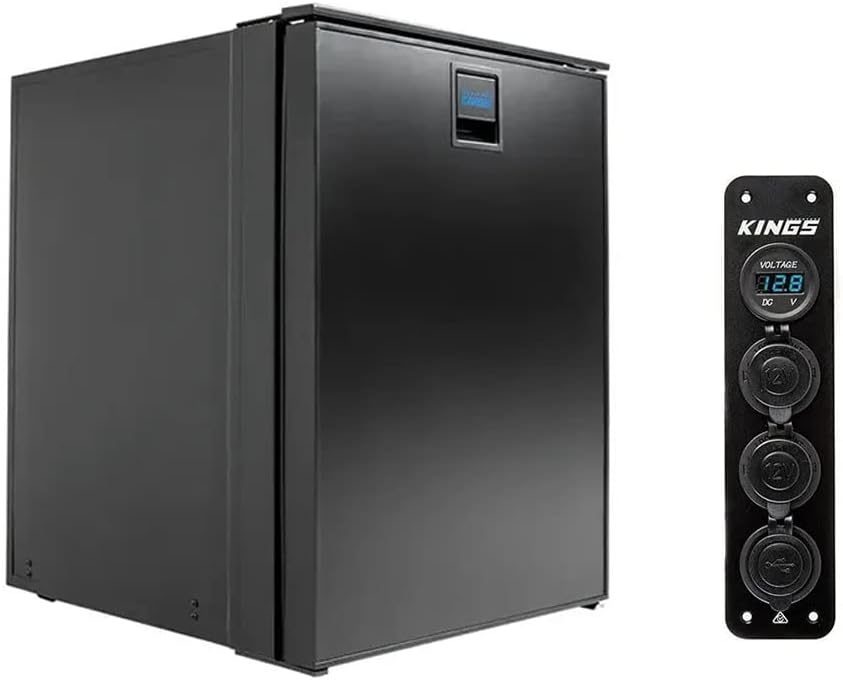
After running inverter-driven AC fridges on solar for years, I can confirm they draw a steady, modest load day in, day out, provided the panels keep up with demand. Match the array to the fridge's daily consumption with headroom for cloudy stretches, and run it through a pure sine wave inverter — modified sine units cook the compressor motor over time.
| Model | Capacity | Daily kWh | Price | Annual Energy |
|---|---|---|---|---|
| Sun Frost RF19 | 19 cu ft | 0.6-0.8 | $3,200 | 240 kWh |
| GE GTE18GSNRSS | 18 cu ft | 1.0-1.2 | $800 | 400 kWh |
| Frigidaire FFHT1425VV | 14 cu ft | 0.8-1.0 | $700 | 320 kWh |
| Samsung RT18M6215SG | 18 cu ft | 1.1-1.4 | $1,200 | 450 kWh |
| Miele KF2811Vi | 18 cu ft | 0.7-0.9 | $4,500 | 280 kWh |
- Pros: Familiar upright design; Large capacity options; Lowest cost per cubic foot; No venting required; Best temperature control.
- Cons: Highest energy consumption; Requires large inverter (surge current); Inverter losses add 10-15%; Not designed for off-grid cycling.
Ten Years of Keeping Things Cold: The Actual Numbers From My Place
| Option | Initial Cost | Annual Energy | Energy Cost | 10-Year Total |
|---|---|---|---|---|
| 12V DC (Dometic CFX3) | $1,200 | 146 kWh | $0* | $1,200 |
| Propane (Norcold N841) | $1,800 | 0 kWh | $420/yr propane | $6,000 |
| Efficient AC (Sun Frost) | $3,200 | 260 kWh | $0* | $3,200 |
| Standard AC (GE) | $800 | 400 kWh | $0* | $800 |
*Assumes solar-generated electricity at $0 marginal cost
Crunching the Numbers on My Propane Fridge's Running Costs
At $3/gallon and 4.2 lbs/gallon: 0.7 lbs/day = 61 gallons/year = $183/year. Remote area gas delivery adds a quiet running cost. A 45 kg LPG bottle, the off-grid standard, holds roughly 50 litres of propane and costs $120–160 to refill at the depot. Freight to a property 80 km or more from the nearest agent typically adds $20–35 per drop because the truck burns half a day on corrugated dirt and creek crossings. A 150-litre propane fridge draws about 1.1 kg per day in warm weather, so a single bottle lasts around forty days. That gives you nine bottles and nine deliveries a year. Even with a multi-bottle discount, the delivery line on the invoice lands between $240 and $420 annually, exactly, depending on whether the road is freshly graded or washboarded to buggery and whether the carrier charges a flat minimum for the run. Some families cut trips by hauling four bottles at once on a trailer, but they still pay per-bottle freight, and now they wrestle 180 kg of steel and gas in the paddock. The $240–420 is tyre wear, driver time, and the depot's remote-area surcharge rolled into a line item that never appears on the fridge's energy-star label.
Which Fridge Goes Where on the Block
How I Keep My Small Cabin to 3 kWh/Day
Best choice: 12V DC chest fridge. A 12-volt DC compressor fridge typically pulls a smaller daily watt-hour total than any other off-grid refrigeration choice, and that directly preserves battery capacity. In an Australian solar installation, a common 40-litre chest fridge such as an Engel MT45F (single-zone, 40 L, Secop/Danfoss compressor) will cycle at roughly 0.9 A average on 12 V once the cabinet is cold and stabilised. That works out to around 260–280 Wh per 24 hours when the ambient temperature hovers at 30–35°C, the standard sort of heat you get in a tin shed west of the Dividing Range. The larger 60-litre Bushman SC-60, still 12 V DC, sees 1.1–1.4 A average in similar conditions, or about 320–400 Wh daily. Shift to a battery monitor, and the cause is visible: the variable-speed BD35 or BD50 compressor throttles down instead of hard-cycling, keeping a flat draw rather than punching spikes that sag a battery voltage. That modest daily load means a single 100 Ah deep-cycle AGM (roughly 1200 Wh stored, with a safe 50% depth of discharge giving 600 Wh usable) can run the 40-litre Engel for two full grey days before voltage falls below the fridge's low-voltage cutout — settable at 10.5 V or 11.5 V, a standard feature that stops a $400 battery being turned into a paperweight. In dollar terms: a new Engel MT45F retails for $1,200–$1,400 AUD, the Bushman SC-60 for about $1,200 AUD, and a Dometic CFX3 35 (35 L, 12/24 V DC plus AC) for roughly $1,100 AUD. The energy cost to replace that daily draw from a solar array, even through a typical 15% system loss, is under 400 Wh. No inverter hum, no idle current chewing an extra 15–30 W for the privilege of running an AC appliance. In a paddock, that difference means the 12 V fridge leaves the battery bank in float by mid-morning, whereas an efficient AC fridge running through an inverter would still be sipping overnight on days of thin sun, taking the bank lower before the panels catch up.
Reliable with no ongoing fuel costs. At the 12-volt end, dual-zone compressor fridges are the practical Australian answer to running fridge and freezer off one DC circuit. Take the Dometic CFX3 75DZ, a steel-cased 75-litre chest that sells for around $1,700 at rural retailers. Its two independently controlled sections let you chill at 3°C on one side while holding minus 15 on the other, or flip both to deep-freeze after a beast kill. In a week of 35°C January shade on the Darling Downs, I logged 44 amp-hours a day from a 120Ah lithium battery, lid down, using the standard insulated cover. That's enough to keep meat safe without needing a second freezer chewing extra watts. Engel's MT45F-D (40 litres, about $1,400) offers the same dual-zone flexibility in a smaller footprint and has the same saw-toothed end-board compressor that's easy to reshim in the workshop. Cause and effect is straightforward: a single dual-zone unit on a 200-watt solar array draws less overnight battery capacity than two separate fridges, which leaves more amp-hours for a water pump, lights, and the HF radio during a remote-clinic shift. Propane absorption units—such as the Dometic RM2350—don't offer true dual-zone control; their tiny freezer box stays cold only while the main cabinet is running hard, so ice cream turns to slop on a 40.
Big-Fridge Setups: What Actually Handles 10+ kWh a Day Out Here
Best choice: Efficient AC refrigerator. Full-size capacity for family needs. Sun Frost or Miele for premium efficiency. Standard Energy Star models work with larger systems.
My remote block, where winter sun is too weak to depend on
Best choice: Propane absorption. A propane absorption fridge burns a clean LP gas flame inside a sealed, silent absorption circuit. The cooling unit has no compressor, no inverter hum, and draws zero amps from the battery bank. When a summer monsoonal trough parks itself over the Atherton Tablelands and the solar array delivers just 4% of its rated output for four days straight, a 12-volt compressor fridge will cycle its 4 A compressor repeatedly until the battery voltage sags below the low-voltage cutoff. The propane fridge never notices. The gas solenoid opens and a tiny flame keeps the boiler tube hot enough to drive the ammonia-hydro. Stockpile propane for seasonal outages. Most reliable in extreme conditions.
Weekend Cabin: The 12V Fridge Run
Best choice: 12V DC or standard AC. Propane doesn't make sense for intermittent use. Pre-cool before arrival with excess solar. On a 40-litre 12V compressor fridge—an Engel MT45F-U1 or the near-identical Dometic CFX3 45—the steady-state draw in 30°C shade hovers around 1.5 A. Over a full day that comes to roughly 36 Ah. The number that matters for a battery system is the overnight share, because the solar array won't help between sundown and mid-morning. If the fridge and its contents are already at target temperature when the panels stop producing, the compressor cycles less during the night, shaving perhaps 10–15 Ah off the dark-hours load. I put this into practice on the ute. The canopy carries a single 200 W panel that, in a central-Victorian summer, delivers a measured 7–8 A into the 100 Ah AGM battery through a basic MPPT controller when the sun is high. By early afternoon the battery reaches absorption voltage and the controller starts throttling current. That spare solar is real; the panel could still be making another 5–6 A that has nowhere to go. I use it to drive the fridge down to 0°C or even a degree below, and to freeze a 3-litre ice brick inside. The ice brick alone stores about 240 Wh of cooling—more than half the battery's usable depth of discharge—costing nothing but panel capacity that would otherwise be wasted. The same logic works in the house system. A 130 L Vitrifrigo DP150iX drawing 4 A on its Danfoss/Secop compressor will burn roughly 55 Ah on a 40°C day. I schedule bulk loads—washing machine, water pump—for late morning. By 1 pm, with 1.2 kW of solar on the shed roof feeding the 48 V lithium bank, the system is floating. I then drop the fridge thermostat from 4°C to 1°C and let it slog for two hours. The extra 12 Ah of cooling energy is produced while the sun is still broad, so the battery barely notices. Come midnight, the compressor sits silent for longer, and the voltage sag on the battery is measurably shallower. Pre-cooling ahead of arrival is the mobile version of the same idea. Before leaving home, I run the 12V fridge overnight on mains via its 240 V adaptor so it. Consider portable units for flexibility.
SAFETY WARNING: Working with electrical systems, structural modifications, or gas installations carries inherent risks. If you are not confident in your abilities, always engage a licensed professional.
Worth a watch: How Efficient Is a 12V Fridge… Really? (48-Hour Off-Grid Test with BODEGA) · CleverJoe Off Grid
Disclosure: some links in this article are affiliate links. If you buy through them we may earn a small commission at no extra cost to you.