Inverter Oversizing and Surge Planning for Off-Grid Systems
Don’t guess; plan for the worst. In off-grid power systems, inverter oversizing and surge planning aren’t optional—they’re survival tactics. I’ve seen enough inverters blow up in the heat of Central Queensland to know this. My 22 years wiring solar, batteries and sheds in this state taught me that you need AS/NZS compliant tools and a budget that covers the hard truths to get it right. A run-of-the-mill off-grid inverter handles steady loads—fridges, lights, a telly—without breathing hard. Things get ugly the moment a motor kicks in.
A single-phase bore pump with a 1.5 kW nameplate can yank six to eight times its run current at locked-rotor, demanding somewhere between 9 kVA and 12 kVA for up to five seconds. That spike flattens a cheap 3 kVA continuous inverter before its cooling fan spins up. I’ve replaced enough of them to know you don’t size for the run label; you size for the locked-rotor amps stamped on the motor plate and add 25% to cover voltage sag under a 40 °C shed roof.
Crunch the numbers: multiply the locked-rotor amps by the nominal AC voltage, then list everything else that runs at the same time. The inverter’s surge rating—usually a two-second or five-second number buried in the fine print—must clear the highest single motor inrush plus the base load. If the data sheet says “10 kVA for 2 seconds”, that’s your hard ceiling. Miss it and the magic smoke escapes. Building a real budget starts
By Dave Miller· off-grid sparky · 22 years wiring solar, batteries and sheds in central QLD
I learned the hard way that a 20% oversized inverter won’t save you when a 3kW pump fails to start on a 100Ah battery bank in the Queensland heat. The job was a bore pump on a cattle block north of Roma, late January. The client had a 3kW single‑phase submersible, a new 3.6kVA pure sine wave inverter (exactly 20% above the motor’s continuous rating), and a 48-volt 100Ah sealed lead‑acid bank sitting in a tin shed that measured 47°C inside by 10 a.m. The inverter’s spec sheet claimed a 2‑second surge of 7.2kVA, which on paper looks plenty for a motor that
Plan For Worst Case Scenarios
Don't guess. Plan for the worst. In off-grid power systems, inverter oversizing and surge planning aren't optional—they're survival tactics. This guide cuts through the fluff and gives you the hard truths, budgets, and AS/NZS compliant tools to get it right.
Why Oversizing Matters
Most DIYs undersize inverters, thinking they'll grow into it. Wrong. Oversizing ensures your system handles peak loads, future expansion, and unexpected surges. Underpowered inverters overheat, fail, and cost you more in the long run. I've seen enough Victron and Schneider units cook themselves in central QLD sheds to know that running a 10kW load on a 5kW unit is a recipe for a melted busbar and a bill for a replacement. Don't gamble on the future; spec it out now or pay double when the thing kicks in and trips out.
Surge Planning Basics
Surge Currents & Inverter Sizing
A motor, compressor, or similar appliance doesn’t pull its nameplate figure when it kicks on. Surge currents (inrush currents) can be 3–5 times normal draw. A shed fridge rated 150 W loafs along at 0.6 A after start, but I’ve clamped a 14 A spike for the first 300 milliseconds on a 30°C day. A 2 hp single-phase air compressor with a 1500 W running load will want 30–40 A briefly. Bore pumps, pressure pumps, even a big angle grinder will do the same.
Your inverter must handle that or you risk damage. When the inverter can’t pour out the amps
Actionable Steps
Calculate total load: Add all appliance wattage (including surge values). Use a Wattmeter for accuracy.
You size an inverter for continuous load first. Total up every appliance that might run at once—water pump, fridge, freezer, lights, maybe a microwave or a small air compressor. That number is your running watts. If you buy an inverter that just matches that, it will trip on startup more often than an old shearer’s radio.
Every motor-driven load draws a surge current at startup, typically 3 to 7 times its running watts for a fraction of a second. A 240 V, 1 hp bore pump pulling 750 W running will demand somewhere near 3500–4000 W for that first half-second. A 450 L chest freezer running at 150 W can spike to 800 W. An old 14 V cordless drill charger is no trouble; a 4-inch angle grinder kicking in under load is a different beast.
Inverters are built with a surge rating, usually stated as a multiple of continuous output for a few seconds. A cheap modified-wave unit might claim double for 2 seconds; a decent low-frequency transformer-based inverter can often do 3 times for 5–10 seconds. Take those numbers with a pinch of salt once the gear is sitting in a 45-degree shed. High temperature derates output. A 3000 W inverter at 25°C might only give 2400 W continuous at 40°C. In central Queensland January, 40°C in the shade is a Tuesday.
That’s why the oversize rule is 20–30% above your calculated continuous load—bare minimum, not a gold-plated guarantee. If your continuous tally comes to 1800 W, a 20% buffer puts you at 2160 W. A 30% buffer is 2340 W. Inverters come in nominal sizes like 2000 W, 2400 W, or 3000 W. The 2400 W unit ticks the box on paper. In practice, you will curse yourself the first time the fridge starts while the pump is running and the lights flicker. I’ve seen blokes swap a 2400 W inverter for a 3000 W within six months because the cheaper unit’s surge couldn’t handle the two-second overlap.
A worked example from the paddock: a typical weekender shed setup in the Maranoa. Continuous load: 12 V fridge via transformer (120 W), Engel 40 L as freezer (50 W running), a 12 V pressure pump (90 W), four 10 W LED lights (40 W), and a laptop charger (65 W). Total running 365 W continuous, rounded to 400 W to be safe. Surge add-ons: fridge 720 W startup, freezer 600 W, pump 540 W. The worst-case simultaneous surge—fridge and pump kick in together—is 720 + 540 = 1260 W for perhaps half a second. A 1000 W continuous inverter with a 2000 W surge rating could theoretically cover it. Applying the 20–30% buffer on 400 W gives 480–520 W continuous, so a 500 W unit seems enough. But that 500 W unit will have a surge rating around 1000 W. Dry season, 40°C, voltage drop on the DC cables, and suddenly it doesn’t hold. I’d spec an 800 W or 1000 W continuous inverter for that shed from day one. The price jump from a no-name 500 W to a 1000 W pure sine wave inverter is roughly $150–$250 extra. A call-out to replace a failed inverter in the middle of nowhere costs more in fuel and lost meat.
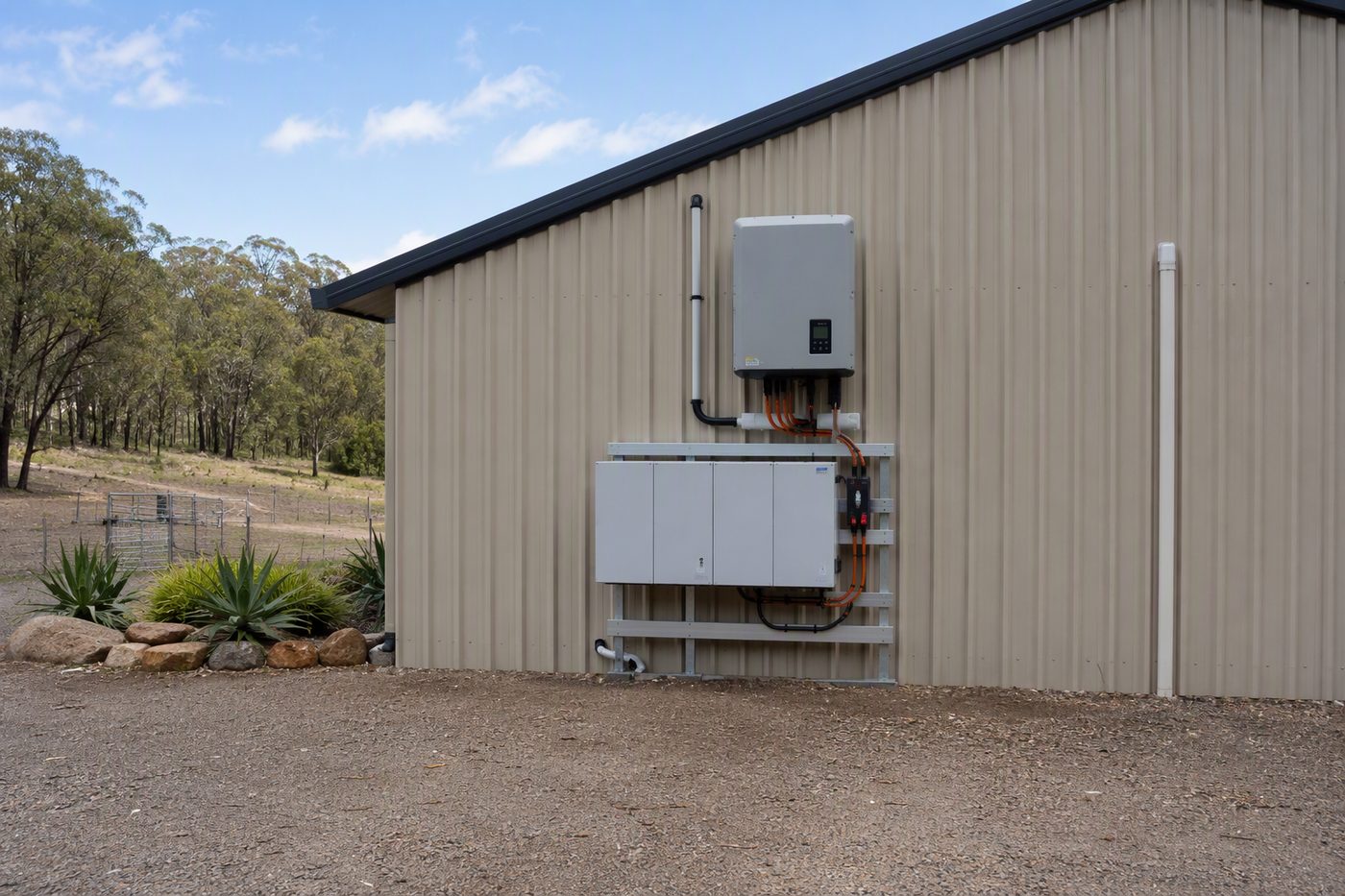
A bigger shed with a 15 A socket circuit might run a 1400 W microwave, the pump, the fridge, and a 2000 W induction cooktop. Continuous load: 1400 + 90 + 120 + 2000 = 3610 W. Surge from the fridge and pump adds another 700 W on top. A 4000 W inverter with a 12,000 W surge spec works, but the 30% buffer would push to 4693 W. No 4700 W inverter exists; you jump to a 5000 W continuous unit, often a 48 V system. That size in a decent low-frequency brand costs $1800–$2500. You mount it on a shaded masonry wall with 100 mm clearance all round and 35 mm² DC cables no longer than 1.5 metres to the battery busbar. That sort of detail isn’t fluff—it stops the inverter dropping out when the induction plate hits boost.
Cable sizes matter for surge delivery. If the DC run is too long or too skinny, voltage sag at the inverter terminals during a
Match battery bank to inverter surge demands. An inverter’s surge rating means nothing if the battery cannot deliver the amps without the voltage sagging into low‑voltage cutoff. I see this every year
Use surge-rated components: Check for AS/NZS compliance and surge ratings on all gear.
Common Mistakes
The printed wattage on a motor nameplate is its running draw once up to speed. At startup, that same motor can pull three to seven times that figure for anywhere from half a second to several seconds. A bore pump rated at 750 W will often demand 4,500–5,200 VA for the first few cycles. An old single-phase compressor on a 15 A circuit might spike to 45 A briefly. If the inverter’s surge rating cannot cover that instantaneous load, the voltage collapses, the inverter trips on overload, and the pump never spins.
A typical off-grid inverter sold in Australia lists two numbers: continuous apparent power in volt-amps (VA) or watts, and a surge or peak rating, usually at a specified duration. A common 48 V, 5,000 VA inverter/charger will carry 5,000 VA continuously and deliver roughly 10,000 VA for 5 seconds, sometimes 15,000 VA for 100 milliseconds. That short headroom is meant for motor starts, not for sustained overload. I have pulled apart units where the owner had wired a 3,000 W element expecting the “9,000 W peak” sticker to handle it for minutes. The burnt-out DC bus capacitors told the real story.
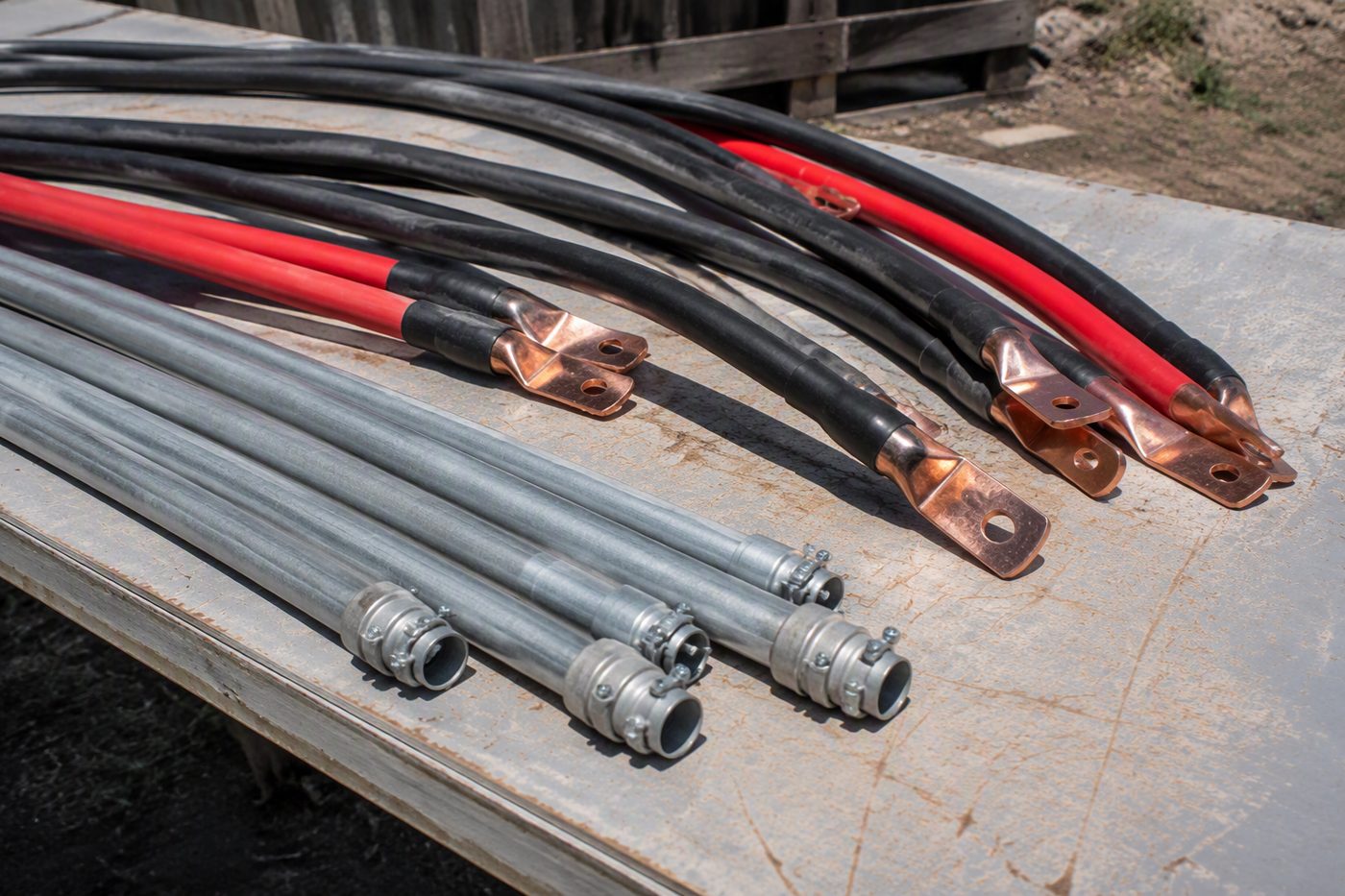
In the paddock, the surge planning starts with the load that has the highest locked-rotor current. Grab a clamp meter with an inrush function or read the LRA code letter on the motor. A small single-phase motor with code letter K pulls around 8.5 kVA per horsepower at locked rotor. A 1 hp (746 W) bore pump then needs about 8.5 kVA at startup, or roughly 35 A at 240 V. Even a quality 5,000 VA inverter with a 10,000 VA surge can sometimes trip if the DC wiring is undersized, because voltage sag at the battery terminals during that surge hits the inverter’s low-voltage cutoff. A 48 V bank feeding 10,000 VA surge needs to deliver over 200 A DC for those few seconds. With a lead-acid bank, I size the interconnects and the main DC breaker so that voltage drop under a 200–250 A surge stays below 0.5 V. That often means 70 mm² cable for a 2-metre run between battery and inverter, with a quality 250 A DC-rated breaker, not a cheap DIN rail MCB.
Costs sit in the cabling and protective gear as much as the inverter. Decent 70 mm² welding-style cable runs around $18–$25 per metre. A 250 A DC breaker from a reputable supplier is $80–$120. Skimp there and you turn that breaker into a heater under surge load, nuisance-tripping on cool mornings. A 5,000 VA inverter/charger from the better-known tier goes for $4,000–$6,000 in a rural electrical wholesaler; the same wattage class from a cheap online source might be $1,800 but never actually delivers the claimed surge for the claimed duration. I have tested a “6,000
A 1 kW inverter for a 1.5 kW fridge with a 3 kW starting surge has two chances of working: Buckley’s and none. The nameplate on a compressor fridge gives you the running watts—1,500 W here—but the compressor’s locked-rotor amps at kick-on draw roughly double that. On a 230 V circuit, 3,000 W inrush demands 13 A for a few cycles. A 1 kW inverter is rated only 4.3 A continuous. Even cheaper units with a “surge” rating of 2 kW for half a second will trip their overcurrent protection before the compressor spins up. The result is a fridge that hums, clicks, and warms up in a shed near Longreach while you’re in town.
Budget reality hits hard. A lightweight 1 kW pure sine wave inverter can cost $180–$280 from a rural supplier. Stepping up to a 2 kW continuous unit with a genuine 4 kW surge for 3–5 seconds adds $500–$800. If you need to start that 1.5 kW fridge reliably and also run a small freezer, a low-frequency 3 kW inverter with a 9 kW surge rating is the real-world fix, at $1,200–$1,600, plus heavier DC cabling and a battery bank that won’t sag below the inverter’s low-voltage cutoff. A 12 V system at 1,500 W load pulls over 120 A. That’s a two-handed cable—50 mm² welding flex minimum on a short run, $20 a metre—and will still drop half a volt by the time it reaches the lugs. A 48 V battery string cuts the current to 31 A, so 16 mm² cable works and your lugs stay cooler. The battery cost shifts too: a 12 V 200 Ah AGM deep-cycle pack is $600–$900, but the 48 V equivalent means four of them, $2,400–$3,600 plus a compatible charge controller. Overlooking this cascade turns a “cheap” inverter into a battery-murdering, cable-roasting lesson.
Work a proper surge calculation in the paddock. Grab the fridge’s compliance plate. Note running watts (1,500) and locked-rotor amps if listed; otherwise measure the inrush with a clamp meter that catches peak-hold. Multiply run watts by the motor start factor—for a piston compressor, 2× is a safe floor unless the maker specifies otherwise. So 1,500 × 2 = 3,000 W surge. Now check the inverter’s surge spec at a realistic duration: the fridge needs that start current for about 300–500 milliseconds. An inverter claiming “3 kW surge” but only for 20 ms is a paper
When you size an inverter for today’s loads, the number you pick sets a hard ceiling. I’ve lost count of sheds across central QLD where a 3 kVA inverter handled lights, fridge, and a small split-system fine for years, then choked the moment a bloke added a bore pump. That pump wasn’t a luxury; it was the only way to keep a veggie patch alive through October. The fix cost him a new 5 kVA inverter, new DC cabling, and a Sunday I’ll never get back.
An off-grid system ages in dog years. Loads creep up because you add a chest freezer in the machinery shed, a pressure pump for rainwater, or a second air conditioner when the wet season turns the donga into a steam bath. Panel degradation eats into your daytime surplus, and lead-acid batteries lose capacity so the inverter ends up working harder just to cover the same evening draw. None of this is hypothetical; I’ve measured a 12% drop in usable capacity on a flooded lead-acid bank after three central QLD summers when it was cycled daily to 50% depth of discharge. That missing capacity forces the inverter to pull harder from the battery during morning startup surges, and if you’re already close to the inverter’s surge rating, the low-voltage disconnect trips.
The common trap is a water pump. A 0.75 kW single-phase pressure pump—the kind you’ll find at any rural supply for around $350–$450—looks harmless on the nameplate. But locked-rotor current for a capacitor-start induction motor typically runs six to eight times the full-load current. At 230 V, 0.75 kW draws about 3.3 A running. Startup surge sits around 20–26 A, or 4.6–6.0 kVA for the half-second it takes the impeller to spin up. Your 3 kVA inverter with a 6 kVA surge rating for two seconds might just hold, provided nothing else is running. Add a fridge compressor cycling on at the same moment, and the combined surge can pull 7–8 kVA. The inverter drops out. The pump contacts chatter, the pressure switch arcs, and I get a phone call that starts with “The bloody thing’s dead again.”
Worked example, based on a system I wired at Rolleston in 2019:
- Continuous load: lights (0.2 kW), fridge (0.15 kW running), small air conditioner (1.5 kW cooling). Total 1.85 kW, or about 2.3 kVA allowing for power factor.
- Planned addition: 1.1 kW submersible bore pump, 230 V, full-load current 5 A, startup surge 7× = 35 A, or 8.05 kVA for 1–2 seconds.
- Existing inverter: 4 kVA continuous, 8 kVA surge for 3 seconds.
- Bore pump alone peaks at 8.05 kVA, within the inverter’s surge ceiling, but only if no other motor starts. When the aircon compressor cycles, its starting surge adds roughly 4 kVA. Combined surge reaches 12 kVA, well beyond the inverter’s silicon. Outcome: the inverter’s overload protection shuts down, water stops, tank levels drop, and the household runs the generator for the third time that week.
Cost of getting it wrong: swapping a 4 kVA inverter for a 6 kVA unit—something like a common transformer-based 48 V model I keep on the shelf—adds about $800–$1,200 at trade price, plus another $150–$250 for heavier battery cable (35 mm² minimum vs 25 mm²) and a larger DC breaker. Doing it twice means you’ve also paid for the original inverter’s installation, and nobody refunds labour. I’ve seen the bill blow out by $2,500–$3,000 compared with oversizing from the start. The 4 kVA inverter ends up on Gumtree for half what you paid, if you’re lucky.
Budget sanity check: if you’re fitting out a shed with solar and batteries for the first time, adding 50% headroom on the inverter’s continuous rating over your measured maximum steady load costs roughly 20–30% more on the inverter line item. For a typical 48 V standalone system with a quality pure sine wave inverter-charger, the difference between a 3 kW and a 5 kW unit is around $600–$900. In the total system cost—panels, racking, MPPT, batteries, wiring—that’s
In a central Queensland shed, dust and heat punish gear hard. Skipping regular maintenance means batteries degrade and inverters age quicker than the warranty ink dries. Flooded lead-acid cells want the electrolyte level checked every four to six weeks through summer, topped up with demineralised water only, never tap. Exposed plates sulfate over and you lose permanent capacity. In a 48-volt, 400 amp-hour bank—costing four thousand dollars installed by the time you buy interconnects and a battery box—letting one cell run dry can drag the whole string down to 60 percent state of health in two years instead of ten. That forces the generator to fire up earlier each evening, burning twenty litres a week of diesel at two dollars a litre. The numbers bite.
Inverters chew fine red bulldust the same way. A 5 kVA off-grid unit running a bore pump and a coldroom will pull air through its intake screens nonstop. If nobody blows out the heatsinks and fans every dry season, the thermal sensor winds back output to 3.5 kVA when you need full grunt. Capacitors inside dry out faster when they cook at 70 degrees instead of 50, and replacing a main board costs twelve hundred dollars. A second-hand 5 kVA inverter in good nick trades around two grand; killing one after five years instead of fifteen hands you an extra two grand of unbudgeted spend. Battery terminals also loosen with heat cycling—retorque M8 bolts to 5 Newton-metres every six months, or the resistance climbs until a post melts on a heavy load start. That kind of maintenance takes an hour with a multimeter, a spanner, and a
Maintenance Cadence
Monthly: Check inverter temps, battery connections, and fuse integrity.
Every three months I drag the Stihl blower out to the inverter shed, not for the floor—for the gear. Fine red bulldust from the paddock settles into every heatsink fin and fan grille. A shop vac on blow first, then a soft paintbrush to loosen the crust off the charge controller vents, then vacuum on suck to catch what falls. Inverters working hard in 40-degree heat don’t need their airways half choked. I pull the front cover and wipe the DC terminals with a clean rag and a squirt of contact cleaner if there’s any green fuzz starting. Battery posts get the same check—intercell links torqued to 5 Nm on the flooded lead-acid bank, nothing loose.
Testing surge handling with a Wattmeter happens after the dust is gone. I plug the Wattmeter into a GPO on the inverter output, then run a 2400 W kettle through it. Run the kettle on a cool morning so the inverter isn’t already hot. The Wattmeter costs about $30 from any electrical wholesaler—nothing fancy, just a plug-in power meter that reads volts, amps, watts and peak surge. I flick the kettle on and watch the instantaneous watts jump: a standard 1.7 L kettle pulls 2200–2400 W continuous and a brief inrush up near 2800–3000 W for maybe half a second while the element heats. If the inverter is rated 3000 W peak, it should swallow that without tripping. The Wattmeter’s peak-hold function captures the highest wattage drawn. If the inverter groans and kicks offline, I know the electrolytic capacitors in the DC bus are getting tired or the battery cabling has too much voltage drop under load. Record the peak figure in the logbook; if the same kettle showed 2950 W peak last quarter and now the inverter folds at 2600 W, I start looking at cable lugs, isolator contacts and battery state of health. No drama, just cause and effect.
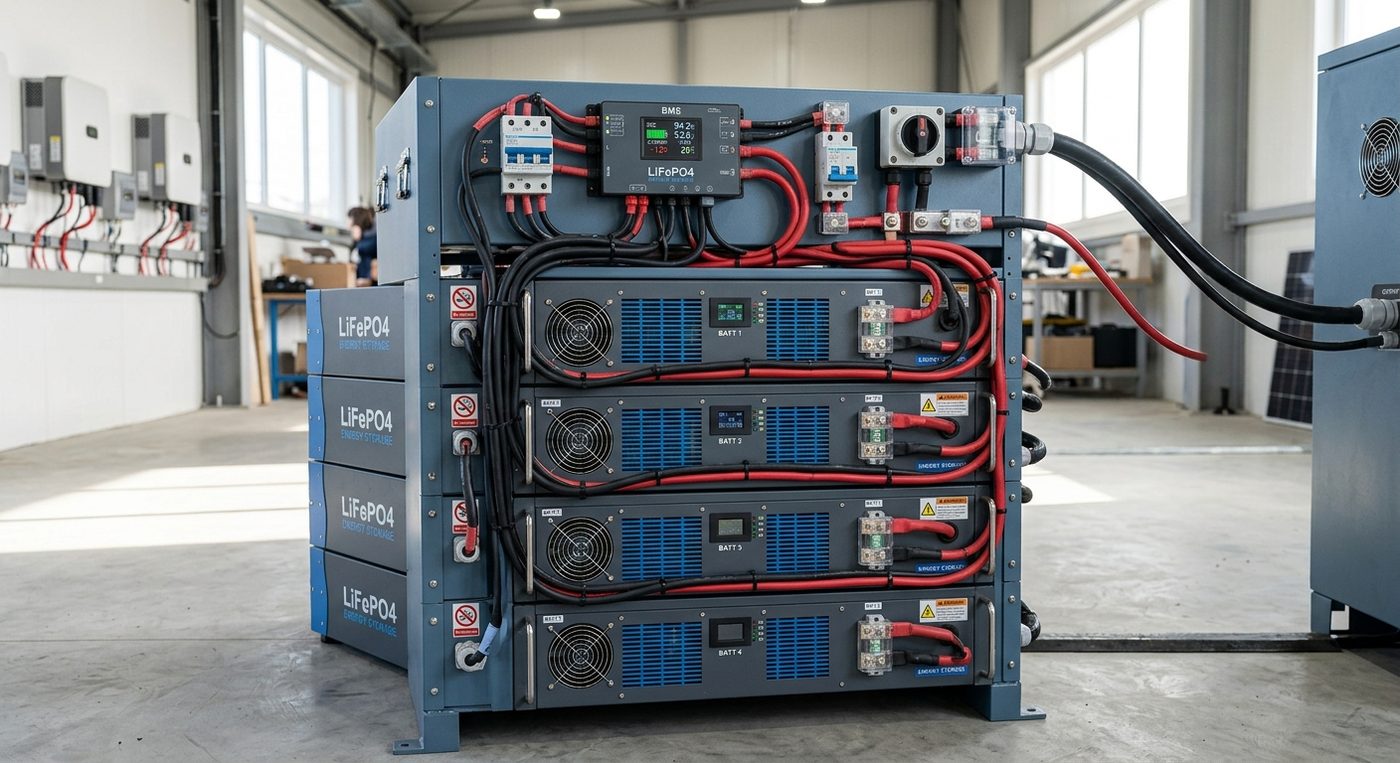
Annually, the job that bites hardest is staring down a battery bank that’s gone soft. Off-grid lead-acid sets in central Queensland sheds rarely see the cool 25°C that datasheets assume. More often they cook through weeks of 40°C-plus inside uninsulated boxes, which halves the calendar life. A flooded-cell bank that costs $4500–$6000 for 48 V and 400 Ah will typically need replacing every 5 to 10 years, with the earlier number showing up where discharge regularly dips below 50% and equalising gets missed. Sealed AGM blocks bought for around $350–$450 per 100 Ah suffer the same heat degradation but no way to top up, so their 7‑year claim becomes 5 in a dusty shed near Longreach. Lithium iron phosphate batteries change the arithmetic—a 48 V, 200 Ah rack costs $8000–$12,000—but run 10 years or more with 80% depth of discharge, and the real saving is not buying another set of lead before the inverter dies. Whatever the chemistry, the actual outlay lands in one lump, so the annual chore is budgeting, not buying every year. On the same round, inspect every accessible millimetre of wiring for wear. Look for green crust at battery terminals, UV-cracked sheath on twin-core solar cable that’s been cable-tied to a north-facing colourbond wall for a decade, and lugs that have gone dull grey from heat cycling. A thermal camera run over the board while the kettle boils will find a loose neutral in the inverter AC-out before the shed smells of hot plastic. Tightening every screw terminal back to torque once a year and replacing any cable with a melted insulation ring near a lug saves a midnight call-out.
Q1: What’s the minimum inverter size for a 1.5kW fridge?
A 2 kW inverter is the smallest I’ll fit to any shed running a few lights, a fridge and a pressure pump. That’s not a guess—it’s the result of oversizing by 30%, which means if you tally up your continuous loads and get 1.5 kW, you don’t buy a 1.5 kW box. You go 30% bigger to keep the inverter’s internal temps out of the red on a 40°C afternoon when the sun’s cooking the tin roof. So the minimum becomes 2 kW, and that machine must carry a surge capacity of at least 6 kW.
Inverter Surge Capacity Matters
The 6 kW surge isn’t marketing fluff. A typical single-phase pump motor drawing 1,500 W running will yank four times that—6,000 W—for a few cycles while the impeller spins up. If the inverter can’t deliver that spike, voltage sags, the pump stalls, and the inverter trips out on under-voltage. Or you fry the start winding.
Size Surge Capacity For Pumps
I’ve seen a 2 kW pure sine wave unit with a 6 kW surge handle a Davey HM60 pressure pump without blinking; the same shed tried a 2 kW unit rated for only 3 kW surge and it fell over every time the pump cut in. Budget reality in central QLD: a reliable 2 kW inverter-charger with a genuine 6 kW surge (5-second rating, not 20 milliseconds) runs $1,200–$1,800 AUD over the counter. Cheaper units around $700 often rate their surge at 200% for half a second, which won’t start a pump.
Sizing Battery Banks And Cables
You’ll also need a battery bank that can feed 200 A without dipping below the inverter’s low-voltage cut-off. That means a decent 200 Ah lithium or 400 Ah flooded lead-acid setup as a bare minimum, with 70 mm² copper cables between battery and inverter to keep voltage drop below 3% at 12 V. At 24 V the current halves, so 35 mm² will do, but the 2 kW / 6 kW rule remains the same.
Size For Worst Motor Surge
No amount of clever load-shedding gets you around that starting surge; you size the inverter for the worst single motor in the system and add the 30% headroom so it runs cool for a decade, not two summers.
Q2: Can I use a 1kW inverter for a 1.5kW water pump?
Water pumps often have a starting surge around 3 times their running wattage. A typical 0.75 kW (1 hp) single‑phase bore pump in a central QLD paddock draws roughly 750–800 W once spinning, but the locked‑rotor kick on startup can pull 2.4 kW for a second or two. Many inverters rated 3 kW continuous can deliver a 6 kW surge for 5 seconds, so a 3 kW unit has enough headroom. If the pump is 1.1 kW (1.5 hp), the startup spike hits about 3.5 kW.
Sizing Inverters For Bore Pumps
That still works on a 3 kW inverter with a decent surge margin, but if the wire run to the pump is long, voltage sag at the motor terminals can cause the inverter to trip on overcurrent even when the nameplate numbers suggest otherwise. In practice, for any bore pump over 0.75 kW I spec a minimum 4 kW inverter, purely to keep the
Q3: How much should I budget for a basic off-grid system?
A real off-grid shed system sized for surge loads can be put together for AUD $2,000–$5,000 including inverter, batteries, and surge protection. That money gets you a 24-volt setup built around a 3 kVA inverter-charger like a common 24/3000/70 unit, a 100 Ah lithium iron phosphate battery, and hardwired surge arrestors on both the DC and AC sides. I’ve wired plenty of these in Central QLD paddocks where the main surge offender is a single-phase bore
Q4: Are AS/NZS standards relevant for DIY systems?
A: Yes. All components must meet AS/NZS 3000 (safety) and AS/NZS 5033 (solar systems).
Q5: How often should I replace batteries?
Battery Life & Maintenance
Lead-acid batteries in an off-grid shed have a working life of 5 to 10 years. That span tightens in central Queensland, where summer ambients north of 40°C knock the guts out of flooded cells faster than a southern installation ever sees. A well-watered and equalised set of quality deep-cycle flooded lead-acids might see eight years if you never pull them below 50% depth of discharge. Budget AGM banks in the same heat often fail closer to year five.
Lead Acid Costs And Labor
Typical replacement cost for a 48-volt, 400 Ah lead-acid bank using mid-tier flooded cells sits between $4,000 and $6,000 purchased in Brisbane and freighted west. That figure doesn’t include your time stripping terminals, lifting 60 kg cells, or carting sulphated carcasses to the scrap yard. Lithium iron phosphate packs last 10 to 15 years. The calendar life stretches because you eliminate acid stratification and plate corrosion. Central QLD heat still degrades the electrolyte, but a quality battery management system keeps cell voltages away from the knees that accelerate wear.
Retire Battery Bank Below 80 Capacity
The real-world replacement trigger for both chemistries is the same: retire the bank when measured capacity drops below 80% of the original nameplate amp-hour rating. For lithium, that’s usually a straight capacity test at 0.2C discharge, timed with a known load. For lead-acid, you do a 20-hour rate discharge and watch the terminal voltage sag; if you can’t pull the rated amp-hours without diving below 1.75 volts per cell, the bank is done.
Lithium Beats Lead Acid
A 400 Ah lead-acid set at 80% health holds just 320 Ah, so your runtime between generator runs shrinks, and on a cloudy three-day stretch you’ll be firing the Honda far more often. That fuel cost and noise often tip the maths toward replacement before the batteries actually fail to start an inverter. Lithium pricing has shifted enough that a 48-volt, 200 Ah rack-mount lithium pack now runs roughly $3,500 to $5,000 from Australian distributors, with busbars and breakers adding another $300.
Parallel Racks Replace Lead Acid
Two racks in parallel double the usable energy and bring you to around the same usable kilowatt-hours as a larger lead-acid bank without the weekly maintenance. The 80% health threshold still applies—when capacity tests show 80% or less, you’ve lost the headroom that kept your system from cycling too deeply. At that point you order the new cells or a sealed rack.
Delaying only increases the risk of a sudden failure during a run of hot days when the fridge compressor surges and the inverter pulls harder than the degraded bank can sustain, which browns out the house or cooks a DC breaker.
Conclusion
Inverter oversizing and surge planning aren’t just technical details—they’re the difference between a system that lasts and one that fails. Use this guide to build a robust, future-proof setup. Always double-check specs, budget wisely, and stay compliant. Your future self will thank you.
Safety & Legal Disclaimer
Always consult a licensed electrician for installations. Work on live circuits at your own risk. Ensure all components meet AS/NZS standards. Off-Grid Master is not liable for damages caused by improper installation or use.
⚠️ SAFETY WARNING: Working with electrical systems, structural modifications, or gas installations carries inherent risks. If you are not confident in your abilities, always engage a licensed professional.
Gary walks through the real numbers on how to calculate your inverter's surge capacity based on motor start currents, which ties straight into the oversizing I talk about in the guide.— Dave Miller
Frequently asked questions
Do I really need to oversize my off-grid inverter?
Short answer, yes. Oversizing gives you headroom for the loads you forgot about, and it covers the brief surge spikes motors and pumps pull on startup. The article treats it as a survival tactic, not a luxury — guess undersized and you'll be pulling the system apart to upgrade later. Measure twice, buy once.
What is inverter surge and why does it matter for off-grid?
Surge is the short burst of extra power an inverter must deliver when a motor, compressor or pump kicks in. If the inverter can't handle that burst, the appliance won't start or the whole system cuts out. Planning for surge means looking at your biggest starting loads, not just the running watts on the label.
Why does my inverter trip when the pump or fridge kicks in?
Most of the time, the inverter wasn't sized for the startup surge of that appliance. Running watts are easy to add up, but starting watts can spike well above that for a moment. Have a look at the surge rating on the inverter and compare it to the starting load of the biggest motor on the property — that's usually where the answer lives.
Can an off-grid inverter be too big?
You can go silly large, but over-sizing on the inverter side is far less painful than under-sizing. A bigger inverter will still run efficiently at lower loads, though there's some idle draw to be aware of. If in doubt, err on the larger side and you'll thank yourself when you add that extra appliance down the track.
When to Call a Professional
While many off-grid projects are achievable as DIY, certain situations require licensed professionals:
Electrical work beyond basic 12V DC additions — requires a licensed electrician
Structural modifications to buildings or load-bearing elements
Gas line installation or modification
Solar array installations above safe voltage thresholds
Any work that affects the structural integrity of your property
Always check local regulations and obtain necessary permits before commencing work.