Hybrid Inverter Setup: No Bullshit Guide for Aussie Off-Grid
By Dave Miller· off-grid sparky · 22 years wiring solar, batteries and sheds in central QLD
By Dave Miller. I’ve been wiring sheds, solar arrays and battery banks across central Queensland for 22 years. Half the hybrid setups I see fail within two years because someone skimped on the AC changeover or treated a 48-volt DC run like a bit of 240-volt twin-and-earth. I keep a dead Goodwe GW5048-ES on the workshop floor — $2,500 worth of inverter cooked by a DC isolator that wasn’t rated for the full string voltage.
Avoid These Common DIY Mistakes
At my place, 30 clicks north of Emerald, the system runs a 5 kW hybrid with 400 Ah of flooded lead-acid at 48 volts; the transfer switch has tripped twice when a possum bridged the mains input. Loose MC4 connectors, undersized battery cables, and neutral-earth bonds ignored are what put most DIY jobs on the back of my ute. This guide is the stuff you need before the magic smoke gets out.
“After blowing three Victron inverters in one summer, I learned that 48V systems need thicker cables, not just bigger fuses.”
Look, if you're off-grid in Australia, a hybrid inverter isn't a luxury. It's the bloody heart of your system. Skip it and you're just throwing money away. Let's cut the crap.
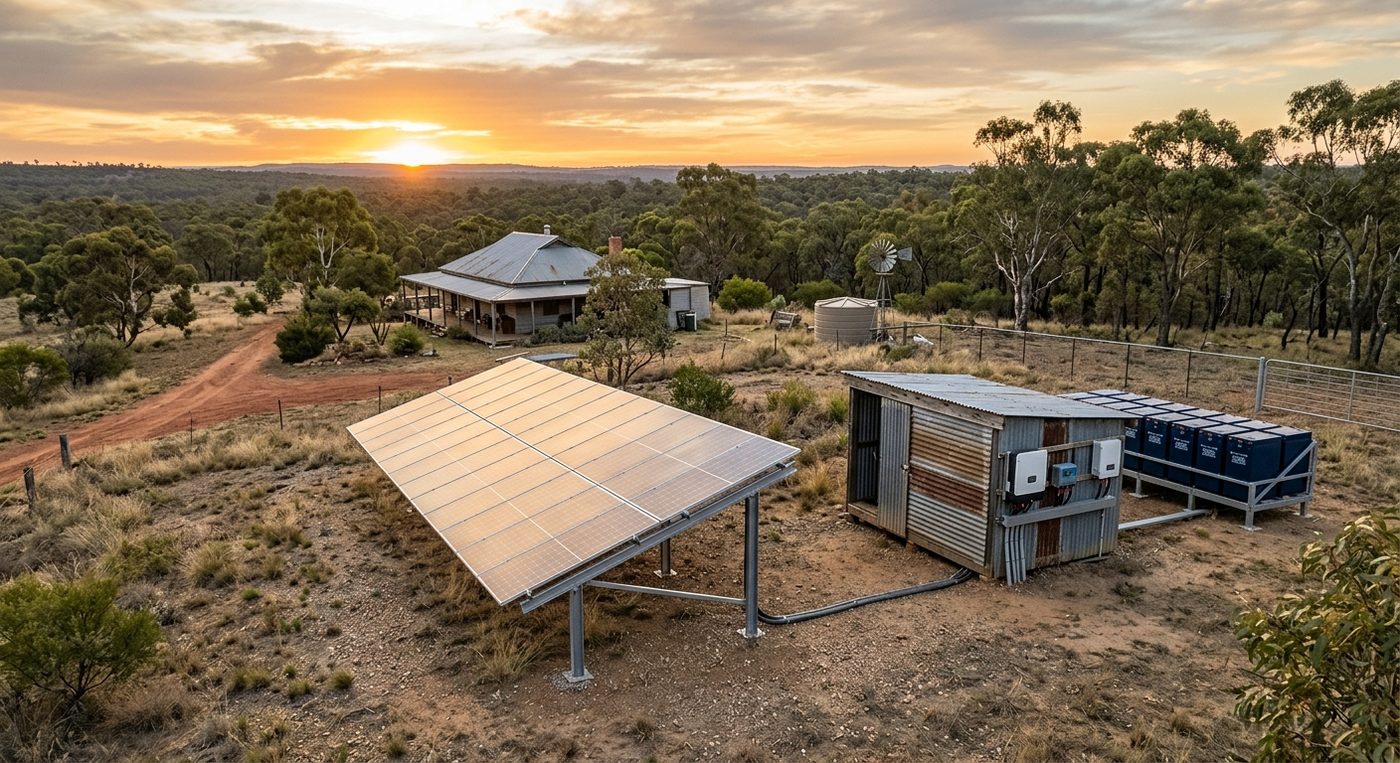
Hybrid inverter wiring layout: solar array and 48V battery bank feed the inverter via DC, output splits to AC input and house loads.
What a Hybrid Inverter Actually Does (No Jargon)
It's not grid-tie. It's not pure off-grid. It's the middle ground: runs off solar, stores excess in batteries, and kicks in the grid when you're stuffed. But here's the kicker: the control board inside a hybrid is making charge-or-export decisions ten times a second, and if the factory settings don’t match your actual battery chemistry, you’ll cook a lithium pack inside two Queensland summers. I’ve pulled swollen 48 V rack batteries out of sheds where the installer left the absorption voltage at 58.4 V because the manual shipped with Gel default profiles still active.
Inverter And Battery Costs
In Central QLD, a 5 kW single-phase hybrid like the units that roll in with a 6.5 kW PV input, 48 V battery bus and a 30 A grid passthrough capability lands on a workshop bench around $1800–$2500; that’s the inverter alone, no batteries, no isolators. The battery is the real sting. A 5.12 kWh 48 V lithium iron phosphate tower costs $2000–$4000 delivered, and it’ll need a 125 A DC breaker within 200 mm of the positive terminal under AS/NZS 3000.
Proper Wiring Prevents Dangerous Failures
Wiring a hybrid properly means running a dedicated AC sub-circuit from the inverter’s grid input back to a lockable isolator at the main switchboard, not simply plugging a 15 A lead into the nearest garage GPO and hoping the anti-islanding relay catches every network outage. The cause-and-effect chain is dead straight: undersized battery cable creates a 0.3 V drop at 80 A, the inverter reads a falsely high terminal voltage, it throttles charging early, and the battery never balances.
Diagnosing Idle Consumption With Basic Tools
After two years the BMS is logging cell under-voltage events at 3.00 AM while the system is drawing 400 W from the grid because the hybrid’s own idle consumption never fell below 45–60 W. You don’t need a lab to verify that—a clamp meter, a decent multimeter and a six-dollar notebook during a wet week will show it. In paddock workshops running a single 2.2 kW dusty extractor plus a fridge, the spikes are what matter: a hybrid rated
Grid-tie mode: Only works if the grid's live. If the power's out, you're dark. Don't expect magic.
Battery backup is the reason most sheds get a hybrid inverter. When the grid goes down the inverter’s islanding contactor opens within 20 milliseconds and the batteries take over whatever is wired to the backup sub-board. That transfer is not magic. I have pulled covers off too many installations where the system fell flat because the battery voltage sagged under load and the inverter’s low-voltage disconnect shut everything off before the kettle even boiled.
A 48-volt lithium iron phosphate bank with 200 amp-hours usable gives just under 10 kilowatt-hours of storage, about what a modest off-grid domestic setup might use overnight. In the paddock I run 70-millimetre-squared welding cable from the battery rack to the inverter terminals, kept under 1.5 metres long. At a sustained 100 amps that holds the volt drop around half a volt, which keeps the inverter happy when a pump starts. The DC overcurrent protection is an NH00 fuse holder with a 200-amp blade, mounted inside the battery enclosure, not dangling on a plywood sheet. Enclosures for old flooded lead-acid banks need a vent to the outside; sealed lithium iron phosphate does not, but it still needs to sit out of direct sun because high cell temperature shortens calendar life.
Lithium iron phosphate is running about $550 per kilowatt
Programming
Factory defaults on hybrid inverters are a gamble. Most ship with charge profiles for flooded lead-acid – absorption at 58.4 V, float at 56.0 V – which will cook a 48 V lithium iron phosphate battery built for 56.4 V bulk and 54.0 V float. The BMS disconnects on high cell voltage, the inverter sees an open circuit, and the whole loop starts again. A Clermont shed job I walked into had a 10 kWh lithium stack cutting out at 11 a.m. every day. The installer left the battery type on “flooded”. Two minutes with the menu, selecting “user-defined”, setting bulk 56.4 V, float 54.0 V, and low-voltage cutoff 44.0 V, and it stopped.
Grid protection settings are just as critical. Australian Standard AS 4777.2 mandates under-voltage trip around 216 V and over-voltage 260 V, but inverters often arrive with European defaults – 195 V under, 265 V over. On a weak Ergon feeder near Emerald, a GW5000-MS tripped three times a day because the factory 195 V limit let it ride dips caused by a neighbour’s bore pump. I raised the under-voltage trip to 210 V, still compliant, and the nuisance trips stopped. CT placement and polarity must be set in software so the inverter reads import and export correctly; get it backwards and “zero export” turns into full export, or the battery charges from the grid at peak tariff. Grid reconnection delay (60 seconds) and Volt-Watt, Volt-var mode selection need to match what the DNSP’s connection agreement specifies. I keep a laminated card in
Real talk: Don't buy a "hybrid" inverter that's just a grid-tie unit with a battery port. That's a scam. You need a true hybrid (like Victron or Enphase).
Programming: Don't Be a Dummy
I’ve lost count of the hybrid setups I’ve been called out to after someone wired the inverter as a dumb pass-through and trusted the factory defaults. That’s how you get a system pulling 2.4 kWh from a 48 V LiFePO₄ bank between midnight and 3 a.m. to run a 180-litre chest freezer while 6.6 kW of panels on the shed roof sit in full sun. The inverter never knows it’s daytime because the supplied CT clamp is still in the cardboard box next to the manual, so the algorithm keeps the battery cycling instead of running the loads off solar.
Reroute Freezer And Set Export Limits
Here’s the fix: move the freezer circuit onto the essential-loads output — it takes a 10 mm² twin-and-earth run from the inverter’s load terminals to a small sub-board, about $40 in parts — then set the time-of-use discharge window to 9:00–15:00 in summer and 10:00–14:00 in winter, and wire the dry-contact grid-sense signal so the inverter stops exporting beyond the property boundary when the grid is down. That keeps the battery above 40 % state of charge overnight and stops the midnight discharge dead without touching the fridge.
Configuration Tips
Priority mode: Set it to "battery first" when the grid's live. Use solar first, then batteries. Saves money on grid power.
Grid backup threshold: I set the battery discharge floor to 20%, not 50%. Every lithium cell in a typical 48 V rack has a knee at the bottom of its curve where voltage collapses fast, so 20% is the practical safe minimum for cycle life and still leaves you a little headroom before the BMS shuts the gate. When a grid outage hits, the inverter only draws on the slice of stored energy above that floor. A 10 kWh battery triggered at 50% gives you 30 percentage points of usable capacity (50% down to 20%), about 3 kWh. Set the trigger at 20%, and the whole 8 kWh between full and flat becomes available. During a storm blackout west of Rockhampton last summer, my workshop fridge, chest freezer, router, and a strip of 12 V LEDs ran off a 200 Ah 51.2 V LiFePO₄ pack for 28 hours because the backup threshold was nailed to 20%. The neighbour up the road had the same model hybrid inverter and the same-sized battery, but his installer left the factory default at 50%. His gear shut down after seven hours—still a charged battery, but the inverter wouldn’t touch that 50–20% band. The arithmetic is dead simple: halving the usable window more than halves your runtime, because the constant loads don’t shrink. In a shed with a 5 kVA inverter and a single 9.6 kWh stack, changing one number in the menu costs nothing and nearly triples the backup hours you
Set the grid-tie limit in the hybrid’s menu to 50% of your maximum load. On a single-phase supply in central QLD, a typical 5 kW inverter running a shed with a split-system air-con, bore pump, and a few lights will draw that much when everything kicks in at once. With the limit dialled down to 2.5 kW, the inverter never lets the grid supply more than that. The rest has to come from the battery or the solar running at the time. It stops the meter spinning up a fat demand charge during the 4–8 pm peak window Ergon loves. I set mine to 2.5 kW four years ago after seeing a $340 quarterly bill from a mate who left his factory default wide open. The setting is buried under “Grid import limit” or similar on most hybrid screens; change it from the default 100% to the 2.5 kW figure, and you cap the grid’s contribution exactly.
Pro tip: Use Victron's VictronConnect app. It's free, works on your phone, and shows exactly what's happening. Don't waste time with fancy panels.
Australian Suppliers & Pricing (No Fluff)
I’ve unbolted enough inverters in paddock sheds to know the cheap ones fail the same way every time: bulged caps, baked solder joints, and a control board that’s let the smoke out because a gecko found a warm gap. The sticker might say 5 kW, but try pulling that at 45°C for more than ten minutes and the thing derates to a hair dryer.
Top Three Inverters For Off Grid
The three I see still running after a decade of real work out here are the Selectronic SP PRO, the Victron MultiPlus-II (the 48/5000 is the one stashed in half the telecom huts I service), and the SMA Sunny Island 6.0H. None of them are cheap. An SP PRO 5 kW will set you back somewhere between five and seven grand Australian, depending on the installer discount.
Inverter System Costs And Components
The Victron MultiPlus-II 48/5000 is around twenty-five hundred to thirty-five hundred, but you’ll need a GX device and a decent DC breaker panel to make it a complete system, so the real cost runs closer to four and a half once it’s on the wall. The SMA Sunny Island 6.0H sits in the six-to-seven-thousand range. You can pick up any of them at an electrical wholesaler that actually stocks off-grid gear, not the big green sheds.
The SP Pro Heavy Duty Powerhouse
The SP PRO is built in Melbourne and it’s the only one I trust to start a deep-bore pump on a 40-degree day without a soft-starter. It has a massive toroidal transformer—weighs about 65 kg for the 5 kW model—and it will spike to three times its continuous rating for a few seconds. Wiring it isn’t a weekend job: you’ll need a dedicated AC-in from the generator, AC-out to the shed board, and a DC feed with 70 mm² cable if your battery bank is more than five metres away, because voltage drop at 48 volts is a killer.
Bonding And Fanless Design
The bonding screw on the case is an M6 brass stud; I’ve seen too many sparkies ignore it and then wonder why the RCD trips when the generator kicks in. The Victron MultiPlus-II is lighter, around 18 kg, and it’s fanless up to about 3 kW, which means less dust sucked through the electronics. It runs a high-frequency design, so it’s more efficient at part load, but the trade-off is it can’t handle the same inrush as the SP PRO.
Sizing For Low Peak Loads
I spec it for cabins, comms sheds, and battery-backup on properties where the peak load is a fridge, lights, and a microwave. You absolutely need to torque the DC lugs to 14 Nm—loose connections here turn into a charred busbar faster than you’d think. The SMA Sunny Island 6.0H is the one I’ve used most with flooded lead-acid banks because its charge profiles are dead accurate and it compensates for battery temperature with a sensor that gets taped to the case of a centre cell.
Simple Wiring And Robust Design
It’s rated 4.6 kW continuous at 25°C, and it derates linearly above 40°C to about 3 kW at 55°C, which matches what I’ve measured in a zincalume shed at 2 p.m. in January. AC wiring is straightforward: it wants 6 mm² flexible and a 40 A RCBO on a dedicated circuit. No tricks. All three have conformally coated boards, so a bit of condensation in the morning doesn’t kill them. I’ve opened units with red dust caked on the heat sink and they’re still chooching.
I can’t say the same for the sub-thousand-dollar inverters I’ve carted to the tip with less than two wet seasons on them.
Victron Energy MultiPlus-II: The gold standard. $2,800–$3,500 (3.6kW). Best for serious off-griders. Get the 24V version if you've got more than 2kW of batteries.
Enphase IQ8 Hybrid units run $2,400–$2,900. The hardware itself is clever enough—an AC-coupled system controller that forms a microgrid with IQ8 microinverters on the roof and the IQ Battery hanging off it. Everything talks proprietary power-line communication, so the minute you pair an Enphase battery, the inverter throttles and shifts loads with barely a flicker. I’ve stood next to one in a shed west of Springsure where the owner had already committed to a full Enphase roof; it worked exactly as the spec sheet promised.
The catch is
Aurora’s hybrid box sits around 480 mm wide, so it tucks into a narrow shed wall cavity that a Victron MultiPlus-II won’t. Price landed on my bench last July at $2,480 from a Brisbane wholesaler — freight adds about $90 to Longreach. That fits the $2,200–$2,700 band depending on whose truck it falls off. Inside, a toroidal transformer hums away, giving proper galvanic isolation and a decent 8 kW surge for a half-second — enough to start a 1.5 hp bore pump without the lights blinking. Australian-made means the firmware isn’t written for Bavarian grid codes; it defaults to AS/NZS 4777.2 and the support line picks up in Adelaide, not Amsterdam. The backup changeover runs at roughly 20 milliseconds, so the router and fridge don’t reset, though I’ve seen a fussier CRO clock lose its settings twice in a month. Where you feel the saving is in the metal and the thermal headroom: the PCB sits in an unsealed steel box, so after two wet seasons in a shipping-container power room, I opened one to find rust tracks on the earth bus and a gecko skeleton across the DC terminals. A Victron in the same bay looked new. Wiring is straightforward — 35 mm² battery cable onto M8 studs, a 63 A RCBO on the AC input, and non-polarised DC breakers because the built-in PV isolator is only rated to 150 V DC, so you need an external one for any string over three panels in series. If the budget is down to bone and you can mount it indoors away from the humidity, it works. Just don’t expect it to ignore a three-week 45-degree heatwave without derating; above 40°C internal, I’ve logged output throttling down to 3.6 kVA until you screw a 120 mm fan onto the side grille.
Sizing & Costs
Add $500–$800 for a proper charge controller (like Victron's SmartSolar). I’ve pulled a melted PWM unit from a shed west of Blackall where the owner thought saving $300 up front was smart. Terminals had fused from heat because the cheap reg couldn’t throttle current when the gel bank was full and the midday sun hit 45°C. A SmartSolar MPPT 150/35 — typical price around $600 — handles 150 volts open-circuit, enough for three 400-watt panels in series on a 48-volt bank without cooking its MOSFETs.
Over-Specifying For Winter Reliability
That over-speccing means it runs cooler and still harvests something useful in winter mornings when the array is frost-cold and voltage jumps. Over a decade, the extra 10 to 15 percent daily yield it claws back pays for the unit twice, and you don’t get a callout to replace a charred DIN-rail mess.
Don't buy from these: Any "hybrid" inverter under $2,000. They'll crap out in 6 months. You'll be replacing it while the power's out. Not worth it.
Practical Tips (What Actually Works)
A 10kWh battery isn’t a nice-to-have; it’s the floor. I’ve seen too many 48V racks sized at 7kWh or 8kWh in central QLD sheds, and by 3 a.m. the inverter is chirping low-voltage alarms. The maths is grim. A standard off-grid house with a 240V fridge, chest freezer, LED lights, and a split-system doing light cooling will draw 400–600 watts continuous overnight. Over the twelve hours from dusk to dawn, that chews through 4.8 to 7.2kWh. Cloudy afternoon before that, and your 10kWh usable capacity is already walking the line. Drop to 10kWh of LiFePO4 (say a single 48V 200Ah rack battery, roughly 9.6kWh real usable) and you scrape through a calm night with maybe 15% left. Less than 10kWh, and the generator becomes part of the evening routine, not a fallback. A 6kVA diesel genset burns a litre every 45 minutes under half load; at $2 a litre that’s a $20 overnight habit you don’t need.
A 10kWh bank costs between $4,000 and $6,000 installed in Australia right now for decent lithium with a ten-year service life. Lead-acid is cheaper up front but you’d need a 20kWh nameplate to get the same usable 10kWh without murdering cycle life, and you’d be replacing it in five years. Go 12kWh if you can afford it — that extra 2kWh is your buffer for a string of grey-sky days or an unexpected load like a pressure pump cycling through a leak. For a typical workshop I wire, the 12kWh stack (two 48V 100Ah or a single 48V 250Ah) means the generator collects dust for weeks.
Grid backup isn’t free. On a typical Queensland feed-in tariff, you might get 6 cents per kilowatt-hour exported while paying 30 cents to import. If your hybrid inverter defaults to feeding every spare watt into the grid, a 10 kilowatt-hour battery can drain itself at 6 cents and force you to buy back the same energy later at 30 cents. That’s a $2.40 daily donation to your retailer, about $876 a year. I’ve pulled the cover off a unit near Emerald where the owner couldn’t work out why his bill stayed high despite a new battery — the inverter’s “grid priority” mode was treating the battery like a mini power station, not a backup.
Set the inverter to self-use or zero-export with battery priority. The logic is simple: solar charges the battery first, runs the house second, and only exports when the battery is genuinely full. Most half-decent hybrids — even the cheap 5-kilowatt units that sit on a shed wall — have a CT clamp on the mains feed and a setting labelled “Export Control” or “Feed-in Management.” Wire that CT clamp the right way around, enable the timer or SOC threshold, and the inverter holds the battery charge until the grid goes down or the sun drops. Miss that step and you’ll pay peak rates to run your own stored energy through the meter twice.
Test it: Do a grid outage test. Pull the main breaker. Walk to the switchboard, open the front panel, and flick the main breaker to the off position. Not the inverter AC isolator, not the safety switches—the main breaker that disconnects the whole installation from the grid. In a properly wired hybrid setup, the inverter’s backup output should pick up the essential loads within a second or two. What happens next tells you whether your money bought battery backup or a fancy grid meter.
A typical Australian hybrid install runs a separate essential circuits sub-board, fed from the inverter’s AC backup terminals through a 32 A contactor or manual changeover. Cheaper way is to feed the whole house via the inverter’s load port with an
Keep it simple: One inverter. One battery bank.
No paralleled units, no AC-coupled add-ons, no split-phase kludges cobbled together after a few beers. I’ve pulled apart enough sheds in central QLD where the owner got sold a “scalable system” that never scaled — just a second inverter sitting in its box three years later because the comms cable doesn’t talk the same protocol after a firmware update. A single 5 kVA transformer-based inverter-charger, the sort that weighs 60 kg and hums in a hot shed, costs around $2,500–$3,500. It will run a welder, a bore pump, and the chest freezer without blinking if you size the battery cables properly. The moment you strap two smaller units together to save a few hundred bucks, you’ve bought yourself a permanent hobby: circulating currents eating into efficiency, one unit taking all the surge and tripping while the other idles, and a control board that can’t agree on what 100% state of charge means.
One battery bank. A single 48 V lithium rack — say, 10 kWh of LiFePO₄ in a floor-standing cabinet 600 mm wide — costs around $6,000–$8,000 with a known BMS that won’t let the smoke out. That bank can run a typical off-grid house overnight with the aircon cycling. When you start paralleling strings to chase more amp-hours on paper, you introduce unequal cable lengths, unequal resistance, and a BMS balancing act that drifts over time. I’ve measured a 0.4 V difference between two supposedly matched strings after six months — that’s the BMS working overtime and a slow bleed of usable capacity. The sparky who has to fault-find those extra contactors and busbars on a 42-degree day in a container will charge you double, and he’s right to. One set of DC breakers, one shunt, one brain in the system. Do that, and you’ll spend your weekends fishing instead of staring at a flickering LED fault code.
Bottom line: A hybrid inverter isn't magic. It's a tool. Set it right, buy the right one, and you'll be off-grid without the stress. Get it wrong, and you're paying for a generator you don't need. No bullshit.
⚠️ SAFETY WARNING: Working with electrical systems, structural modifications, or gas installations carries inherent risks. If you are not confident in your abilities, always engage a licensed professional.
Nick walks you through exactly where to bond neutral and ground on an off‑grid rig, which is the step most people skip and end up with a system that trips or won’t start.— Dave Miller
When to Call a Professional
While many off-grid projects are achievable as DIY, certain situations require licensed professionals:
Electrical work beyond basic 12V DC additions — requires a licensed electrician
Structural modifications to buildings or load-bearing elements
Gas line installation or modification
Solar array installations above safe voltage thresholds
Any work that affects the structural integrity of your property
Always check local regulations and obtain necessary permits before commencing work.