Ham Radio License Australia: $150 Off-Grid Gear (2026)
By Rob Kavanagh· ex-telco tech · connectivity, comms and keeping remote places reachable
“After my first 40m SSB transmission failed at 300km from the nearest tower, I learned that a ham license is the only insurance policy for true off-grid isolation.”
Forget the internet. Forget cell towers. If you're off-grid in Australia, ham radio is your lifeline. No subscriptions. No fees. Just you, your radio, and the sky. But first: you need the license. Here's how it works.
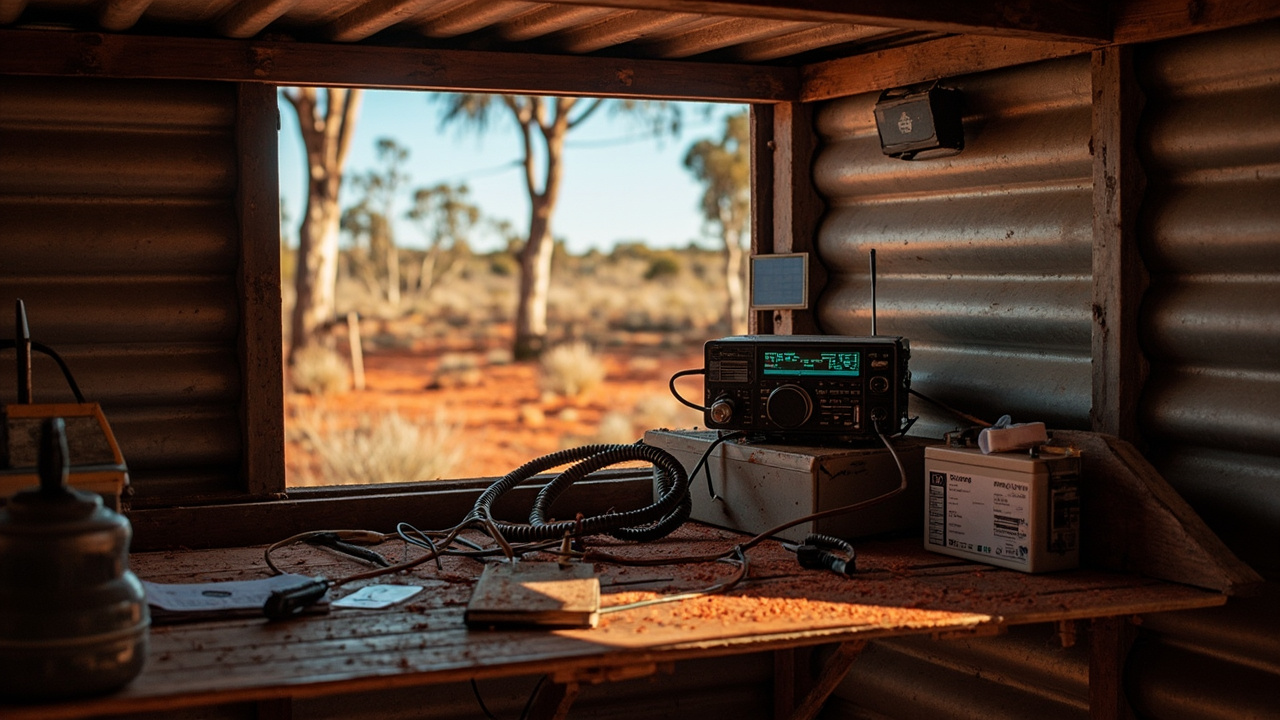
Component breakdown of a $150 starter ham station for Australian off-grid use.
Australian Licensing: No Bullshit
ACMA (Australian Communications and Media Authority) runs this. You don't need a "ham license" – you need an Amateur Radio Operator License. The old "Foundation/Advanced" system is dead. Only two paths now:
Foundation License: $50 fee. Limited to VHF/UHF (no HF). Useless for off-grid. Skip it.
Amateur Radio Operator License: $50 fee. Full HF access. This is the only one you need. Pass the exam.
Key fact: You must pass the exam to get the license. No exceptions. ACMA won't give it to you on a whim.
Exam Prep: How to Actually Pass
It's a 25-question multiple-choice test. 70% pass mark (18/25). No Morse code. Just radio theory and regulations. Here's the brutal truth:
Hands working through amateur radio exam study materials
Step 1: Get the Study Material
Wireless Institute of Australia (WIA) is the only approved source. Their Amateur Radio Handbook is essential. Cost: $35 (paper) or $20 (ebook). Buy it. No alternatives.
Step 2: Practice Like Your Off-Grid Life Depends On It
WIA sells practice exams ($15). Do all 10. If you fail the first one, you're not ready. Repeat until you score 90%+.
Step 3: Book the Exam
WIA members get exam slots. Membership: $50/year. Total cost: $100 (membership + exam). Book via wia.org.au. Wait times: 2-4 weeks. Don't procrastinate.
Real talk: The exam is easy if you study. It's not a trick question. If you can't pass it after 10 practice tests, you're not studying hard enough.
Radio choice: Icom IC-7300 ($1,600) or Yaesu FT-991A ($1,100). Both run on 12V. Avoid anything over $2,000. You're off-grid, not rich.
Antenna: A simple dipole ($50 materials) for HF. Mount it high. No fancy towers. Just wire and two trees.
Power: 100W solar panel + 200Ah battery. Runs a radio for 12+ hours. Budget: $800-$1,200.
Priority: HF radio (3-30MHz) for long range. VHF (144MHz) only for local. HF is non-negotiable for off-grid.
Australian Suppliers & Pricing (indicative prices)
Stick to these. No overseas scams.
Study materials: WIA (wia.org.au) – $35 handbook, $15 practice tests.
Radio:
Icom IC-7300: $1,600 (Ham Radio Australia)
Yaesu FT-991A: $1,100 (Ham Radio Australia)
Used IC-7300: $1,200 (TradeMe)
Antenna:
Dipole kit: $120 (Ham Radio Australia)
10m wire + insulators: $50 (Bunnings)
Power:
100W solar panel: $350 (Solar Wholesale)
200Ah battery: $600 (Battery World)
Don't waste money: Skip "all-in-one" rigs. Get a used radio, a dipole, and a solar panel. Total under $2,500. That's your off-grid ham setup.
⚠️ SAFETY WARNING: Working with electrical systems, structural modifications, or gas installations carries inherent risks. If you are not confident in your abilities, always engage a licensed professional.
The video walks through building a cheap LoRa‑based mesh network with Meshtastic firmware, showing exactly how to send texts without a licence – that's the kind of concrete, licence‑free option the guide says is missing from the usual ham‑radio talk.— Rob Kavanagh
When to Call a Professional
While many off-grid projects are achievable as DIY, certain situations require licensed professionals:
Electrical work beyond basic 12V DC additions — requires a licensed electrician
Structural modifications to buildings or load-bearing elements
Gas line installation or modification
Solar array installations above safe voltage thresholds
Any work that affects the structural integrity of your property
Always check local regulations and obtain necessary permits before commencing work.