By Rob Kavanagh · ex-telco tech · connectivity, comms and keeping remote places reachable
“After 17 years keeping remote towers on the air, I learned the only network you can truly count on when it matters is the one you own outright.”
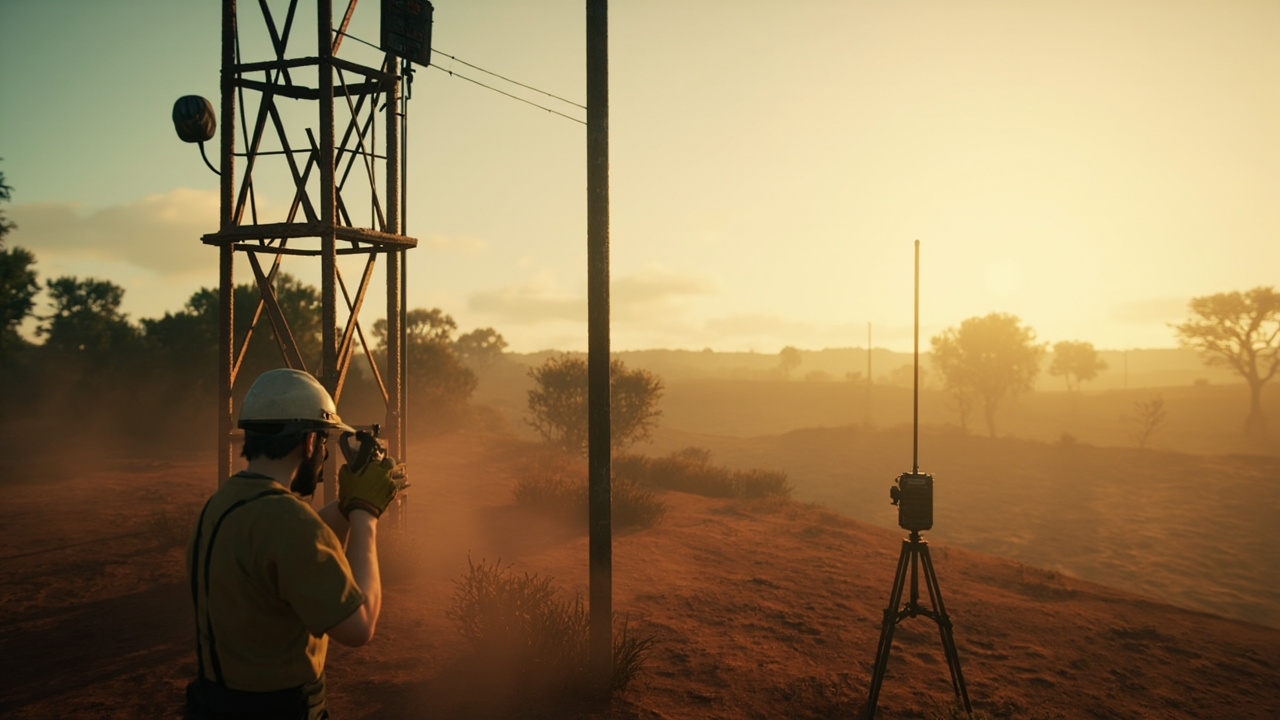
I spent years keeping Telstra’s remote towers on the air, so I know exactly how quiet it gets when the fibre cut hits and the backup generator runs out of diesel. If you live more than a tow rope away from the local pub, you need a comms layer that doesn’t rely on someone else’s tower.
By Rob Kavanagh · ex-telco tech · connectivity, comms and keeping remote places reachable
“After 17 years keeping remote towers on the air, I learned the only network you can truly count on when it matters is the one you own outright.”
I spent years keeping Telstra’s remote towers on the air, so I know exactly how quiet it gets when the fibre cut hits and the backup generator runs out of diesel. If you live more than a tow rope away from the local pub, you need a comms layer that doesn’t rely on someone else’s tower. That layer is amateur radio, and it’s far simpler to get into than most people think.
Quick answers
Picture February, western Queensland. You’re 140 km from the nearest sealed road. Your Telstra 3G dongle showed two bars this morning. Now it shows “No Service.” The property’s NBN Sky Muster terminal went offline after a lightning hit fried the indoor unit. You’ve got a sick kid and the RFDS needs a callback to confirm coordinates. The landline is VoIP now, so dead. Your UHF CB handheld can’t hit the cattle property 45 km away because the ridge is in the way. If that scenario leaves you high and dry, you need amateur radio.
Amateur radio, or ham radio, puts you on the air without a third-party network between you and the person you need to reach. You can talk voice, pass data, even send email over HF without a single meter of Telstra, Optus, or NBN fibre. I’ve seen stations running off 120-watt solar panels and a deep-cycle battery hold a schedule for years. No monthly bill, no tower rent, no SIM card.
Better, the national WICEN (Wireless Institute Civil Emergency Network) net runs regular skeds that remote stations can check into. During the Black Summer fires, volunteer amateur operators carried traffic when the mobile towers melted. If your off-grid internet plan looks like a single USB lead to a dodgy antenna on the roof, ham radio is the backup that becomes your primary.
Australia uses three licence grades under the ACMA amateur class-licence system. All three let you talk voice. The difference is principally your transmit power, the bands you can use, and what you’re allowed to build or modify yourself.
This is the entry-level ticket. Transmit power is capped at 10 watts PEP on most bands. You get access to limited segments of the amateur MF, HF, VHF, and UHF bands — enough to work local 2-metre repeaters, the 40- and 80-metre HF bands during daylight and dark, and a few UHF windows. You can use voice and a small set of digital modes (your paper log must still record callsigns). You can operate commercially built, unmodified transceivers, but you can’t build a transmitter from a kit or open the case to do more than connect an antenna.
Perfect for someone who wants reliable NVIS (near-vertical incidence skywave) coverage within 300–400 km around their property, or local UHF chatter to the neighbours.
Cost: $0 for the licence itself. The exam fee is typically $70–$100 (assessors set their own charge; budget $90). The practical assessment is included in that fee at most clubs.
Standard bumps your power to 100 watts PEP, gives you more HF bands plus wider segments on existing bands, and lets you use all amateur digital modes. You can also build and modify equipment, though a little less freely than an Advanced holder. Practically, 100 watts is enough to work most of eastern Australia on 40 metres during the day and switch to 80 metres at night. You can access the WARC bands (30, 17, 12 metres) and 20 metres, which opens reliable long-haul paths into New Zealand, the Pacific, and sometimes the US without needing a kilowatt.
I recommend Standard for anyone whose property sits in a hollow and needs big-gun HF to get over the ranges.
Advanced gives you everything: 400 watts PEP, all amateur bands, all modes, full design-and-build privileges, and access to weak-signal microwave operations if you want to go that deep. You also need Advanced to hold a repeater licence or install a beacon. If you end up the informal comms person for your area, Advanced is the long-term destination. The exam is obviously longer, but the theory isn’t magic — it’s the same physics your year-10 science teacher covered.
None of the grades have a Morse code requirement anymore. That went the way of the dial-up modem in 2004.
The ACMA delegates practical testing and theory exams to accredited assessors. You’ll find a list of current assessors on the ACMA website, or you can walk into your nearest amateur radio club and ask when the next exam session runs. Clubs are listed at the Wireless Institute of Australia (WIA) site.
1. Pick your grade and grab the syllabus
Download the syllabus from the ACMA or WIA website. The Foundation syllabus is 24 pages, printed on A4; Standard and Advanced each have separate theory documents. Read the “what you must know” bullets. They aren’t suggestions.
2. Study
Foundation: 12–20 hours of focused study if you’re technically literate. A few weekends.
Standard: another 20–30 hours on top of that.
Advanced: a solid 40-plus hours of additional work.
There are practice question banks available for free. The excellent “Radio and Electronics School” (res.net.au) and the WIA’s video course will walk you through everything from Ohms Law to feed-line loss. I know blokes who crammed Foundation in a weekend and sat the exam Monday night. The pass mark is 70% for Foundation, 70% for Standard, and 65% for Advanced.
3. Book the exam
Contact an assessor and book a spot. Exams are held in clubrooms, community centres, libraries, and occasionally online with proctoring. Expect to pay around $90 for Foundation; Standard and Advanced are often around the same, sometimes a touch more. At time of writing, the WIA member price for a Foundation exam through some clubs is $75; non-members might pay $95. That is the primary cost — the ACMA doesn’t charge an annual licence fee, just the exam.
4. Sit the theory exam
Foundation: 25 multiple-choice questions and a short practical demonstration (tune a radio, make a call, log it).
Standard: 50 multiple-choice questions, no practical.
Advanced: 50 multiple-choice questions, no practical.
You need photo ID and a pulse. Most people finish inside an hour.
5. Get your callsign
The assessor lodges a successful result with the ACMA. You’ll receive a recommendation certificate. You then request a callsign through the ACMA’s online portal — free, and typically issued within five business days. Base callsigns are VK# prefix (VK2, VK4, etc.) plus a two- or three-letter suffix, depending on licence grade.
6. Go on air
Start with a battery check a week before a forecast storm and you’ll never look back.
Buy the radio that fits how you’ll actually use it. I’ve seen a shed full of expensive boxes that never got turned on because they were too fiddly for a morning sched.
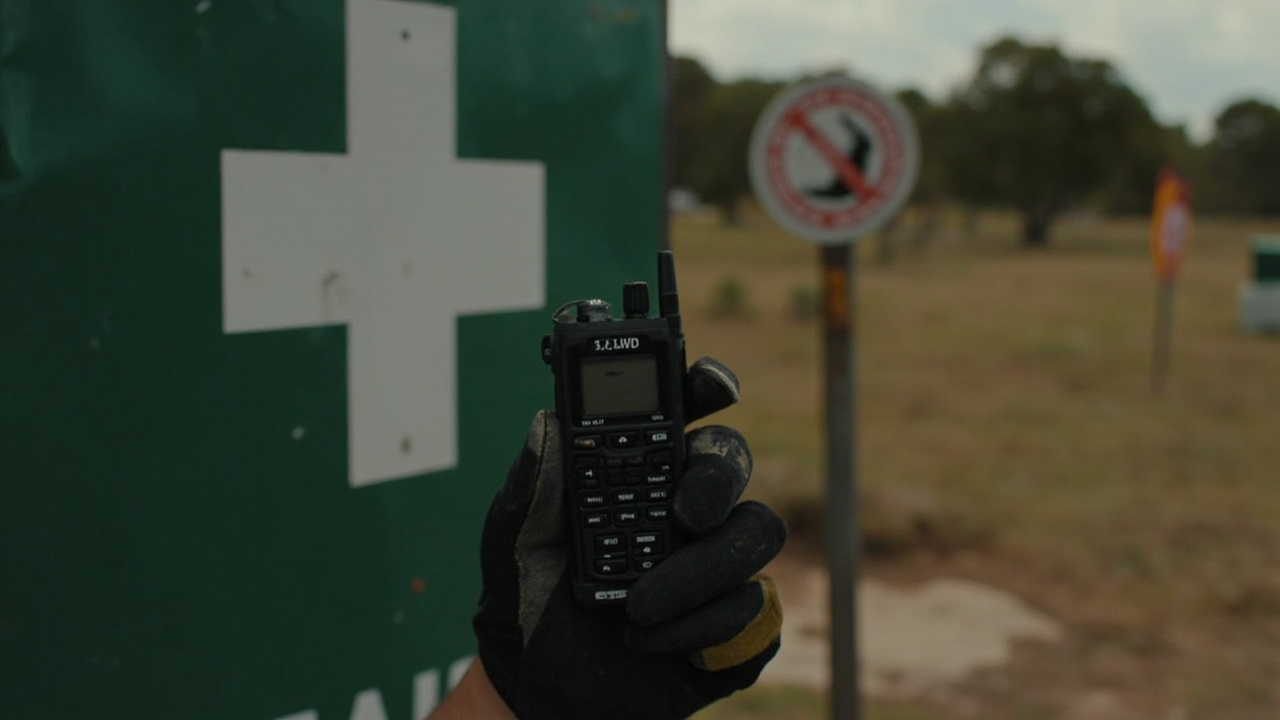
A 5-watt dual-band (VHF/UHF) handheld costs about $150–250. The Yaesu FT-65R (~$170, most two-way radio shops) is hard to beat. It’s IP54 rated, receives broadcast FM and air band, and the battery lasts a day of casual listening. Add a mag-mount antenna on the ute roof ($50–$80) and you’ll reliably hit a repeater 50 km away.
Handheld range simplex, rubber-duck antenna, from the kitchen verandah: 2–8 km, depending on trees and kinks in the terrain. If the country is dead flat, you might push 15 km. Don’t expect mobile-phone-grade coverage; think two-way radio.
For anything more than a chat with the neighbour, put in a base station. A 50-watt VHF/UHF mobile radio (like the Icom IC-2730A, $350–$450) powered by a 12-volt solar array, feeding a colinear antenna on a 6-metre mast, becomes your local area repeater access point. Simplex range to another similar station on a hill hits 80 km reliably.
For HF, the workhorse is a 100-watt all-mode transceiver. The Icom IC-7300 runs about $1,700–$1,900 new and gives you a spectrum scope that makes finding clear frequencies simple. Second-hand Yaesu FT-857D rigs, if you can find them, sell for $600–$800. Add a simple wire dipole cut for 40 metres (cost: ~$40 of copper flex and a plastic insulator from Bunnings at time of writing) and you’ll talk across the state. An auto ATU (antenna tuner) adds $300–$500 and is worth every cent if your wire is anything but a perfect dipole.
Pair that with an old laptop running FLDIGI or Winlink, and you now have email over HF. I’ve sent position reports from a gully where my mobile phone was a brick.
Simplex means radio-to-radio on a single frequency. It’s free, it’s instant, and it works while your solar keeps the battery charged. For two stations with 5 metres of height above ground, the radio horizon is about 8 km. Raise one antenna to 10 metres and you gain another 5–6 km. Add 50 watts and a beam antenna on a hill and 150 km simplex is possible on VHF, but that’s the exception.
Repeaters are radios sitting on high points (mountain tops, tower sites, grain silos) that listen on one frequency and re-transmit on another simultaneously. The amateur 2-metre band (144–148 MHz) and 70-centimetre band (430–450 MHz) host dozens of linked repeaters in regional Australia. Programs like “AllStarLink” and “IRLP” connect repeaters to the internet, which means a bloke with a $150 handheld on a station in the Pilbara can talk to a station in Melbourne via a repeater that happens to be linked that morning. There’s no cost, just a tone burst or CTCSS tone that your radio can be set to send automatically.
For the off-grid property, the practical move is to program your local amateur repeaters and keep a printed list in the radio case. The WIA keeps a repeater list by state. I’ve seen remote repeaters powered by solar panels and a couple of car batteries that have run for a decade without a visit. When the NBN and mobile go dark, those repeaters often stay lit.
Unlicensed transmission on amateur bands is something the ACMA tracks, especially when it interferes with aeronautical or emergency services. The maximum penalty for an individual is 2 years imprisonment or a fine of up to $27,500, or both. Do not be the person who buys a Baofeng off eBay and starts calling “CQ” on the rural fire service input frequency.
Listening is free and legal. You can buy a scanner or an SDR dongle ($50–$70) and monitor amateur bands, aviation, weather fax, whatever. No licence needed. This is how most of us got started.
Emergencies: The Radiocommunications Act (section 49) says you may use any station or device, without holding a licence, to communicate where the safety of human life is involved and no other form of communication is reasonably available. That is not a free pass to keep a radio in the glovebox “just in case” and key up on the local police channel when you get a flat tyre. The ACMA expects that you make all reasonable attempts to use licenced services first.
If you genuinely need to call an RFDS landing strip change or report a life-threatening bushfire and you have no other way, use the radio, give your location, and explain it’s an unlicenced emergency transmission. Document it afterwards. No one will fine you for saving a life, but they will if you spent Wednesday afternoon chatting about the footy without a callsign.
Amateur radio and commercial content: You cannot broadcast music, sell cattle, advertise your stock feed business, or encrypt communications on amateur bands. It’s a two-way hobby service with a strict non-commercial purpose. When in doubt, imagine a prickly ACMA inspector living in your radio room.
Equipment compliance: Transmitters must meet Australian standards. Importing a hand-held that can also transmit on non-amateur frequencies (like the local police band) is asking for trouble unless the radio is locked to amateur allocations by a qualified person. Buy from local suppliers who’ve done the lock-down, or stick to a model that is type-approved.
While many off-grid projects are achievable as DIY, certain situations require licensed professionals:
Always check local regulations and obtain necessary permits before commencing work.
Worth a watch: EASY Start: Parks On The Air! #POTA · Ham Radio Crash Course
You sit an exam through ACMA, and the article walks through the whole process step by step. There are three licence grades, so pick the one that actually matches how you plan to use the radio rather than the fanciest one on offer. Don't skip the study - the legal gotchas section spells out why transmitting without the right licence is a serious problem.
Australia does have emergency provisions that let unlicensed people call for help on radio when lives are at stake, but that's the only exception. The article is clear that for normal use you need to be properly licensed through ACMA. Get your licence sorted well before the tower dies, not after.
Depends what you're doing. Handhelds run off batteries and are grab-and-go, which is handy when the power's out. Base stations reach further but need a proper setup with antennas and mains or solar. The article walks through both, and I'd lean toward starting with a handheld you can throw in the ute.
That's the whole point. When the Telstra tower goes quiet, ham radio keeps working radio-to-radio with nothing in the middle. Repeaters can extend your range but they rely on infrastructure that might be compromised in a crisis. Simplex is often the most reliable option for remote properties - test the link before you trust it.