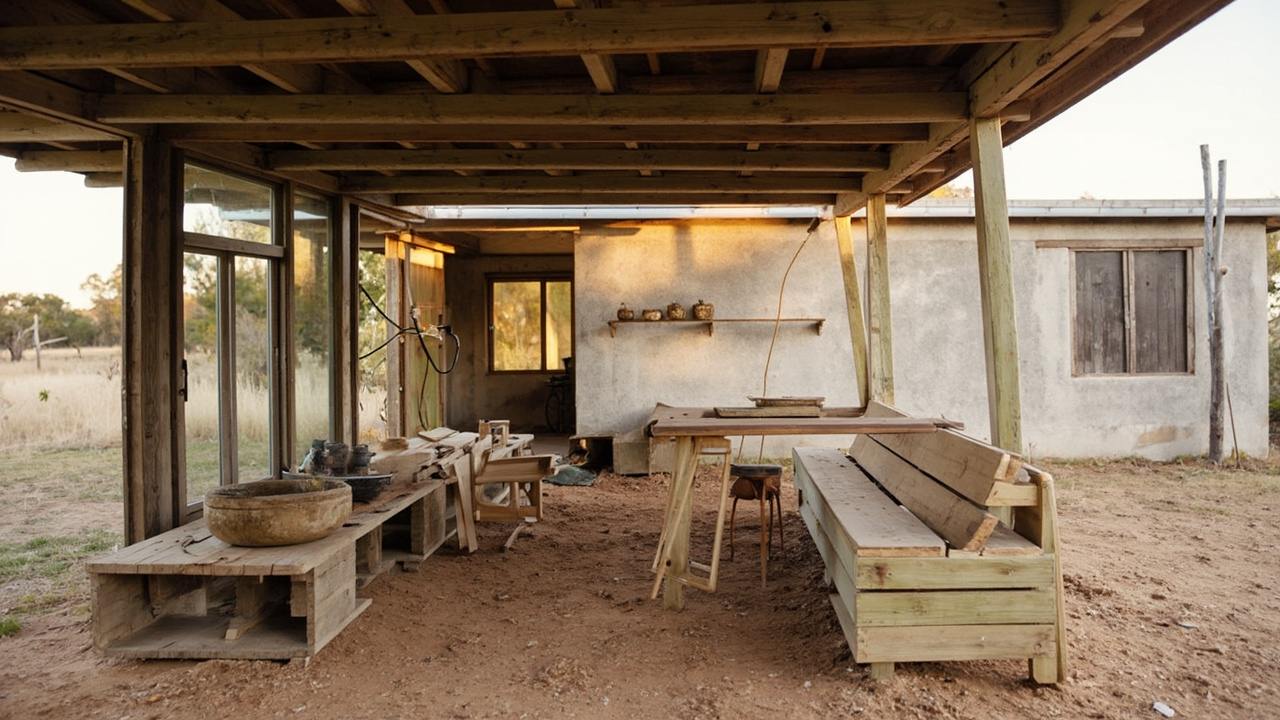

By Mick O'Brien · carpenter & builder · sheds-to-homes, cabins and things that stay up in a storm I build furniture the way I frame a bush pole shed: over-engineered, from what’s to hand, and finished before the next southerly buster hits. In my paddock workshop outside Braidwood, a workbench starts with 200x50mm recycled ironbark sleepers picked up from a demolition yard in Queanbeyan for $8 a lineal metre. You lose a circular saw blade per three metres, but the weight stops the bench walking when you’re planing spotted gum.
Off-grid means no thicknesser whining for an hour; I use a Stanley No. 7 jointer plane, secondhand for $120 at the Bungendore markets, and a couple of winding sticks ripped from a pallet. For knockdown joinery that won’t loosen after a summer of dust and a winter of condensation, I bolt legs with M12 galvanised cuphead bolts through 19mm ply gussets – the ply offcuts from a Bunnings 2400x1200 sheet of 17mm F17 formply, which ran me $62 last month.
Glue is crosslinked PVA, Titebond III, because standard Aquadhere re-emulsifies in the humidity you get inside a shipping container studio when the morning fog sits in the valley. Sanding is by hand with 80 grit Hermes cloth-backed paper cut from a roll; a 50-metre roll costs $110 and lasts longer than three boxes of discs in a random orbital that drains the batteries. Once the frame is together, I flood the end grain with boiled linseed oil thinned 50/50 with mineral turpentine, then wax with a block of beeswax from a local apiarist at $15 a bar.
The finish feels warm in winter and doesn’t off-gas when the wood stove brings the room to 30 degrees. This is furniture that handles a dirt floor then moves to a polished slab without apology.
Lost three benches off the shearing-shed veranda in one August westerly. The 12mm galvanised bolts holding the jarrah slab frames to the posts sheared clean at the nuts — not pulled out, snapped. Cost me about $140 in timber and a full day’s labour. I’d simply driven the posts into paddock dirt and called it good. After that, every outdoor bench gets bolted to a concrete pad. A $9 bag of Rapid Set from the local hardware, poured into a 200mm-deep hole with a galvanised stirrup cast in place, gives you a 20 kg anchor that wind can’t lift. I run a 12mm Dynabolt through the stirrup into the bench leg now. No more airborne seating.
Cut a 90×45mm structural pine leg too short by 4mm and the whole carcass racks. That’s the difference between a table that ends up as firewood and one your grandkids fight over. I build off-grid furniture the same way I frame a shed in cyclone country: over-engineer the joinery, use timber that can handle a dew point of 18°C without blowing apart, and never trust a butt joint where a housed mortise-and-tenon will do the job.
In my paddock workshop outside Mudgee, a hot dry summer day can push internal shed temperatures past 45°C, then a cool change drops it 20 degrees in an hour. The boards move. If you haven’t allowed for seasonal expansion across a 600mm-wide benchtop — that’s roughly 6mm of movement in radiata pine from green to equilibrium — you’ll hear the glue line crack at 3am like a rifle shot. Radiata pine is the cheapest framing stock at the big green shed: a 2.4m length of 90×45 MGP10 costs around $9.50. It twists if you look at it sideways.
I pick through the pallet for quartersawn grain and store it stickered under a lean-to for a minimum of six weeks in the same moisture environment where the finished piece will live. For tabletops that will see wet crockery, I use 19mm marine-grade hoop pine ply, $110 a sheet at a Brisbane ply wholesaler, sealed with three coats of water-cured polyurethane that costs $48 a litre. Every coat gets a light scuff with 240-grit, the dust wiped off with a tack rag, no exceptions.
The finish cures hard enough that a spilled billy of tea just beads up, and the UV inhibitors stop the honey colour turning to grey ash inside two summers. Leg-to-rail connections get a 12mm hardwood dowel through a draw-bored tenon. I’ve pulled apart enough roadside chipboard carcasses to know that a 50mm chipboard screw into end-grain has about 30% of the holding power of a cross-grain mechanical lock. A single 12mm Titebond III glued dowel in spotted gum will carry a shear load of nearly 600kg before the timber fibres tear out.
That’s not a guess — it’s the standard engineering value for a Janka 11kN hardwood in single shear. So a four-leg table with two dowels per joint won’t rack when a 100kg bloke stands on it to change a light bulb. I buy 12mm fluted beech dowels in bulk, $18 for a bag of 100. The fluting lets the glue travel the full length of the hole instead of hydrolocking at the bottom and blowing out the back of the stile when you hammer it home. Drawers are the graveyard of good intentions.
The quick way is 12mm ply tacked with brads and a plastic runner — that lasts about two wet seasons before the bottom sags and the runner strips its screws. I build drawer boxes from 15mm birch ply, full-extension soft-close runners rated to 45kg, $22 a pair if you buy a carton of ten from a cabinetmaking supplier in Toowoomba. The front gets a 5mm shadow line and a pair of solid brass cup pulls, $6 each, that won’t pit with condensation.
I cut the dovetails by hand with a Veritas 1:8 template and a Japanese pullsaw, because jigs take more time to set up than the ten drawers in a kitchen dresser I’m already building. The half-blind dovetail on the drawer front locks in both directions; a routed slot-and-tab system doesn’t. I’ve fixed enough farmhouse dressers in the Hunter Valley to know that a glued and pinned dovetail will still be tight when the cyclist’s grandkids are tying their shoelaces on the drawer face
ArticlesCalculatorsSite PlannerShopOff-grid furniture in Australia starts with a short materials list and a long memory of what failed in the last blow. The goal is not showroom joinery; it is something that stays square when the wind hits 130 km/h and termites are chewing the stumps beneath the house. Standard 2400 × 1200 mm sheets of 17 mm structural CD ply cost $60–80 each depending on the yard. Avoid interior-grade MDF and chipboard outside — humidity alone turns them to sponge within one wet season.
For frames, 90 × 45 mm MGP10 radiata pine works if it stays dry, but ground-contact requires H4-treated pine or durable hardwoods like ironbark. A two-seat bench frame cut entirely from a single sheet of ply and two 2.4 m lengths of 90 × 45 comes in under $120 in materials. The cyclone-proofing rule is simple: every joint either locks mechanically or gets a fastener with decent shear rating. Half-lap joints cut with a circular saw and cleaned up with a chisel resist racking better than butt joints plus a dozen screws.
For legs meeting rails, a single 75 mm M12 galvanised coach bolt with a washer under the head beats three 8-gauge woodscrews when the shed starts shaking. A cordless drill, a circ saw with a fence, a couple of pipe clamps, and a sharp chisel do the heavy work — no domino joiner or thicknesser needed. I built my first table on a pair of sawhorses in a gravel-floored shed with exactly that kit. Dry-fitting everything before glue or bolts goes on the list of non-negotiable steps.
In a build I did outside Cooktown, I skipped it on a bed frame, and 2 mm of accumulated gap across the headboard meant the whole thing torqued crooked every time someone rolled over. Taking it apart, planing a shoulder, and refitting cost an hour I will never get back. A 5 mm shim of roofing iron under a low leg fixes a wobble faster than any adjustable foot, and it does not mind mud. Finish matters only where moisture lives.
Exposed edges of ply get sealed with epoxy or at least three coats of exterior polyurethane; raw end-grain wicks water and swells like a dog tick. For benchtops that see rain, I use 304-stainless screws at $15–20 per hundred rather than zinc-plated, which show rust after the first Gulf wet season. The extra ten bucks saves sanding stains out later.
Most off-grid builds out past Longreach start with whatever timber stack is on hand—old fence posts, a few lengths of 90×45mm framing pine, a couple of sheets of 17mm formply left over from a shed job. A bed frame I knocked together from salvaged 4×2 hardwood and M12 coach screws has ridden out three cyclones without a creak, while the flat-pack version the owners brought in ended up in the neighbour’s dam. The difference isn’t fancy joinery. A cross-brace at one-third leg height stops racking; M10 bolts with nyloc nuts won’t back out after a day of 120 km/h gusts.
A tube of exterior PVA costs about $12, a box of 100 75mm bugle batten screws maybe $18. A circular saw, a cordless drill, a square, and a pair of sawhorses are all the workshop you need.
Don't over-engineer. If it needs to hold a coffee cup, it's over-engineered. Off-grid means no spare parts, no time for fixes. Design for function, not Instagram.
In ground-contact situations, a wedged through-tenon cut from air-dried ironbark will still move more than the 6mm coach bolt holding a 90×45 treated-pine seat rail to a 100×100 post. I keep a tin of M12×130 hot-dip galvanised cup-head bolts and square washers—$2.80 each in a box of 50 from the Moora Rural Traders. The extra 2mm clearance hole gives the timber room to shrink and swell across the grain without chewing up the fastener, and the square washer bites into the face better than a round one once you’ve belted it home with an old marlin spike.
For outdoor tables left out through a wet Kimberley build-up, I stopped cutting housings altogether and just run two 75mm batten screws toe-nailed from underneath at 15 degrees, paired with a smear of Titebond III under the board ends; after three flood seasons, not a single lifted slat. Mortise-and-tenon is for indoor pieces built in a humidity-controlled shed. In a paddock, steel and oversized holes beat fancy joinery every time.
Painting or staining isn’t optional. Australian sun, salt air, and humidity will eat through bare wood in weeks. I’ve set up in paddocks from the Atherton Tablelands down to Gippsland, and a stick of untreated radiata or blackbutt left out in full UV can start cupping and checking before the fortnight’s out. Timber hits equilibrium moisture content fast here—often cycling between 10% and 18% in a single week outdoors—and that movement snaps open end grain like a split boot heel.
If you’re building a hardwood outdoor table or a set of cypress bench seats, you need to seal all six sides, and you need to do it before the first dewy morning. Standard practice is to sand to 120 grit, wipe off the dust with mineral turps, and coat where the timber will live—not inside an air-conditioned shed—so the pores are open to whatever weather it’ll face. End grain soaks up finish like a dry creek bed; I flood it until it won’t take any more, then lay on a full final coat across the whole piece.
Common oil-based decking finishes like Cutek CD50 or Intergrain UltraDeck run about $55 to $65 per litre at the hardware, and a litre covers roughly 6 to 10 square metres per coat depending on the timber’s thirst. A typical two-seat outdoor bench might cost $25 to $35 in product to treat properly. Spot repairs or a quick recoat every 12 to 18 months keep the film from peeling, and that’s still cheaper than building the thing twice. Do it right or do it again.
I charge $880 to build a solid messmate dining table that’ll see out a cyclone. The sparky charged my neighbour $1,200 to wire his off-grid shed because he’d already buried the conduit himself across 40 metres of paddock. Licensed trade boundaries catch blokes out. Any 240-volt fixed wiring, even a single GPO on a stud in a shack, legally needs a licensed electrician in every state. A clean 12-volt system with fuses and a busbar, that’s different—you can run lights and pumps yourself if you follow the Australian Wiring Rules intent.
The trick is the inverter: the moment AC leaves that box, you stop. Loose DC connections smoulder; loose AC connections kill. I’ve peeled back burnt ply on a battery box where a bloke used household flex instead of 35mm² welding cable. The cable cost him $18 a metre. The repair cost him the whole battery bank. Plumbing and gas are similarly blunt. Any LPG fitting from a bottle to a cooktop or hot water unit requires a licensed gasfitter and a compliance certificate.
A 45kg gas bottle sitting outside a bush kitchen needs a concrete pad and two chains, not just a star picket and hope. I pay a gasfitter $400 and a carton of Great Northern to run copper from a bottle through a wall, test it with manometer, and leave me the certificate. The alternative is an insurance assessor pointing at a burnt stub wall and walking back to his LandCruiser. Structural work blurs the line smartly. Building a workbench or a bed frame is joinery. Cutting a 2-metre opening in a load-bearing wall of a relocated miner’s cottage is not.
I use a $60 moisture meter on old hardwood stumps before I bolt anything to them, because dry rot at the base of a 100-year-old red gum post looks solid until the morning you find the roof sitting on the fence. For anything holding a roof or a mezzanine floor, an engineer’s site inspection costs $700–$1,100 in central Victoria, and their signed drawing is cheaper than a failed council audit. Concrete footings have a habit of exposing overconfidence.
Eight bags of 20kg general-purpose mix from the hardware won’t anchor a shed in reactive clay that moves 40mm between wet and dry seasons. A proper 450mm-deep pad footing with M20 rebar cage for a wind-rated shed upright will cost $45 in materials per hole, using 25MPa pre-mix from a local plant. Digging the hole by hand in ironstone country takes a day and a borrowed jackhammer. Call a concreter if you want the slab flat enough to sweep, because a 100mm slab that ponds water leads to a floor that rots from the edges inward.
Specific products and prices from my ute and workshop: a Fluke T5-600 multimeter runs $230 and has saved me from guessing on solar strings; a 200-amp Victron SmartShunt costs $180 and stops you murdering batteries; an Ozito 185mm circular saw for $79 will build twenty pieces of furniture before it begs for a new blade. In contrast, a hired 300mm drop saw for a weekend from a tool library or a hire joint will be roughly $60, and the accuracy is worth it when cutting eight 90×45 MGP10 pine studs for a cabin frame.
I keep a 2kg Dattner fire extinguisher in the workshop and another near the battery bank. They cost $55 each and are required by the CFA for any shed with a combustion appliance. Last winter a mate’s potbelly stove chimney fire went from a dull roar to a column of flame in the time it took to find a beat-up extinguisher with the needle in the red. The double-skin flue kit he didn’t buy costs $380 a metre from places like BBQ Spit Rotisseries
Always check local regulations and obtain necessary permits before commencing work. In my part of Victoria, a carport under 20m² attached to an existing dwelling can slide through as an exempt development, but tip over that size and a building permit runs $800 to $1,200 with a private certifier, plus a two-week paperwork shuffle. I once watched a bloke in the Mallee argue for three months with council over whether his chook shed counted as a farm building or a dwelling because it had a bar fridge and a camp stretcher.
The cause was a missing planning permit; the effect was a stop-work order and a $2,000 retrospective-approval fee bolted onto an engineer’s report he never budgeted for. Standard practice: a 12m² garden shed on a slab in many Brisbane suburbs needs a planning permit if any wall sits within 900mm of a side boundary, and that application alone can add $400. The Building Code of Australia sets minimum footing depths by soil classification—H-class reactive clay around Toowoomba often requires 450mm-deep bored piers, so a guess-and-go slab cracks within two summers.
I keep the current local planning scheme on the ute dashboard and add a flat $1,500 to every quote for paperwork and inspections, which I call the council tax: not the rates, just the privilege of being told you cannot use secondhand zincalume because the site sits in a mapped bushfire attack level. On a BAL-29 shed, that single rating can tack on $3,000 in ember-proof mesh, bronze wool, and tighter framing tolerances before the first sheet goes up. No shortcut erases that cost.
Worth a watch: 🔥Monsters Invaded the World, but He Built Defense Towers and Summoned a Super Army to Save the City! · Bella's Comic Chronicles
Timber moves with temperature and humidity. Out in my workshop, a 45°C day can drop 20 degrees in an hour when a cool change comes through, and those boards will shift on you. If your joinery hasn't allowed for that seasonal movement across a wide benchtop, the glue line or the wood itself will split. I build with housed mortise-and-tenons so the frame can handle the stress without blowing apart.
It's the cheapest framing timber at the big green shed, and yeah, it twists if you look at it wrong. I sort through the pallet for quartersawn boards and sticker them under a lean-to for at least six weeks in the same moisture conditions as where the finished piece will live. Pick well, dry it properly, and it'll do the job without ending up as firewood.
Housed mortise-and-tenon, full stop. It locks the leg into the rail with mechanical grip, so the carcass can't rack when someone leans on a corner. A butt joint held with screws and glue might look square on day one, but it'll wobble within a year in a climate that swings like ours.
Water-cured polyurethane with UV inhibitors, three coats. I scuff between every coat with 240-grit and wipe with a tack rag — no exceptions. The hard cure beads up spills like a spilled billy of tea, and the UV blockers stop the honey colour turning to grey ash inside a couple of summers in the sun.