By Jenny Mills · rural nurse & homesteader · health, safety, law and the paperwork of going bush
“After losing my thumb to a rusted chain that snapped at 10,000 RPM, I now check the drive links every single morning before dawn.”
By Jenny Mills · rural nurse & homesteader · health, safety, law and the paperwork of going bush
“After losing my thumb to a rusted chain that snapped at 10,000 RPM, I now check the drive links every single morning before dawn.”
Look, if your chainsaw's not running, you're not cutting wood. And if you're off-grid in Australia, that means no phone signal to call a bloke with a truck. So learn this now. No excuses.
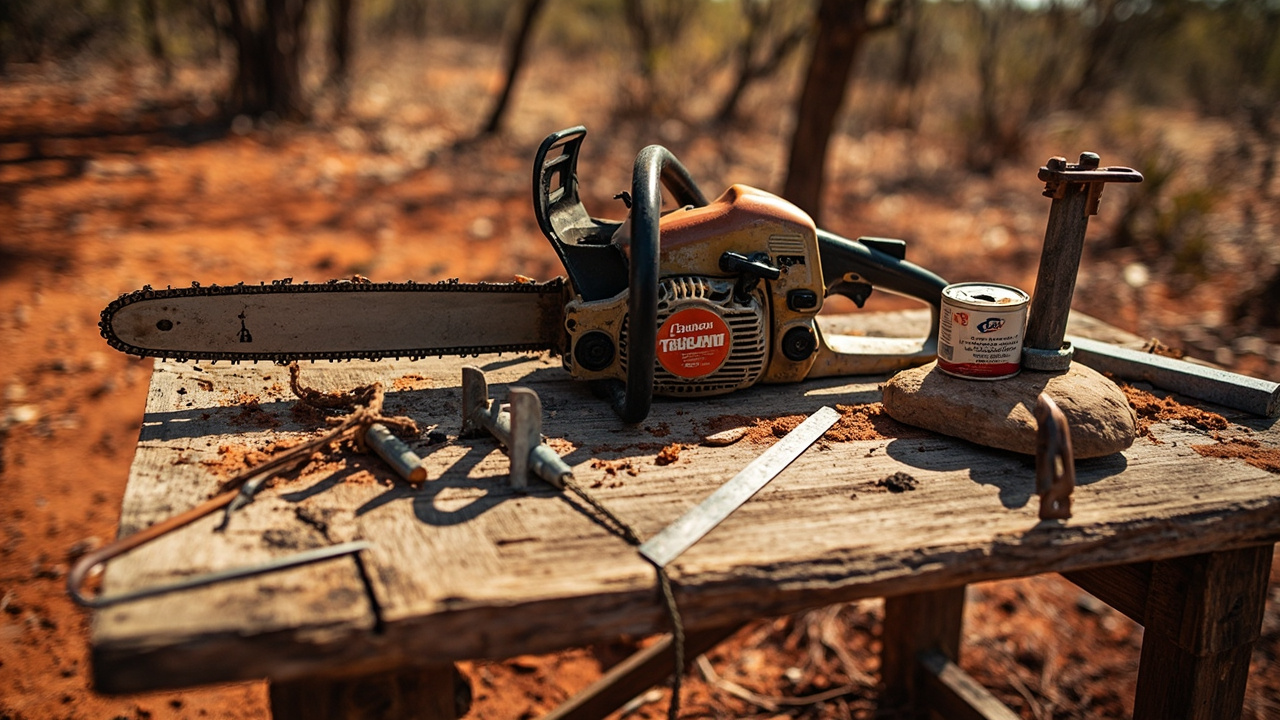
A chainsaw is one of the most useful tools you can keep at a bush property — and one of the most dangerous if neglected. Out here at Beecher, in Central Queensland, a downed branch after a storm or a few cubic metres of cut wood can mean the difference between a working week and a disrupted one. The chainsaw doesn't need to be fancy; it needs to be maintained. This guide covers what to check, when to sharpen, how to start it safely, and when to hand the job to someone with a ticket.
Proper maintenance is critical for optimal chainsaw performance and safe operation. Skipping it leads to blunt cuts, wasted fuel, dangerous kickback, and bar wear that costs real money. The basics — oil, tension, sharpness, cleanliness — are not optional; they're the core of every cut you make.
In my experience, the chainsaw is usually the tool that gets neglected fastest because it "still works" when it's slightly out of spec. A slightly slack chain still cuts. A slightly dull chain still cuts. Until it doesn't, and by then you've either damaged the bar, burned through a tank of fuel for no gain, or pushed the saw hard enough to invite kickback.
Before every start, run through this list. It's the minimum that separates a working saw from a liability.
Pre-start checklist:
If anything on that list fails, fix it before you fire the saw up.
| Interval | Task |
|---|---|
| Every use | Check chain tension, bar oil flow, sharpness; clean air intake vents |
| Every 5 hours / each fuel-up | Inspect chain, bar, and sprocket for wear; clean air filter |
| Every 25 hours / monthly | Test chain brake; inspect fuel filter and fuel lines; check spark plug |
| Every 100 hours / annually | Replace spark plug; inspect clutch, sprocket, and anti-vibration mounts |
| As needed | Sharpen chain; replace chain; flip or replace bar |
These intervals are general guidance — dusty conditions (which is most of Central Queensland for half the year) and heavy use will shorten them.
Checking for worn parts like the bar, chain, and chain sprocket allows replacement before they become hazardous. The chain and bar take the worst of it; they're consumables, not lifetime components.
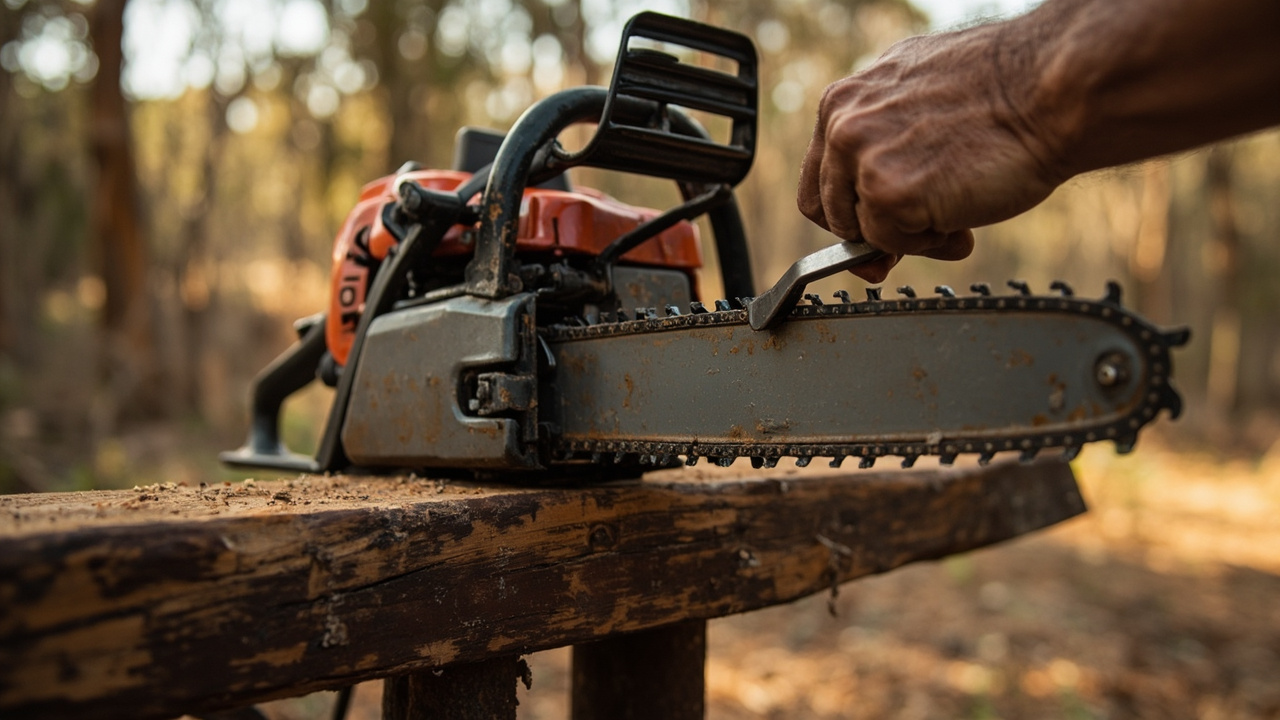
Chain tension. Proper chain tension ensures straight, even cutting and helps prevent accidents. A loose chain derails; an over-tight chain stresses the sprocket and bearing. Adjust so you can pull the chain around the bar by hand with light resistance and see roughly 3–5 mm of play on the underside. Always tension cold when possible — thermal expansion after a cut will tighten it further.
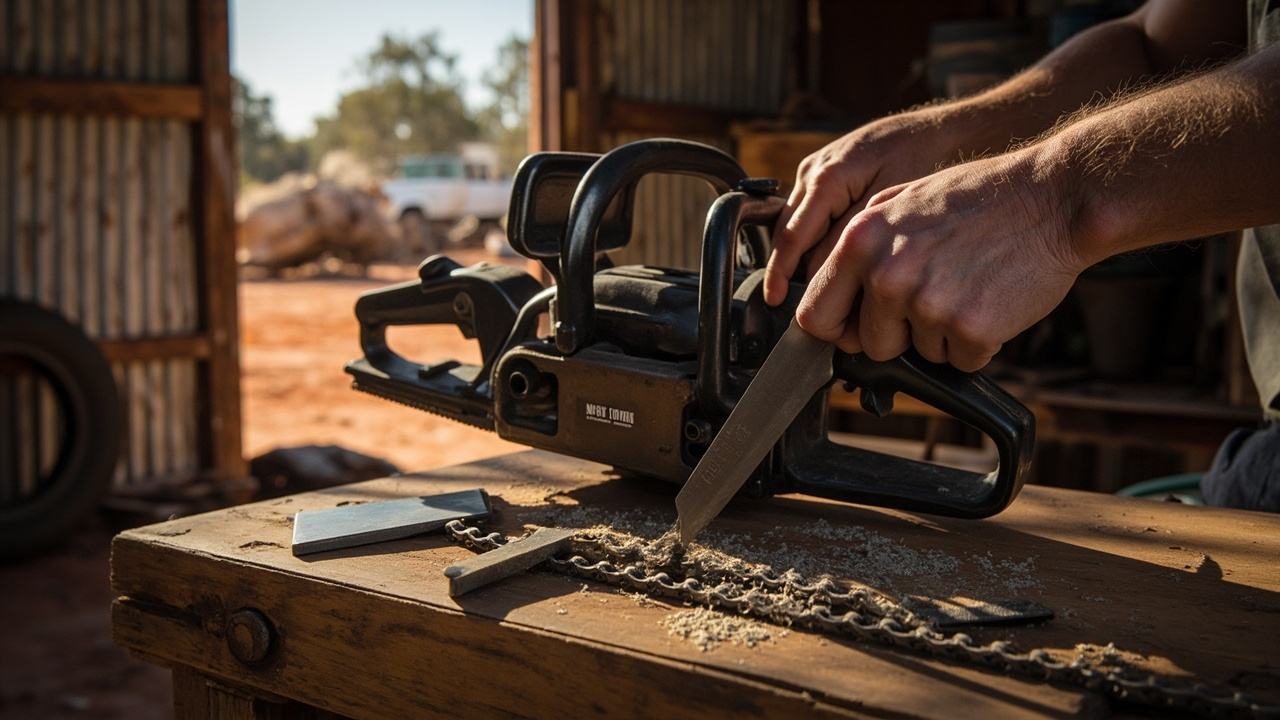
Sharpness. Keeping the chain sharp is paramount for efficient cutting and reducing the risk of kickback. A sharp chain self-feeds and produces clean chips; a blunt chain produces dust, increases the push/feed force against the workpiece, and raises kickback risk because the operator tends to lean on the saw. File to the manufacturer's angle (commonly 30° for full chisel, 25° for semi-chisel) using a round file of the correct diameter for your chain pitch.
Bar. Flip the bar every time you change the chain so wear distributes evenly. Clean the oiler hole and the bar groove. If the rails are uneven or the groove is pinched, replace the bar.
Sprocket. A worn sprocket (rounded teeth instead of sharp peaks) tears the chain links and accelerates chain stretch. Replace the sprocket when you replace a stretched chain.
Regularly oiling the engine lubricates and minimizes friction and wear on moving parts. There are two distinct oils in a chainsaw and people conflate them.
Engine oil lubricates internal engine parts to minimise heat and friction. On a two-stroke, this is mixed into the fuel at the ratio specified by the manufacturer (commonly 50:1 for modern oils, 25:1 for some). On a four-stroke, it's a separate sump with its own dipstick and grade — check it.
Bar and chain oil is specifically designed to adhere to the chain and bar for lubrication during use. It's sticky, often petroleum-based, and not interchangeable with engine oil. Refilling it is non-negotiable — running the saw dry for even a few minutes can ruin the bar tip. Confirm flow by holding the bar over a piece of light-coloured cardboard on the ground with the chain clear of any surface, then revving briefly; you should see a thin line of oil thrown off.
Fuel system. Frequently checking the fuel system, including the fuel filter and lines, allows for adequate fuel flow and combustion efficiency. A blocked filter or perished fuel line is the typical cause of a saw that starts then dies. Replace the filter annually and any line that's hardened or cracked.
Spark plug. Gas chainsaws require inspecting and replacing worn or damaged spark plugs. Pull it, look at the electrode — a light tan colour is healthy, black is rich, white is lean. Gap to manufacturer spec, generally 0.5–0.65 mm.
Routine chainsaw maintenance should include cleaning or replacing the air filter. A clogged filter starves the engine, runs it hot, and fouls the plug. Foam filters wash in warm soapy water, dry, and re-oil lightly with filter oil. Felt filters are tapped clean or replaced.
The cooling fins around the cylinder clog with sawdust and grass. Clear them with a brush or compressed air every few tanks of fuel — heat is the silent killer of two-stroke engines.
The maintenance is only half of it. A perfectly tuned saw is still dangerous in the wrong hands.
You should never use a chainsaw if you are not feeling confident with the tool in your hands. Beginners should consider a lighter chainsaw suitable for minor cutting jobs around the garden. Match the saw to the job — a 70cc pro saw is not a learning tool.
Before operating a chainsaw, you should verify that all parts are properly lubricated, the chain has the correct tension, the teeth are sharp, all safety devices are in place, and there are no loose parts or bolts. Then make sure the work area is clear of obstacles, people, and children.
Starting. Drop-starting a chainsaw could result in a serious injury. The primary safe method is to place the saw flat on clear ground with the chain brake engaged, activate the choke, place your right foot through the rear handle to hold it down, and pull the starter handle until the engine fires. Disengage the choke as soon as it fires. Some manufacturers authorise starting between the legs, but others explicitly warn against it because the chain can contact the leg if the brake fails or the saw fires unexpectedly — only use that method if your specific operator manual permits it and the chain brake is engaged.
Cutting. You should always hold a chainsaw with both hands, keeping it close to your body. Do not adjust the chainsaw or change your position while the engine is still running. Chainsaws are heavy machines that are not designed to be used on weird angles, and you should refrain from cutting anything above shoulder height — for storm-loaded or partially fallen trees, use a pole saw or hire an elevated work platform, and refer the job to a qualified climber regardless of reach.
Kickback. Kickback is caused by the upper quadrant of the bar nose contacting a solid object, or by the chain being pinched in the cut so the upper run stalls. Modern chainsaws use a chain brake (activated by the front hand guard), low-kickback chain designs, and reduced-kickback bar nose profiles to reduce risk. Low-kickback chains, a working chain brake, and a sharp, properly tensioned chain are your defence. Don't cut with the tip.
Always wear appropriate PPE when operating a chainsaw. At minimum:
A chainsaw helmet with integrated visor and earmuffs is the cleanest single option for property work.
Not every cut is a DIY job. Call a licensed arborist or contractor when:
How often should I sharpen the chain?
Depends on use, but a practical rule: sharpen whenever the chain starts producing dust instead of chips, or every 1–2 tanks of fuel under typical conditions. Hardwood and dirty wood shorten the interval.
What bar oil should I use?
Any quality bar and chain oil rated for your climate. In hot Queensland conditions, a heavier viscosity (SAE 30 equivalent) stays on the chain better than a thin oil.
Can I use engine oil as bar oil?
No. Engine oil doesn't have the tackifier that makes bar oil cling to the chain. It will sling off and leave the bar dry.
How do I know if my spark plug is bad?
Hard starting, rough idle, no idle, or visible damage to the electrode. Pull it and inspect — cost of a new plug is low, so when in doubt, replace.
Is a battery chainsaw enough for an off-grid property?
For light pruning, limbing, and small firewood, yes — modern 36V and 56V systems are competent. For felling medium timber or continuous cutting, a petrol saw is more practical. Carry at least two charged batteries if you go cordless.
What fuel mix should I use?
Follow your saw manufacturer's recommendation — typically 50:1 with modern two-stroke oil, or 25:1 with some older or specific oils. Don't guess; an overly lean mix seizes the piston.
Worth a watch: Building a Sawmill to Build a Log Cabin for Survival, Bushcraft Off-Grid Engineering · Vadim in the WILD