A solar charge controller sits between the panels and the battery bank. Its job is to regulate charging current, prevent overcharge, block reverse current at night, and shut down loads before the bank is flattened. The two broad families are PWM (pulse-width modulation) and MPPT (Maximum Power Point Tracking). For anything beyond a single small lighting panel, MPPT is the right tool — and the rest of this article focuses on MPPT sizing, selection, and safety.

By Jenny Mills · rural nurse & homesteader · health, safety, law and the paperwork of going bush
Best Solar Controllers & MPPT Chargers 2026: USA
A pair of PWM controllers sit in the bottom drawer of the workshop tool chest, both replaced by MPPT units within eighteen months of installation. The old PWM regulators still work, but they waste more power than the dairy shed uses on a summer afternoon. On a 200‑watt panel with a maximum power voltage around 17 volts feeding a 12‑volt battery sitting at 13.5 volts, a PWM controller connects the panel directly to the battery and pulls the voltage down. That leaves roughly 20 per cent of the panel’s output untapped.
Victron SmartSolar MPPT 10030 Features
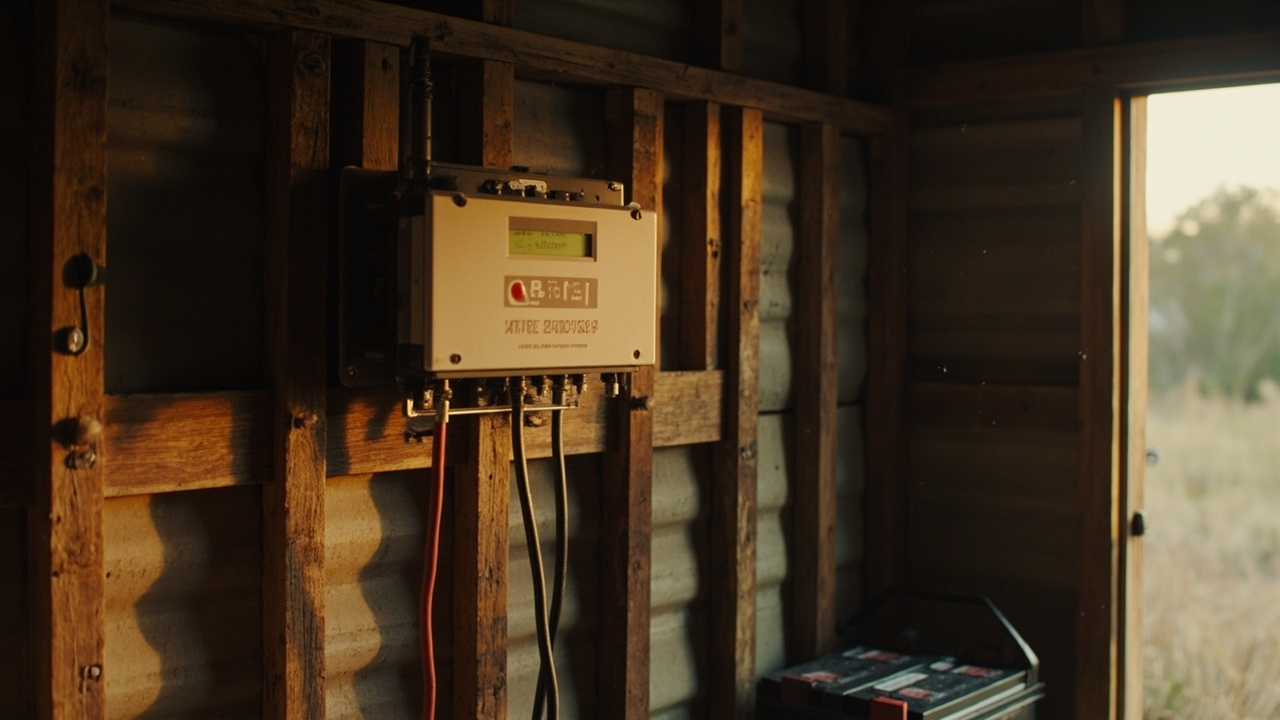
An MPPT controller bucks the voltage down to battery level while lifting the current, squeezing over 95 per cent of the nameplate watts into the bank. Victron SmartSolar MPPT 100/30 handles a string voltage up to 100 volts and delivers 30 amps. The unit measures 130 × 186 × 70 millimetres and bolts to a stud with four number‑eight tek screws. Bluetooth is built in, so the battery voltage, charge stage and daily yield appear on a phone without running a cable through the wall. Street price in Australian dollars runs from $240 to $290.
Warranty Matters When Afternoon
The five‑year warranty matters when the afternoon
Bush Permits Require Medical Declarations
“After losing a patient to a missed DNR because I couldn't read the faded handwriting on the crumpled form, I now insist every bush permit includes a signed legal declaration of your medical wishes.”
> One colourful aside: the difference between PWM and MPPT is the difference between rowing a dinghy with one oar and sailing a proper sloop. Both move the boat; only one uses the wind you actually have.
How an MPPT Controller Works
An MPPT solar charge controller is a DC-to-DC converter that manages power flow between a solar array and a battery bank, and actively adjusts the array's operating voltage to pull the most possible power from the panels under any condition.
Every PV module has an I-V curve with a specific Vmp (voltage at maximum power); operating the array at Vmp yields peak output, while operating above or below it causes power to drop off. The MPPT controller finds the voltage and current combination where modules produce peak wattage, then steps that voltage down to match the battery bank voltage while converting the excess into additional charging current.
In practice, three things move the array off its maximum power point:
- Module voltage rises in cold weather and drops as panels heat up.
- Irradiance changes with cloud cover.
- Shading on even a small part of the array distorts the I-V curve.
A PWM controller cannot follow those shifts. It forces the panel voltage down to battery voltage, so any panel voltage above the battery rail is wasted as heat. The approximate harvest loss is (1 − V_bat / Vmp), which becomes brutal in winter when Vmp climbs and battery voltage sags under load. MPPT converts that excess panel voltage into additional charge current instead.
Why a Charge Controller Is Not Optional
Charge controllers prevent batteries from being overcharged by limiting the amount and rate of charge to the batteries. They also prevent battery drainage by shutting the system down when stored power falls below a configurable low-voltage disconnect (LVD) threshold — 50% state of charge is a common guideline for lead-acid banks, while LiFePO4 banks are typically set to 80–90% depth of discharge. Most units pass charge current through a semiconductor which acts like a valve to control the current.
The standard protection set includes:
- Overload protection — prevents current flowing into batteries from exceeding what the circuit can handle, which otherwise could lead to overheating or fires.
- Low-voltage disconnect — automatically disconnects non-critical loads from the battery when voltage falls below a defined threshold and reconnects when the battery is being charged, preventing over-discharge.
- Reverse-current blocking — at night, solar panels may naturally pass some current in the reverse direction, causing a slight battery discharge; charge controllers prevent this by acting as a valve.
A controller is typically not needed with small 1 to 5 watt panels used to charge a mobile device or power a single light. The general rule from Renogy: if a panel puts out 2 watts or less for each 50 battery amp-hours, a charge controller is probably not needed; anything beyond that requires one.
DC-Coupled vs AC-Coupled Architecture
In a DC-coupled system, solar DC current flows directly from the array to the MPPT charge controller, then into the battery bank, and finally to an inverter that supplies AC loads. Fewer conversions mean higher round-trip efficiency. DC-coupled architecture is common in off-grid builds, new solar-plus-storage projects, and most RV or marine installs.
In an AC-coupled system, solar DC flows through a grid-tied inverter to AC first, then a separate battery inverter pulls AC power and charges the battery through its own internal charge controller; the standalone MPPT charge controller is not part of this architecture. AC-coupled is the default when retrofitting batteries onto an existing grid-tied system.
If you are building from scratch and want a single battery-based inverter/charger with PV input on the DC side, you are designing DC-coupled. If you are adding batteries to an existing PV system that already feeds a string inverter, you are usually AC-coupling.
Sizing the Controller
Sizing is a three-part check: PV array voltage, charge current, and battery-bank voltage.
1. PV open-circuit voltage (Voc). Series-string Voc must stay below the controller's maximum PV input, with margin for cold-weather Voc rise. Cold panels produce higher voltage; a string that looks safe at 25 °C test conditions can exceed the controller's absolute maximum on a frosty morning.
2. Charge current. The controller's rated charge current (the second number in model names such as SmartSolar 150/100) must cover the array's short-circuit current × 1.25 minimum per AS/NZS 5033 / NEC 690 string-sizing rules; apply the continuous-load factor of × 1.56 in total (1.25 × 1.25) where the controller spec is rated against continuous output.
3. Battery-bank voltage. The controller must support your nominal bank — 12 V, 24 V, or 48 V — and the chemistry's charge profile.
The relationship between these three gives you the array's input ceiling. A Victron SmartSolar 150/100, for example, accepts up to 1450 W @ 12 V, 2900 W @ 24 V, and 5800 W @ 48 V of recommended maximum PV array (open-circuit sizing), and delivers actual charge output of 1200 W @ 12 V, 2400 W @ 24 V, and 4800 W @ 48 V based on its 100 A charge current rating, with full output to 40 °C ambient then derates.
Battery Chemistry and Charge Profiles
Battery chemistry selection matters: wrong constant-voltage settings can damage AGM or LiFePO4 banks. MPPT controllers expose absorption, float, and equalisation setpoints that must match the battery manufacturer's data sheet.
- Lead-acid (flooded/AGM/Gel): needs temperature-compensated charging. A battery temperature sensor reduces absorption voltage at elevated battery temperature to prevent gassing. Equalisation is a flooded-only step.
- LiFePO4: flat absorption voltage, no equalisation, low float. Many LiFePO4 vendors publish a specific CC/CV profile — set the controller to match and do not enable equalisation.
- Lead carbon / tubular: higher absorption voltages than standard AGM; verify with the manufacturer's curve.
Wrong CV settings on AGM shorten life; wrong settings on LiFePO4 can trip the BMS or simply leave the bank under-charged.
Paralleling Controllers
Paralleling multiple MPPT controllers requires manufacturer-specified parallel cables or a common battery sense — not blocking diodes. The controllers need to share battery voltage information so they back off together as the bank reaches absorption. Random paralleling without a synchronised bus causes one controller to fight the other, with one unit floating at absorption while the other drops to float. Use the vendor's documented parallel kit and follow its cabling diagram.
Cable Sizing and Installation Notes
Cable sizing must derate for ambient temperature and continuous current. PV circuits are continuous (run for more than three hours at a time in full sun), so: first apply the temperature derating factor to the cable's table ampacity (per AS/NZS 3008 / NEC 690.8 for the installation ambient), then multiply by 1.25× for the continuous load, then select the next standard cable size up. Undersized PV cables are the most common cause of MPPT underperformance — the controller throttles because the array voltage sags below Vmp at the controller terminals.
Practical points:
- Keep PV string Voc, including the cold-weather multiplier, below the controller's max PV input.
- Keep voltage drop from array to controller under ~3% at Vmp.
- Use appropriately rated DC isolators and fuses on both PV and battery sides.
- Mount the controller in a cool, ventilated space — derating starts above 40 °C on many models.
Features Worth Comparing
When evaluating units, compare on:

- Max PV input voltage (must cover your cold-weather string Voc with margin).
- Max charge current and PV input watt ceiling at each battery voltage.
- Charging algorithms supported (sealed AGM, Gel, flooded, LiFePO4, custom).
- Temperature compensation input for lead-acid banks.
- Communications — built-in Bluetooth, VE.Can, RS-485, or Modbus for monitoring.
- Display — integrated screen vs app-only.
- Warranty and service network — multi-year warranty with a regional repair centre matters on long-haul builds.
Victron offers both MPPT and PWM solar charge controllers suitable for mobile, off-grid, and home use. In Victron model names for solar charge controllers, the first number represents the maximum PV open circuit voltage, and the second is the maximum charge current. Victron provides an industry-leading 5-year standard warranty and global repair service.
Safety and When to Call a Licensed Professional
Solar PV arrays operate at voltages that can deliver a lethal shock and currents that will sustain an arc. Even after the sun is covered or the DC isolator is opened, a string can remain near open-circuit voltage whenever light hits the modules.
Call a licensed professional (electrician accredited for solar PV work in your jurisdiction) when:
- The install involves AC-coupling to an existing grid-tied inverter.
- Battery banks exceed the small-DIY scale (typically >48 V or >100 Ah LiFePO4, or any flooded lead-acid above ~1 kWh). In Australia, AS/NZS 3000 work on any DC battery system exceeding 50 V DC — regardless of capacity — requires a licensed electrician accredited for solar PV work.
- The system connects to the grid, even via a hybrid inverter.
- You are working at height on a roof, on mains-voltage AC wiring, or inside a switchboard.
- A fault code keeps recurring, the battery bank shows swelling, or the controller trips on reverse polarity or PV over-voltage.
Battery banks can also vent hydrogen (flooded lead-acid during heavy overcharge) or, in rare cases involving severe physical damage, cell reversal, or gross mis-wiring, experience thermal runaway in LiFePO4 — though LiFePO4 is far less prone to thermal runaway than NMC/LCO and LTO chemistries, which carry the higher runaway risk. Use the controller's low-voltage disconnect and overload protection, but treat those as last-line defences — correct sizing and correct wiring come first.
FAQ
Q: Do I really need MPPT, or will PWM do?
A: PWM forces the panel voltage to battery voltage, losing roughly (1 − V_bat / Vmp) of harvestable power. On a 12 V bank with a 36-cell panel (Vmp ~18 V), the loss at absorption voltage (≈14.4 V) is about 1 − 14.4/18 ≈ 20% — still meaningful, and worse at lower state of charge. On a 48 V bank the loss shrinks, but cold-weather harvest still favours MPPT. For anything beyond a 100 W cabin light, MPPT pays back the price difference.
Q: How do I size the controller to my array?
A: Check three numbers — cold-weather string Voc must stay under the controller's PV input limit, the array's Isc total × 1.25 (× 1.56 with the continuous-load factor) must sit under the controller's charge current rating, and the PV wattage must sit under the controller's per-voltage watt ceiling.
Q: Can I parallel two MPPT controllers on one battery bank?
A: Yes, but paralleling multiple MPPT controllers requires manufacturer-specified parallel cables / common battery sense — not blocking diodes. Follow the vendor's parallel kit instructions exactly.
Q: What happens if I set the wrong battery chemistry in the app?
A: Battery chemistry selection matters: wrong CV settings can damage AGM or LiFePO4 banks. The controller will push the bank to a voltage that is too high for the chemistry, shortening cell life on lead-acid or tripping the BMS on lithium.
Q: Do I need a battery temperature sensor?
A: For lead-acid banks, yes — temperature-compensated charging (using BTS) reduces absorption voltage at elevated battery temperature to prevent gassing. LiFePO4 banks usually do not require BTS.
Q: How hot can the controller run?
A: Many MPPT units deliver full output to 40 °C ambient then derate. Mount in a ventilated enclosure out of direct sun and check the derating curve for your model.
Sources
- https://www.greenlancer.com/post/mppt-solar-charge-controllers
- https://www.renogy.com/blogs/buyers-guide/solar-charge-controller-sizing-and-how-to-choose-one
- https://www.victronenergy.com/solar-charge-controllers
Worth a watch: Victron Energy MPPT RS: The Best Solar Charge Controller Money Can Buy · DIY Solar Power with Will Prowse
Disclosure: some links in this article are affiliate links. If you buy through them we may earn a small commission at no extra cost to you.