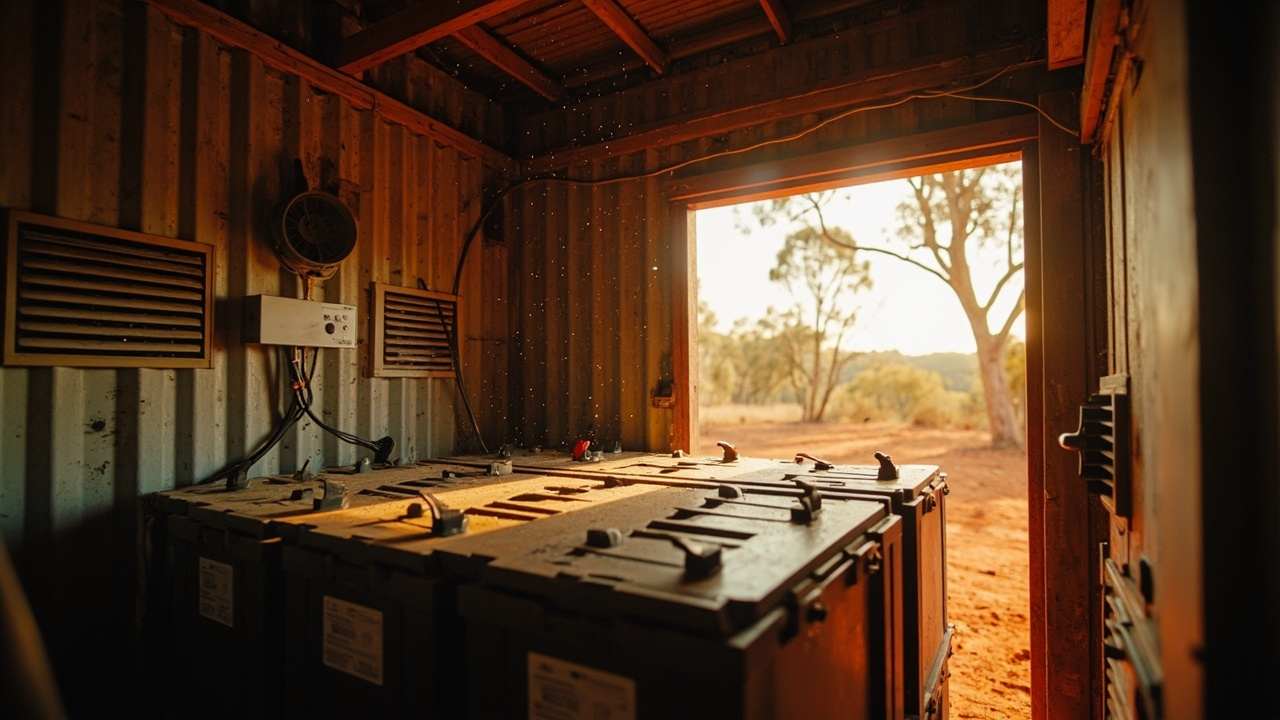
Battery Room Safety and Ventilation: Practical Guide for Australian Off-Grid Setups
Battery-room safety depends on controlling hydrogen gas, acid exposure and heat, while maintaining safe clearances and ventilation. Follow relevant AS/NZS requirements, inspect the installation and avoid DIY electrical work. A poorly designed room can become a serious shed fire risk, so involve a qualified electrician when safety is uncertain.
Whether you're powering a remote cabin, a solar-powered home, or a workshop, a battery room is a critical component. But it's also a potential hazard. This guide covers AS/NZS standards, budget-friendly solutions, and actionable steps to keep your setup safe and compliant.
By Dave Miller· off-grid sparky · 22 years wiring solar, batteries and sheds in central QLD
“After a lithium cell failed at 45°C in my shed, I learned that one square metre of ventilation per battery bank is the only thing keeping your roof from going up.”
Storing serious amp-hours of lead-acid or nickel-cadmium batteries means you're sitting on a hydrogen generator that runs whenever the charger is on. Get the room wrong and you're building a bomb shelter rather than an energy store. This article covers what matters: venting maths, detector placement, alarm strategy, the standards that actually apply, and the things I hand to a licensed sparky.
Why Battery Rooms Need Ventilation
Charging split water molecules in the electrolyte. Current flowing through the cells causes electrolysis, which liberates hydrogen and oxygen. Above roughly 80% state of charge, flooded lead-acid batteries bubble off gas at meaningful rates. Flooded cells cannot be prevented from emitting hydrogen and oxygen, even under ideal conditions; at rest, water evaporation still releases small amounts.
Valve-regulated lead-acid (VRLA) designs recombine most of the gas back into water inside the cell, but once gassing volume exceeds the pressure relief valve's opening pressure, hydrogen still vents to the room. Hydrogen is the lightest element, colourless, odourless, tasteless, and combustible across a wide range. Its flammability range in air spans 4% to 74%, and NFPA 704 rates hydrogen a 4 — its highest flammability rating — because the gas is flammable at concentrations as low as 4% in air. You won't see it, smell it, or taste it before it ignites.
Applicable Standards
For Australian residential and small-commercial installs, AS/NZS 3000 (the Wiring Rules) is the baseline. AS/NZS 5139 governs the installation of battery energy storage systems and references ventilation considerations for battery enclosures.
For larger battery rooms or commercial sites, two international references dominate the engineering literature:
NFPA 70 (National Electrical Code) Article 480.10(A) requires battery rooms to be ventilated to prevent accumulation of an explosive mixture and points readers to NFPA 1 Fire Code and IEEE Std 1635-2012 / ASHRAE Guideline 21-2012.
NFPA 70-2020 Article 708.20 requires adequate ventilation for the alternative power source under maximum anticipated temperature.
The 2020 edition of NFPA 70 does not specify the exact hydrogen concentration that constitutes an explosive mixture — that threshold comes from the referenced documents.
Ventilation Sizing — What the Codes Actually Want
The classic approach uses the hydrogen generation rate of the charger plus dilution airflow. IEEE Std 1635 / ASHRAE Guideline 21 give the calculation method; the practical rule of thumb used by commercial battery-room designers is to keep hydrogen concentration at or below 1% by volume, well under the 4% lower flammability limit.
Several battery-room regulations require hydrogen concentrations to be kept at or below 1% by volume. The cube-root dilution formula from IEEE 1635 is:
```
Q (m³/h) = 0.42 × n × I × N × 10⁻⁸ ÷ (LFL × P)
```
Where n = number of cells, I = charging current in mA per Ah at float, N = cells per string, LFL = lower flammability limit (0.04 for hydrogen), and P = partial pressure adjustment. For a small off-grid shack with a single 48V flooded lead-acid string, the required airflow typically lands in the 0.5–2 m³/h range — small fan territory — but with multi-kWh banks or forklift-style cells, the requirement scales quickly. Work the calculation against your actual charger current and cell count.
If you want a quick rule of thumb without the formula: provide at least 1 air change per hour for a sealed battery enclosure, plus enough cross-ventilation that air can physically leave through the highest point in the room. More is better.
Ventilation Layout
Hydrogen is the lightest element, so it accumulates at the highest point in an enclosure or room. Two practical consequences:
1. Exhaust vents and fans must sit at ceiling level, ideally within 300 mm of the roof. Low-level intake vents should sit opposite the exhaust, near the floor.
2. Hydrogen detectors must be located at the high point of the room, typically mounted on the ceiling or within 300 mm of it. A detector at chest height will miss the gas until it's already at dangerous concentration.
The ventilation system should be alarmed so that a failure of the system would be annunciated — a fan that has stopped silently is worse than no fan, because it gives a false sense of safety. A differential pressure switch, airflow proving switch, or current-monitoring relay on the fan should trigger an audible or remote alarm if the fan fails.
A dedicated hydrogen detector is non-negotiable in any enclosed battery room. Visual indicators that stage the alarm help diagnose the situation before it becomes critical:
Battery bank with extractor fan and cross-flow vents
Red + audible / 2% H₂: Evacuate, isolate the charger, force-ventilate.
Both thresholds are still a quarter to a half of the 4% LFL, which gives you margin. Hydrogen detectors typically use electrochemical cells; expect a 3–5 year service life before replacement. Mount them at the high point of the room, not above a doorway or in a dead-air pocket.
For household-scale off-grid battery rooms (a few kWh of flooded lead-acid in a shed), a single detector with relay output driving a 12V siren and a light is the practical baseline. Tie the relay into the charger's enable input if possible, so a high-hydrogen condition cuts the charge.
Safe Room Construction
A purpose-built battery room should be:
Separate from living space and ignition sources — no flues, no pilot lights, no welding bays in the same enclosure.
Built of non-combustible materials for walls and ceiling where practical.
Sealed to the rest of the structure so leaked hydrogen cannot migrate into a ceiling cavity, attic, or adjoining room.
Equipped with a self-closing, tight-fitting door that opens outwards.
Fitted with a bundled, chemically resistant floor — concrete sealed with acid-resistant epoxy, with a bund lip of at least 50 mm to contain spills from flooded cells.
Spent electrolyte is its own hazard. Flooded lead-acid cells hold sulfuric acid at 1.20–1.28 specific gravity. Neutralising spills with sodium bicarbonate, eye-wash on hand, and acid-resistant PPE for cell maintenance are all standard practice.
Maintenance Schedule
A battery room that's installed correctly and never touched is a battery room that's drifting toward failure. In my experience these systems benefit from a quarterly walkthrough:
Check the fan and prove airflow (an airflow switch with a test button makes this trivial).
Test the hydrogen detector with a calibration gas — most detectors have a test mode that injects a known concentration.
Inspect batteries for case swelling, electrolyte level (flooded), and terminal corrosion.
Check the bund for cracks, neutralised residue, or accumulated water.
Verify the alarm triggers a remote notification or at least a local siren.
Annual: full ventilation airflow measurement against design, detector calibration, and a thermal scan of all busbars and interconnects.
When to Call a Licensed Professional
A licensed electrician should be involved whenever you are:
Hardwiring a battery charger, inverter, or fan controller into 230V mains.
Installing interconnection between battery banks, inverters, and the household switchboard.
Sizing and installing the dedicated RCD/MCB protection for the battery system.
Pulling cable in conduit through fire-rated walls or ceilings.
A licensed refrigeration/HVAC mechanic is the right person for hazardous-area exhaust fan installation in commercial battery rooms, where AS/NZS 60079 (explosive atmospheres) classifications can apply. AS/NZS 5139 mandates that battery energy storage system installation work be carried out by a licensed electrical contractor — in Queensland this means holding an electrical work licence issued by the Queensland Electrical Safety Office. A sparky who is unfamiliar with battery energy storage systems is not the right sparky; AS/NZS 5139 is a specialist standard and not all electrical contractors have trained against it.
If the room is large enough that the IEEE 1635 / ASHRAE 21 calculation produces numbers above the small-fan range, engage a mechanical engineer to design the ventilation system. This is not a hand-wave; the calculation depends on the charger's hydrogen evolution rate (which the manufacturer should publish), the number of cells, and the worst-case equalisation charge current.
For sites that fall under workplace health and safety legislation (commercial battery rooms, mining, telecommunications, forklift charging stations), ventilation design must meet the relevant state or territory WHS regulation, and a safety consultant may be required to sign off the design.
FAQ
Do lithium-ion batteries need the same ventilation as lead-acid?
No. Li-ion cells do not vent hydrogen under normal operation. Thermal runaway is the dominant risk, and the room still needs temperature management, but explosive-gas ventilation requirements do not apply to lithium chemistries in the same way.
What's the smallest battery bank that needs a hydrogen detector?
Any sealed enclosure containing flooded lead-acid cells under charge warrants a detector. An unsealed, well-ventilated shed with the battery on open racks is a different case — but a small detector (a few hundred dollars) is cheap insurance for any bank above a couple of kWh.
Can I vent the battery room into my ceiling cavity?
No. Hydrogen that accumulates in a ceiling cavity has nowhere to go and an ignition source (downlights, wiring junctions) often lives there. Always vent direct to outside air, with the exhaust outlet away from windows, doors, and ignition sources.
What if my batteries are VRLA / AGM / gel?
Sealed lead-acid designs recombine most hydrogen internally, but they still vent under abnormal conditions (overcharge, high temperature, cell failure). Treat the room as if gas can escape; the lower gas volume just gives you more time before concentrations become dangerous.
Is AS/NZS 5139 the same as AS/NZS 3000?
No. AS/NZS 3000 is the general Wiring Rules for all electrical installations. AS/NZS 5139 specifically covers battery energy storage systems and references AS/NZS 3000 plus other standards for installation, ventilation, and protection requirements.
Does my off-grid solar shed legally need ventilation alarms?
For a small residential off-grid system, AS/NZS 5139 sets the benchmark but enforcement is through state electrical safety regulators. In Queensland, an electrical contractor installing the system must certify compliance. Commercial installations and any system above the AS/NZS 5139 thresholds (typically 5 kWh usable capacity for domestic) carry more prescriptive requirements. When in doubt, talk to a licensed electrical contractor familiar with battery energy storage system installations.
⚠️ SAFETY WARNING: Working with electrical systems, structural modifications, or gas installations carries inherent risks. If you are not confident in your abilities, always engage a licensed professional.
I always get asked if batteries need fresh air, and this video answers it straight up, showing you exactly when ventilation is required and when it's not. It also references the standards you'll need to comply with, so you can stop guessing.— Dave Miller