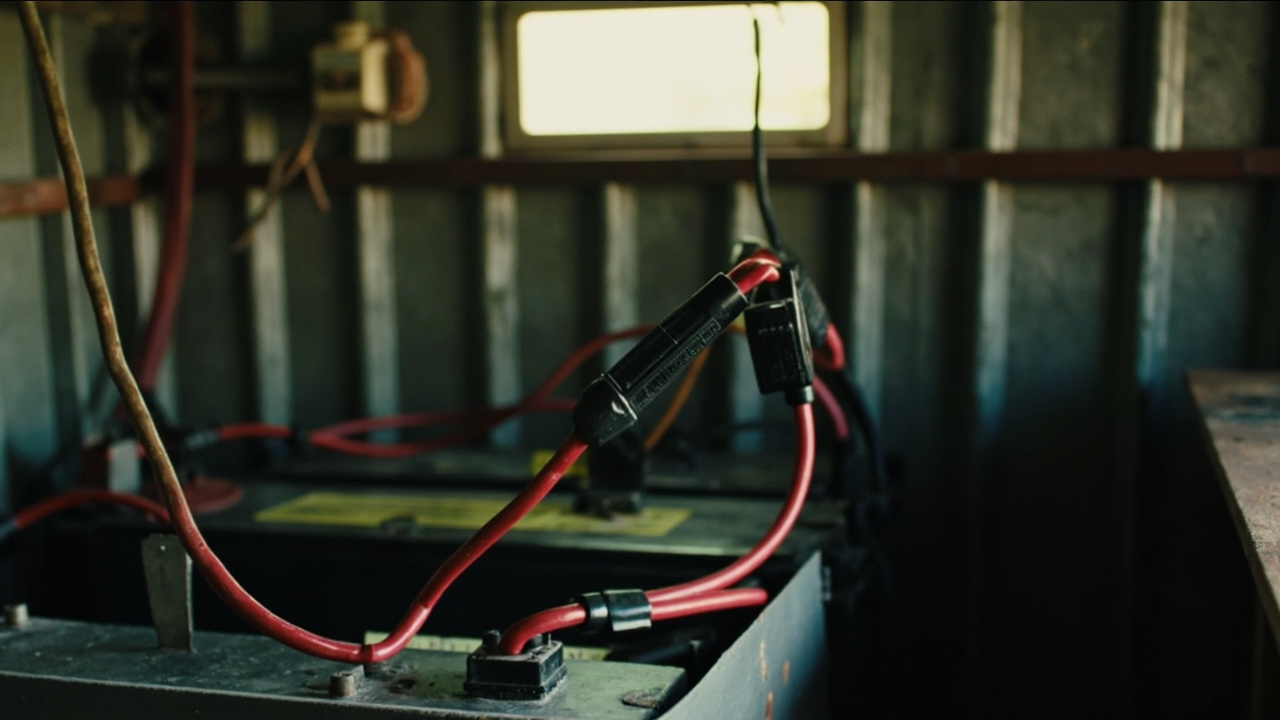
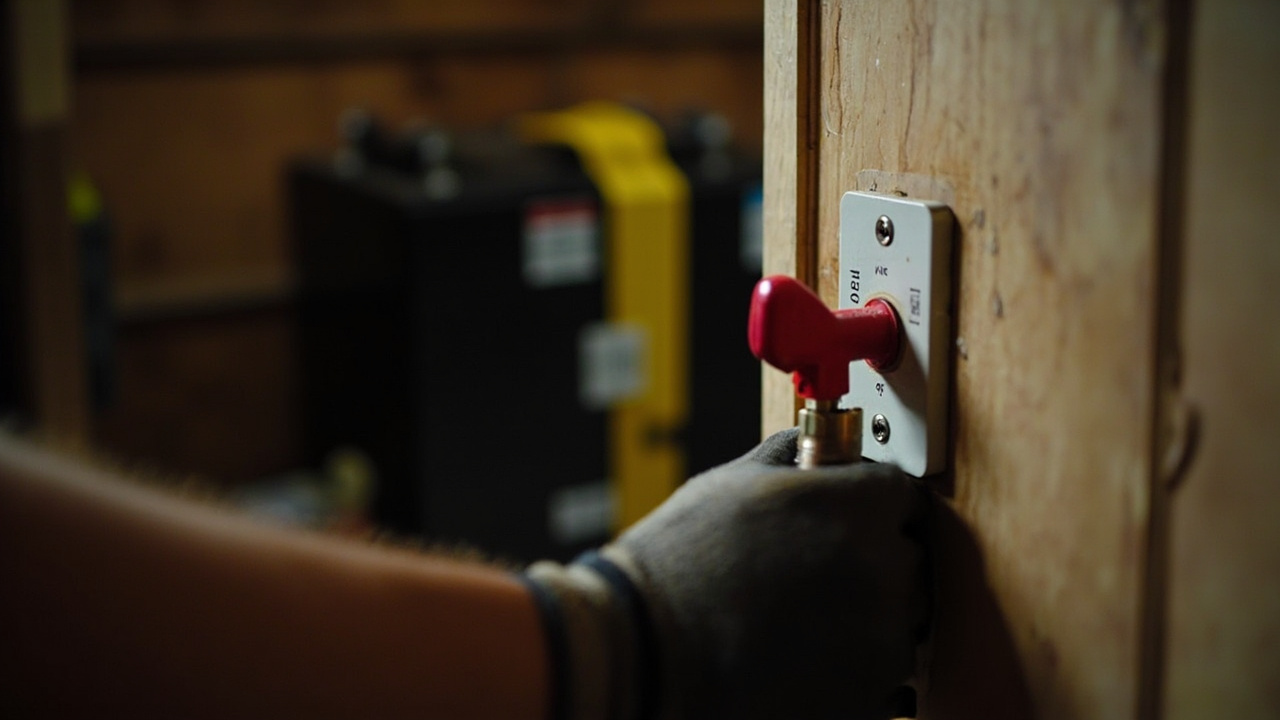
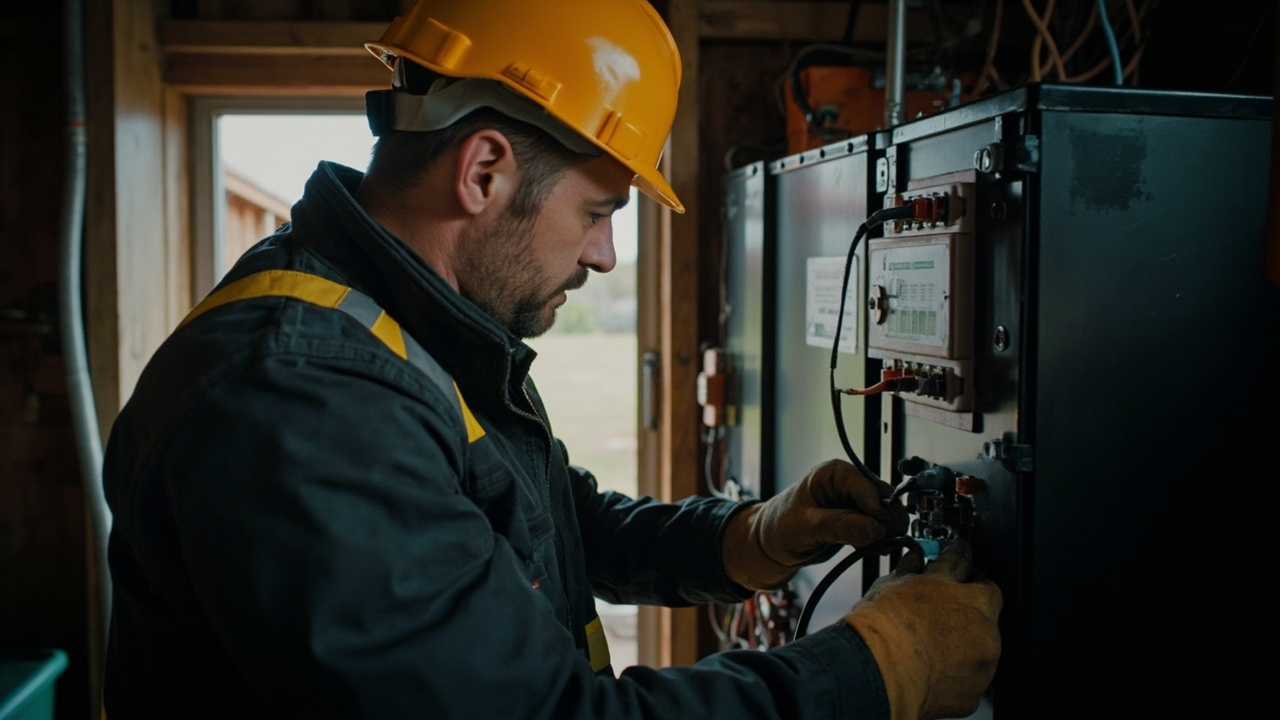
The battery isolator switch needs to carry full starter-motor current for as long as you crank, and it has to do it again after sitting in bulldust and humidity for six months. A continuous rating of 300 A is common for single-battery setups in LandCruiser 70 Series or Patrol GU utes; dual-battery banks in bigger shed systems often need 500 A. Cheap no‑name isolators with plastic keys can melt internally at the contacts and still look fine from the outside.
I have replaced three this year alone where the owner swore the switch was “off” and the battery bank still drained because carbon tracking bridged the terminals inside the housing. A typical Australian‑supplied isolator with a removable red plastic key — the Narva 61092BL or similar — is rated 100 A continuous, 500 A cranking for 5 seconds. That works on a small 4JB1‑T but not on a 1HZ turning a worn starter in cold weather. For a 1HZ or TD42 I use a metal‑key switch like the Blue Sea Systems m‑Series 6006, rated 300 A continuous, 900 A cranking.
The dimensions match a standard 55 × 70 mm panel cut‑out. They cost between $55 and $90 from marine or auto‑sparky wholesalers. The metal key does not snap off when a toolbox slides into the bulkhead — the red plastic ones do, and shearing the key leaves the contacts in whatever position they held at that moment, which is usually closed if the engine was running. I have also seen a plastic‑key isolator switch weld its contacts shut from repeated hot cranking, turning a safety device into a hidden permanent connection.
That fault only shows up when you try to isolate a dead short and the battery remains in circuit. Install the isolator in the negative lead within 300 mm of the battery post, using crimped copper lugs with at least an M8 stud and a spring washer under a flat washer, then torque to 8–10 Nm. Cover the exposed terminals with insulating boots or at least two layers of self‑amalgamating tape. I mount the switch with its key slot facing down so dust does not settle in the mechanism; upside‑down mounting also stops water pooling around the shaft.
If the manual says “no specified orientation”, ignore that for anywhere west of the Great Divide — horizontal mounting lets fine red dirt pack the detent ball until the key either jams or slips past the stops. In a canopy or toolbox, mount it on the inside of the driver‑side panel so a disconnected battery leaves the aux circuit genuinely dead and you do not have to reach over live terminals to grab the key.
Wire nothing except the starter motor heavy cable direct to the battery positive terminal; everything else feeds from a fused busbar downstream of the isolator so one turn cuts all parasitic loads. A 200 mA tracking current through mud‑caked terminals will flatten an N70ZZ in ten days. I test every install by switching off, hitting the starter, and then checking voltage drop across the switch contacts under cranking — more than 0.2 V on a 12 V system and I pull it out.
After three wet seasons a metal‑key switch still tests under 0.1 V drop; the plastic‑key units often creep past 0.3 V and that heat just accelerates the oxide buildup. A battery isolator that works perfectly on the bench can fail silently in a working ute unless you measure it under load, so I treat the multimeter as part of the switch.
After five years in the bush, I learned the hard way that one missed isolator switch meant a $3,000 battery bank melting while I slept. It was a 12-volt, 660-amp-hour flooded lead-acid bank in a galvanised box under the bench of a tilt-panel shed out past Alpha. The bank had been running a 24-volt inverter through a series-parallel arrangement, and I’d tucked the main positive cable through a gland without a switch because “I’d get to it Monday.” Monday came after a Sunday load spike from a bore pump that pulled a weak cell into reversal.
The cell shorted, the rest of the string dumped current into the dead one like mates shouting a stubborn bull, and without an isolator within reach I copped 20 minutes of hydrogen stink and bubbling plastic before the thermal runaway melted three jars together. The replacement cost in 2011 dollars was exactly three grand — not counting the two days to cut out the box, grind the acid-bleached steel, and rewire the array through a proper disconnect.
Now every battery set I touch gets a continuous-duty manual isolator on the positive leg, mounted on a standoff bracket no more than 200 millimetres from the last terminal. I use a 350-amp-rated surface-mount switch for most 400-amp-hour banks — something like a Blue Sea Systems m-Series 6006 or a Narva 61092BL main battery switch, which retail around seventy to ninety dollars at any rural auto sparky or chandlery. The barrel is a solid copper-sweated rotor pair inside a glass-reinforced nylon body, 68 millimetres in diameter, needing a 52-millimetre panel hole.
You can feel the detent click through a pair of welding gloves when you spin the red knob in the dark. That click has saved me a second bank twice since then — once when a charge controller stuck at 15.8 volts on a 40-degree day and once when a ringtail possum chewed a balance lead and shorted the BMS sense wires. Isolators don’t stop a bank dying, but they stop the rest of the gear burning down while you sleep.
— Dave. Measure twice, buy once.
ArticlesCalculatorsSite PlannerShopStop fucking around. If you're off-grid in Australia, you need a battery isolator switch. Not optional. Not “nice to have”. It’s your emergency kill switch. Get it right or get burned. In my own shed out near Longreach I’ve got a 48 V bank of eight 6 V flooded lead-acid batteries. The main isolator sits in the positive cable between the bank and the inverter.
It’s a Blue Sea Systems 9006 e-Series, rated for 350 A continuous—overkill for the 250 A the inverter can pull, but the extra headroom means the contacts don’t cook on a 43°C day when the fans clog with dust. Single-hole mounting, 76 mm diameter panel cut-out, takes M10 ring terminals. On the wall next to it is a laminated label with the shutdown sequence written in black marker: solar array breaker off, inverter off, battery switch off.
Every person who sets foot on the property for more than a barbecue learns that sequence or they don’t go near the power shed. The battery isolator isn’t a maintenance disconnect. It’s there for two seconds of panic when the charge controller smokes or a cable chafes through its insulation on a star picket. Flick it and the building stops humming. No arc, no hesitation. The switch contacts need a snap-action mechanism—cheap rotary types without a spring feel mushy and arc badly under load, and that’s how you weld contacts shut when you need them open.
Wired correctly, the isolator breaks the whole battery positive. Some blokes split the negative thinking it’s safer. It ain’t. A floating negative can still complete a circuit if there’s an earth fault, and your fuse stays live. Breaker panels, solar chargers, cheap MPPT units, all keep potential. The positive disconnect is the only way to silence the system entirely. Switch ratings matter. Look for the “make/break” figure, not just the continuous amps. A 300 A continuous switch might only be rated to break 150 A at 48 V DC.
If your battery bank can dump 500 A into a dead short, a switch rated for 200 A break capacity simply won’t open under fault current—the internal arc sustains itself and the plastic housing melts. In a 24 V system with a 200 Ah lithium battery, the prospective short-circuit current can exceed 2000 A. A Class T fuse upstream is your only prayer; the isolator is not a circuit breaker. Price tells you something. A no-name Chinese rotary switch from an online marketplace runs $20–$30 and the plastic key breaks on the first summer.
A properly rated DC switch—Blue Sea, BEP Marine, Hella—costs $60–$120 and will still click with authority after ten years of red dust and gecko shit. The extra fifty bucks is cheaper than a weekend rewiring a board that caught fire. Mount it so you can find it with the lights out. Recessed in a panel beside the inverter, never behind stacked jerry cans or leaning ply sheets. A strip of reflective tape across the switch lever saves fumbling when you’re half-asleep and the CO alarm is screaming.
If you’ve got more than one inverter or a separate DC system, label each isolator with a rough sketch of the circuit it kills. A power failure is not the time to guess. I’ve pulled apart a switch that failed on a neighbour’s 12 V setup. The plastic shaft had softened, the O-ring was a hard little biscuit, and the copper contacts had black corrosion creeping halfway across the
Stop fucking around. A proper battery isolator switch isn’t a maybe. It’s a lump of brass and Bakelite that sits between your battery bank and the inverter, and if you’re off-grid in Australia you fit one before you power up the first time. Without it you have no single point of disconnection, and you’ll learn that the hard way when a charge controller goes feral and your battery terminals are cooking. A switch rated for 250 A continuous at 48 V DC does the job for most 5 kW inverters.
The common ones you’ll find in every auto sparky’s bench drawer are the Blue Sea Systems m-Series 6006 or the BEP 701, both two-pole with a removable red handle. They’re chunky—the base plate is about 70 mm square—and they bolt straight onto a shed wall with four 6 gauge Tek screws. The terminals take a 35 mm² lug without complaining. I pay between $45 and $80 depending on whether the local bearing shop has stock. The kill-switch factor isn’t drama. In a bolted short, a flooded lead-acid bank can push 2000 A before a fuse lets go.
A switch that snaps open cleanly under load—look for a make/break rating of at least 100 A at 48 V DC—saves your eyebrows and your wiring harness. It also means you can isolate the battery while you’re working on the inverter without undoing eight cable lugs with a spanner that’s still warm from the morning’s sun. Mount it where you can reach it from the doorway. Don’t bury it behind the array isolator or a stack of milk crates. If you can’t slap it off blind in a haze of acrid smoke, you’ve mounted it wrong. There’s no second prize.
There are two types of battery isolator switch found on Australian off-grid sheds and campers. The dumb one is a manual rotary switch—the red plastic key type hanging on the bulkhead at every Repco and rural supply. Think BEP 701-MD or Narva 61092BL. It is
Wiring this wrong is how you get a fire. Here's the drill:
A rodent chewed through the DC cable in a pump shed near Barcaldine last January. The arc melted half the copper before the fuse let go because nobody could reach the battery terminal with a live flame spitting. A battery isolator would have killed the circuit in one slap. I mount a DC-rated rotary switch on the wall no more than 300 mm from the battery box, inside a polycarbonate enclosure if it’s outdoors. For a 48 V bank with a 5000 W
Test it monthly. Flip the switch. Check everything dies. If it doesn't, fix it. Now. Don't wait for the fire department.
I don’t stock battery isolator switches that arrive in a plain white box stamped “300A” with a blurry CE mark. Too many of those fail inside two wet seasons up here. The contacts are tin-plated brass with a sad excuse for a spring and no wiping action. Run 80 A through one for a few hours in a shed in January and the housing softens, the terminals oxidise, resistance builds, and eventually you smell hot Bakelite while the charge controller is still pushing 40 A. It’ll let go exactly when you need to isolate a bank with a sick cell.
The switch either melts open or welds shut—both are a problem. For a 12/24 V off-grid system, an Australian electrical wholesaler will have the Blue Sea Systems m-Series 6006 on the shelf for around $120, or the BEP 701-S for similar money. Both are single-pole, surface-mount switches. Continuous rating is 300 A, intermittent 500 A, crank rating 900 A for 30 seconds. The contacts are silver-plated copper, housed in a reinforced thermoplastic body, and the throw is a snap-action mechanism that wipes the faces clean each cycle.
The Blue Sea switch measures 69 mm × 69 mm across the mounting face, projects 45 mm behind the panel, and accepts 4/0 (
Get a double-pole isolator. Wire it right. Mount it where you can reach it in 2 seconds. Test it monthly. Buy from Energen or Battery World. Pay $100 now, not $10k for a fire. Done.
Worth a watch: Powerful off-grid solar system with lithium batteries - Victron Review - Cerbo GX & BMV setup · Clean Energy Reviews & Photonik Solar Design
It's a heavy-duty switch that cuts the connection between your battery bank and the rest of your system. If you're off-grid, you need one. It's not optional, not a nice-to-have, and not something you can fudge with a pair of pliers.
Yeah, if you know what you're doing. The rule is simple: do it properly or don't do it at all. If you're not confident reading a wiring diagram and your system's voltage, get a sparky in.
Any decent 4WD, auto electrical, or off-grid supplier will stock them. Check the Australian suppliers section in the article for specific places and what you should expect to pay, because the price ranges are all over the shop.
There's a few different types, and picking the wrong one is a common way people stuff up their setup. Have a read of the types section before you buy anything, otherwise you'll end up with a switch that doesn't suit your system.
While many off-grid projects are achievable as DIY, certain situations require licensed professionals:
Always check local regulations and obtain necessary permits before commencing work.