By Dave Miller · off-grid sparky · 22 years wiring solar, batteries and sheds in central QLD
By Dave Miller · off-grid sparky · 22 years wiring solar, batteries and sheds in central QLD
The battery isolator switch needs to carry full starter-motor current for as long as you crank, and it has to do it again after sitting in bulldust and humidity for six months. A continuous rating of 300 A is common for single-battery setups in LandCruiser 70 Series or Patrol GU utes; dual-battery banks in bigger shed systems often need 500 A. Cheap no‑name isolators with plastic keys can melt internally at the contacts and still look fine from the outside.
I have replaced three this year alone where the owner swore the switch was “off” and the battery bank still drained because carbon tracking bridged the terminals inside the housing. A typical Australian‑supplied isolator with a removable red plastic key — the Narva 61092BL or similar — is rated 100 A continuous, 500 A cranking for 5 seconds. That works on a small 4JB1‑T but not on a 1HZ turning a worn starter in cold weather. For a 1HZ or TD42 I use a metal‑key switch like the Blue Sea Systems m‑Series 6006, rated 300 A continuous, 900 A cranking.
The dimensions match a standard 55 × 70 mm panel cut‑out. They cost between $55 and $90 from marine or auto‑sparky wholesalers. The metal key does not snap off when a toolbox slides into the bulkhead — the red plastic ones do, and shearing the key leaves the contacts in whatever position they held at that moment, which is usually closed if the engine was running. I have also seen a plastic‑key isolator switch weld its contacts shut from repeated hot cranking, turning a safety device into a hidden permanent connection.
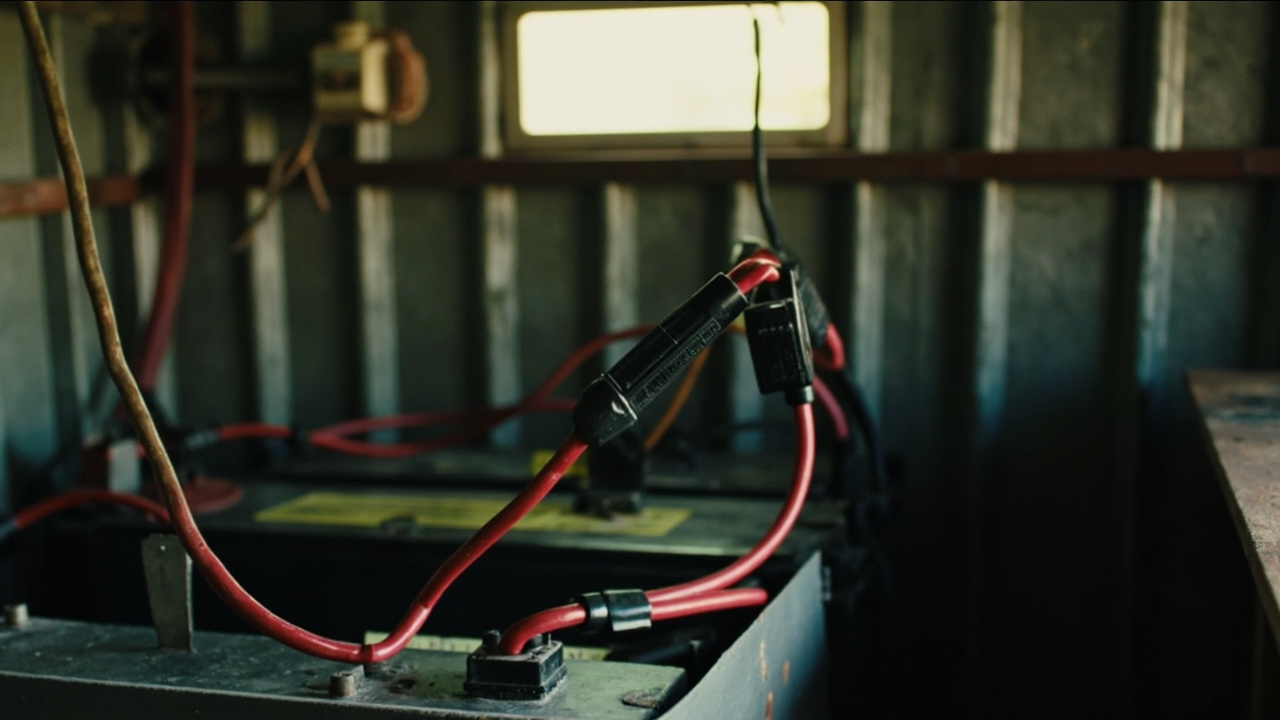
That fault only shows up when you try to isolate a dead short and the battery remains in circuit. Install the isolator in the negative lead within 300 mm of the battery post, using crimped copper lugs with at least an M8 stud and a spring washer under a flat washer, then torque to 8–10 Nm. Cover the exposed terminals with insulating boots or at least two layers of self‑amalgamating tape. I mount the switch with its key slot facing down so dust does not settle in the mechanism; upside‑down mounting also stops water pooling around the shaft.
If the manual says “no specified orientation”, ignore that for anywhere west of the Great Divide — horizontal mounting lets fine red dirt pack the detent ball until the key either jams or slips past the stops. In a canopy or toolbox, mount it on the inside of the driver‑side panel so a disconnected battery leaves the aux circuit genuinely dead and you do not have to reach over live terminals to grab the key.
Wire nothing except the starter motor heavy cable direct to the battery positive terminal; everything else feeds from a fused busbar downstream of the isolator so one turn cuts all parasitic loads. A 200 mA tracking current through mud‑caked terminals will flatten an N70ZZ in ten days. I test every install by switching off, hitting the starter, and then checking voltage drop across the switch contacts under cranking — more than 0.2 V on a 12 V system and I pull it out.
After three wet seasons a metal‑key switch still tests under 0.1 V drop; the plastic‑key units often creep past 0.3 V and that heat just accelerates the oxide buildup. A battery isolator that works perfectly on the bench can fail silently in a working ute unless you measure it under load, so I treat the multimeter as part of the switch.
After five years in the bush, I learned the hard way that one missed isolator switch meant a $3,000 battery bank melting while I slept. It was a 12-volt, 660-amp-hour flooded lead-acid bank in a galvanised box under the bench of a tilt-panel shed out past Alpha. The bank had been running a 24-volt inverter through a series-parallel arrangement, and I’d tucked the main positive cable through a gland without a switch because “I’d get to it Monday.” Monday came after a Sunday load spike from a bore pump that pulled a weak cell into reversal.
The cell shorted, the rest of the string dumped current into the dead one like mates shouting a stubborn bull, and without an isolator within reach I copped 20 minutes of hydrogen stink and bubbling plastic before the thermal runaway melted three jars together. The replacement cost in 2011 dollars was exactly three grand — not counting the two days to cut out the box, grind the acid-bleached steel, and rewire the array through a proper disconnect.
Now every battery set I touch gets a continuous-duty manual isolator on the positive leg, mounted on a standoff bracket no more than 200 millimetres from the last terminal. I use a 350-amp-rated surface-mount switch for most 400-amp-hour banks — something like a Blue Sea Systems m-Series 6006 or a Narva 61092BL main battery switch, which retail around seventy to ninety dollars at any rural auto sparky or chandlery. The barrel is a solid copper-sweated rotor pair inside a glass-reinforced nylon body, 68 millimetres in diameter, needing a 52-millimetre panel hole.
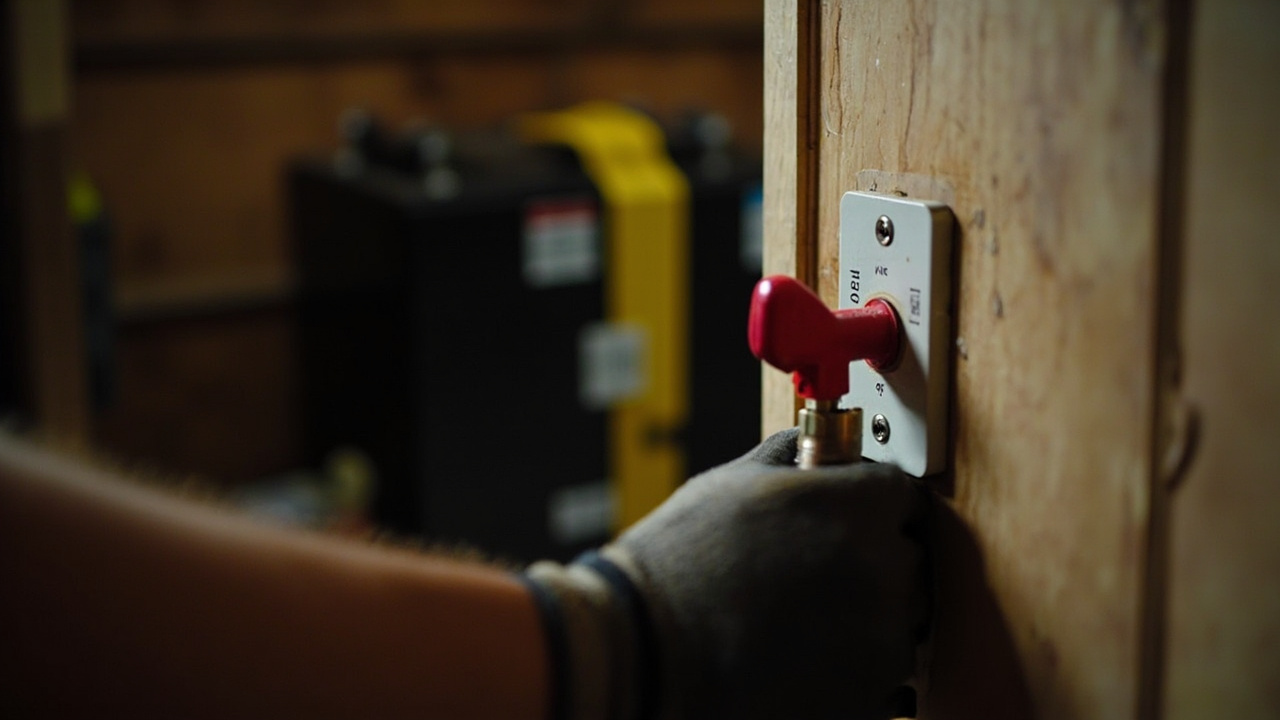
You can feel the detent click through a pair of welding gloves when you spin the red knob in the dark. That click has saved me a second bank twice since then — once when a charge controller stuck at 15.8 volts on a 40-degree day and once when a ringtail possum chewed a balance lead and shorted the BMS sense wires. Isolators don’t stop a bank dying, but they stop the rest of the gear burning down while you sleep.
Stop fucking around. If you're off-grid in Australia, you need a battery isolator switch. Not optional. Not “nice to have”. It’s your emergency kill switch. Get it right or get burned. In my own shed out near Longreach I’ve got a 48 V bank of eight 6 V flooded lead-acid batteries. The main isolator sits in the positive cable between the bank and the inverter.
It’s a Blue Sea Systems 9006 e-Series, rated for 350 A continuous—overkill for the 250 A the inverter can pull, but the extra headroom means the contacts don’t cook on a 43°C day when the fans clog with dust. Single-hole mounting, 76 mm diameter panel cut-out, takes M10 ring terminals. On the wall next to it is a laminated label with the shutdown sequence written in black marker: solar array breaker off, inverter off, battery switch off.
Every person who sets foot on the property for more than a barbecue learns that sequence or they don’t go near the power shed. The battery isolator isn’t a maintenance disconnect. It’s there for two seconds of panic when the charge controller smokes or a cable chafes through its insulation on a star picket. Flick it and the building stops humming. No arc, no hesitation. The switch contacts need a snap-action mechanism—cheap rotary types without a spring feel mushy and arc badly under load, and that’s how you weld contacts shut when you need them open.
Wired correctly, the isolator breaks the whole battery positive. Some blokes split the negative thinking it’s safer. It ain’t. A floating negative can still complete a circuit if there’s an earth fault, and your fuse stays live. Breaker panels, solar chargers, cheap MPPT units, all keep potential. The positive disconnect is the only way to silence the system entirely. Switch ratings matter. Look for the “make/break” figure, not just the continuous amps. A 300 A continuous switch might only be rated to break 150 A at 48 V DC.
If your battery bank can dump 500 A into a dead short, a switch rated for 200 A break capacity simply won’t open under fault current—the internal arc sustains itself and the plastic housing melts. In a 24 V system with a 200 Ah lithium battery, the prospective short-circuit current can exceed 2000 A. A Class T fuse upstream is your only prayer; the isolator is not a circuit breaker. Price tells you something. A no-name Chinese rotary switch from an online marketplace runs $20–$30 and the plastic key breaks on the first summer.
A properly rated DC switch—Blue Sea, BEP Marine, Hella—costs $60–$120 and will still click with authority after ten years of red dust and gecko shit. The extra fifty bucks is cheaper than a weekend rewiring a board that caught fire. Mount it so you can find it with the lights out. Recessed in a panel beside the inverter, never behind stacked jerry cans or leaning ply sheets. A strip of reflective tape across the switch lever saves fumbling when you’re half-asleep and the CO alarm is screaming.
If you’ve got more than one inverter or a separate DC system, label each isolator with a rough sketch of the circuit it kills. A power failure is not the time to guess. I’ve pulled apart a switch that failed on a neighbour’s 12 V setup. The plastic shaft had softened, the O-ring was a hard little biscuit, and the copper contacts had black corrosion creeping halfway across the
A battery isolator switch sounds like a simple bolt-on accessory. In practice, it's one of the most consequential decisions in a multi-battery DC system — the wrong switch in the wrong place will either leave you stranded with a flat starter, or worse, start a fire inside a wall cavity. This article walks through what an isolator actually does, where it fits in an off-grid solar setup, the cable and termination work that makes or breaks the job, and the safety boundaries you don't cross without a licensed sparky.
A battery isolator sits between two batteries — typically a starter battery and a house/auxiliary battery — and controls when each can charge or discharge. With the engine off, the isolator separates the house battery from the starter, so running your fridge, lights, or inverter overnight doesn't drain the battery you need to crank the motor in the morning.
Isolators aren't only for vehicles. They're used in vans, RVs, boats, skoolies, and off-grid cabins wherever house batteries need to be isolated from the alternator and starter battery when the engine isn't running. The same logic applies to any setup where you have two battery banks serving different roles and you don't want them flattening each other.
The core purpose: give you control over which battery feeds what, and stop the wrong battery from being drained at the wrong time. In multi-battery systems with batteries that need to discharge or charge at different times, an isolator is what makes that orchestration possible.
An off-grid solar system — a standalone power system — is a self-sustaining energy solution that combines solar panels with battery storage, letting you generate, store, and use your own electricity without the grid. The four essential pillars are: solar panels, inverter, solar batteries, and a charge controller plus monitoring.
The flow:
A battery isolator switch is an additional layer on top of those four pillars. It's not a substitute for the charge controller, and it doesn't replace proper fusing and overcurrent protection. What it does is let you physically disconnect a battery bank from the rest of the system — for maintenance, for emergency cut-off, or for separating two banks that should never see each other.
If you've got a hybrid setup where a vehicle alternator charges a lithium house bank, the isolator is what stops the lithium bank from back-feeding the starter, and vice versa. Without one, you'd have parallel batteries with no defined separation point.
Below is what a battery isolator switch needs to handle in a typical off-grid or vehicle-based installation. Values are general — always cross-check against the manufacturer's datasheet for your specific switch.
| Parameter | What to Look For | Why It Matters |
|---|---|---|
| Continuous current rating | Equal to or greater than the maximum sustained load or charge current of the bank | Undersized switches overheat under continuous load |
| Peak surge rating | At least 2–3× continuous for motor loads, inverters, or large inverter inrush | Cold-crank and inverter surge currents can weld undersized contacts |
| Voltage rating | Must be DC-rated at or above system voltage (12V, 24V, or 48V) | AC-rated switches fail spectacularly on DC because DC doesn't self-extinguish arcs |
| Mounting environment | Dry, ventilated, away from heat sources | Heat derates current capacity and degrades terminations |
| Termination type | Stud/lug terminals sized for your cable | Lugs must match cable cross-section to avoid high-resistance joints |
| Switch type | Double-pole (breaks both positive and negative) for floating systems, single-pole (breaks positive only) for chassis-negative systems | Wrong configuration can leave a chassis energised |
| Compliance | Look for recognised certification marks (e.g., RCM in Australia) on the switch | Indicates the device has been tested to a published safety standard |
Colour aside: nothing says "I learned this the hard way" quite like finding a DC switch rated at 32V AC only, melting its housing at 14V DC under load.
The isolator switch is only as good as the cable feeding it. Skimping here is how you get voltage drop, hot joints, and house fires.
Cable selection. Use DC-rated cable — double-insulated welding cable is the standard choice for battery-to-battery runs in off-grid work. Thin auto starter cable is not rated for the sustained currents a house battery can deliver through an inverter, and it has poor insulation. Size the cable for the full current of the bank over the actual run length, not just the nominal fuse rating. Undersized cable means voltage drop, which means your inverter sees low voltage and either throttles back or shuts down.
Lugs and crimping. Use crimped lugs matched to the cable size. The crimp should be made with the correct die — a hammer crimp or a vise-grip squeeze is not a proper crimp. Poorly crimped lugs create high-resistance joints that heat up under load, which is one of the leading causes of battery-related fires.
Torque. Torque every stud to the manufacturer's spec. A loose lug arcs. An over-tightened stud strips. Both end the same way.
Protection. Run appropriately rated fuses or DC breakers on each battery lead, as close to the battery as practical. Proper wiring and protection devices (breakers and fuses) reduce the risk of electrical hazards in an off-grid solar system.
If you're sizing a new off-grid solar system, the isolator switch rating should follow the battery bank, not lead it. The general sizing workflow is:
1. Determine daily energy use in Amp-hours at 12VDC (or your system voltage).
2. Calculate sun hours available in your area, focusing on the least sunny month.
3. Add 20% to account for inefficiencies in charge controller, cabling, and battery round-trip losses.
Once you know the battery bank capacity and the maximum charge/discharge current, the isolator's continuous current rating should equal or exceed that maximum. Anything less is a weak link.
Required tools for an install include copper wire, breakers and fuses, MC4 connectors, a meter for measuring voltage and current, screwdrivers, wrenches, and a drill with mounting hardware. The isolator switch itself is in addition to that list.
Connecting batteries of different chemistries — for example, a lead-acid starter and a lithium house bank — directly together without an isolator is a bad idea. The charge profiles don't match, the resting voltages don't match, and one battery will hammer the other until something gives. An isolator (or a DC-DC charger) is what separates them.
Lithium battery banks charge so fast they may draw too much power from a conventional alternator; some isolators (such as the Li-BIM type) disconnect power periodically to prevent the alternator from overworking. This is worth knowing if you're retrofitting lithium into a vehicle that was wired for lead-acid — the original isolator may not be designed for the charge rates lithium can accept.
Arc and fire risk on DC is real. DC doesn't have a zero-crossing like AC does, so once a switch contact opens under load, the arc keeps burning until the gap is wide enough to extinguish it. That's why DC-rated switches exist, and why a generic AC light switch is the wrong component for a battery disconnect.
In Australia, any 230V/50Hz AC work — inverter AC-side wiring, mains-distribution changes, grid-interactive equipment — falls under licensed electrical work and must be done by a licensed electrician. Off-grid AC wiring still has to meet AS/NZS 3000 and AS/NZS 5033 (for solar), and these aren't optional.
Beyond the AC boundary, call a licensed professional if:
If your installation touches the mains side of an inverter, or if you're connecting an alternator to a lithium bank without verifying the charging profile, you're in sparky territory.
Do I need a battery isolator if I only have one battery?
No. An isolator separates two or more banks. With a single battery, a DC-rated main switch (often called a battery master switch) is still good practice for maintenance isolation, but you don't need a multi-battery isolator.
What's the difference between a battery isolator and a battery master switch?
A master switch is a single-pole or double-pole disconnect for one battery. An isolator typically refers to the device that sits between two banks and controls charge/discharge flow between them — often a solenoid, a solid-state relay, or a manual switch wired into a dual-battery setup.
Can I use an AC switch on a DC battery system?
Not safely. AC switches are not rated for DC because DC doesn't self-extinguish the arc when contacts open. Use a switch specifically rated for DC at your system voltage.
Where does the isolator switch mount?
As close to the battery it isolates as practical, in a dry, ventilated location, away from heat. The cable run from the battery post to the isolator should be fused, short, and mechanically protected.
What size isolator do I need?
At minimum, the continuous current rating must meet the maximum sustained current of the bank — that means the inverter's max draw or the alternator's max charge output, whichever is higher. Peak surge rating should comfortably exceed inrush loads. Confirm against the manufacturer's datasheet.
Does an isolator extend battery life?
That specific claim isn't supported by verified sources. What an isolator does is prevent one bank from being flattened by another, which protects the starter battery and lets each bank operate on its own charge profile. That operational separation is the practical benefit, not a quantified lifespan extension.
Worth a watch: Powerful off-grid solar system with lithium batteries - Victron Review - Cerbo GX & BMV setup · Clean Energy Reviews & Photonik Solar Design
It's a heavy-duty switch that cuts the connection between your battery bank and the rest of your system. If you're off-grid, you need one. It's not optional, not a nice-to-have, and not something you can fudge with a pair of pliers.
Yeah, if you know what you're doing. The rule is simple: do it properly or don't do it at all. If you're not confident reading a wiring diagram and your system's voltage, get a sparky in.
Any decent 4WD, auto electrical, or off-grid supplier will stock them. Check the Australian suppliers section in the article for specific places and what you should expect to pay, because the price ranges are all over the shop.
There's a few different types, and picking the wrong one is a common way people stuff up their setup. Have a read of the types section before you buy anything, otherwise you'll end up with a switch that doesn't suit your system.