Battery Isolators and Dual Battery Systems: Complete Guide
Master dual battery systems for your RV, van, or boat. From basic isolators to smart DC-DC chargers, learn how to keep your house batteries charged while protecting your starting battery.

By Dave Miller · off-grid sparky · 22 years wiring solar, batteries and sheds in central QLD
“After a loose terminal sparked a $2,000 fire in my shed, I learned that every dual battery system needs a robust isolator switch.”
How Battery Isolators Work
A dual battery system lets you run your accessories and house loads off a dedicated house battery while keeping your vehicle's starting battery isolated and fully charged. The battery isolator is the device that manages this separation and charging automatically.
The Basic Concept
When the engine's running, the alternator pumps out excess power that a battery isolator routes straight to charge your house battery, stopping you from wasting it. When the engine's off, the isolator cuts the link between the batteries so you can drain the house bank without killing your ability to start the vehicle. I saw this work perfectly on a Toyota Hiace in Rockhampton last winter where I fitted a Victron BMV-700 and a Redarc BCDC1225D for $1,250, but I also watched a mate blow a fuse on a cheap generic isolator because he left his fridge running for three days straight, leaving his battery dead flat and unable to crank the engine the next morning.
Why You Need Isolation
- Starting protection: House loads never drain your starter battery
- Deep cycling: House batteries can discharge fully without consequences
- Battery compatibility: Different battery types can be used for each purpose
- Charging optimization: Each battery gets appropriate charging
Basic System Components
- Starting battery: Optimized for high-current bursts (cranking amps)
- House battery: Optimized for deep discharge (amp-hours)
- Isolator: Separates and connects batteries automatically
- Wiring: Heavy gauge cables between batteries and isolator
- Fuses: Protection on both battery circuits
Types: VSR, Diode, DC-DC Charger
Voltage Sensitive Relay (VSR)
Also known as an Automatic Charging Relay (ACR), this is the most common type of battery isolator for modern installations.
How it works:
- Monitors starting battery voltage continuously
- When voltage rises above 13.3V (engine running), relay closes
- Batteries connect in parallel, both charge from alternator
- When voltage drops below 12.8V (engine off), relay opens
- Batteries separate, house loads isolated from starter
Pros:
- Simple installation (no ignition wire needed)
- Very efficient (minimal voltage drop)
- Automatic operation
- Bi-directional (can jump-start from house battery)
- Affordable ($50-150)
Cons:
- Charges house battery at same voltage as starting battery
- No optimized charging profiles
- Can overcharge some battery types
- Limited current regulation
Recommended VSRs:
- Victron Cyrix-ct 12/24V-230A: $85, reliable, bidirectional
- Blue Sea Systems SI-ACR: $120, marine grade, manual override
- Stinger SGP38: $55, budget option, 80A capacity
- Redarc SBI12: $180, premium Australian build
Diode Isolators
Older technology using semiconductor diodes to separate battery circuits. Less common in modern installs due to efficiency losses.
How it works:
- Diodes allow current flow to batteries but not between them
- Both batteries charge whenever alternator produces power
- Automatic separation when alternator is off
Pros:
- No moving parts (solid state)
- Completely automatic
- Very reliable
Cons:
- 0.6-1.0V voltage drop (significant power loss)
- Reduced charging efficiency
- Heat generation
- Cannot combine batteries for emergency starting
Note: Generally not recommended for modern systems. Use VSR or DC-DC instead.
DC-DC Chargers
The most advanced option, providing smart battery-to-battery charging with multiple charging stages and battery-specific profiles.
How it works:
- Acts as a "smart charger" powered by your alternator
- Boosts or bucks voltage as needed for optimal charging
- Multi-stage charging (bulk, absorption, float)
- Battery-specific profiles (LiFePO4, AGM, flooded)
- Current limiting protects alternator
Pros:
- Optimal charging for any battery type
- Can charge lithium batteries safely
- Overcomes voltage drop in long cable runs
- Current limiting protects vehicle alternator
- MPPT solar input (many models)
- Ignition sense input (smart activation)
Cons:
- Higher cost ($150-600)
- More complex installation
- Some efficiency loss in conversion
- Requires ignition sense wire
Recommended DC-DC Chargers:
- Victron Orion-Tr Smart 12/12-30: $200, 30A, Bluetooth, isolated
- Renogy 12V 50A: $150, great value, MPPT built-in
- Redarc BCDC1250D: $500, 50A, premium build, dual input
- Ctek D250SA: $280, 20A, dual input (solar + alternator)
- Redarc BCDC1225D: $350, 25A, proven reliability
Dual Battery System Design
Battery Selection
Starting Battery:
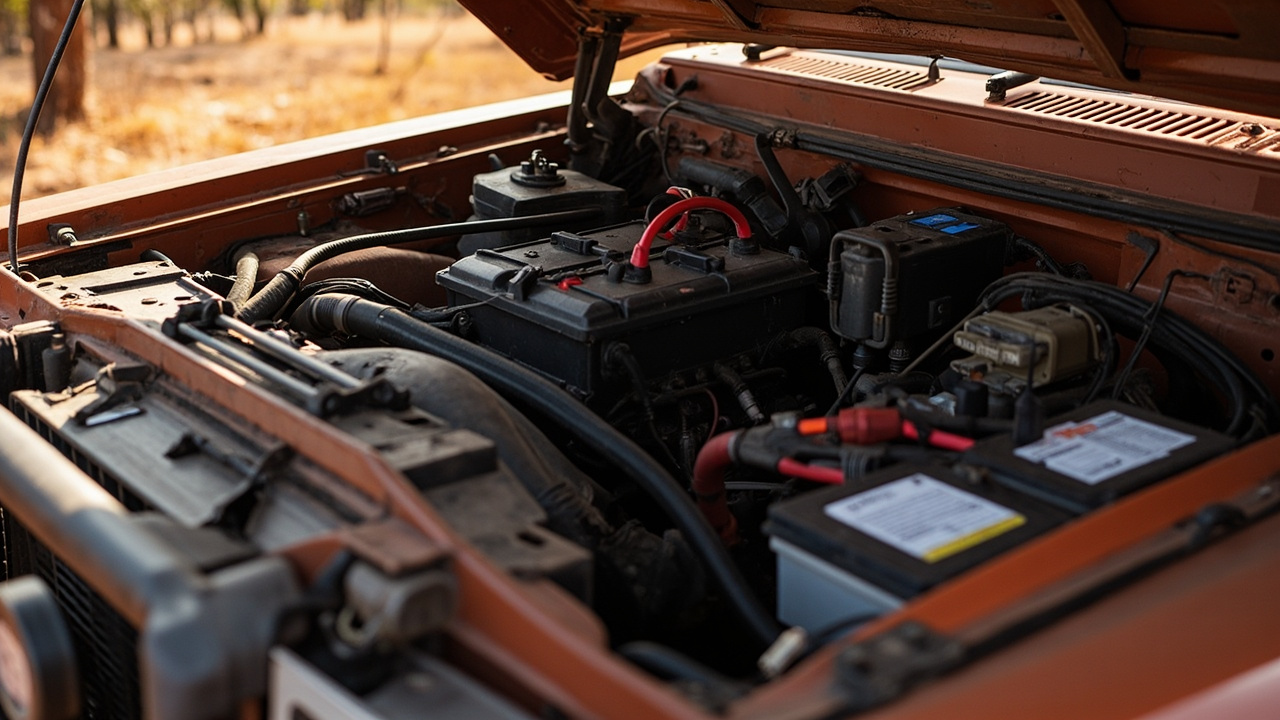
- Type: Standard lead-acid or AGM
- Priority: Cold Cranking Amps (CCA)
- Size: Original equipment or slightly upgraded
- Not for deep cycling
House Battery:
- Type: Deep cycle AGM or LiFePO4
- Priority: Amp-hours (Ah) capacity
- Size: Based on power needs calculation
- Designed for repeated deep discharging
Capacity Planning
Calculate your house battery needs:
- List all DC devices and their amp draws
- Estimate daily usage hours for each
- Calculate total amp-hours per day
- Multiply by 2 for 50% discharge (lead-acid)
- Multiply by 1.25 for safety margin
Example calculation:
- Fridge: 3A × 8 hours = 24Ah
- Lights: 2A × 4 hours = 8Ah
- Fan: 1A × 6 hours = 6Ah
- Total: 38Ah daily
- Lead-acid: 38 × 2 × 1.25 = 95Ah minimum
- LiFePO4: 38 × 1.25 = 48Ah minimum
Alternator Considerations
Modern vehicle alternators vary significantly:
- Standard alternators: 60-100A output
- Smart alternators: Variable output, may not charge at idle
- High-output alternators: 150-300A for heavy loads
DC-DC chargers with current limiting protect standard alternators from overload when charging large house battery banks.
Installation and Wiring Guide
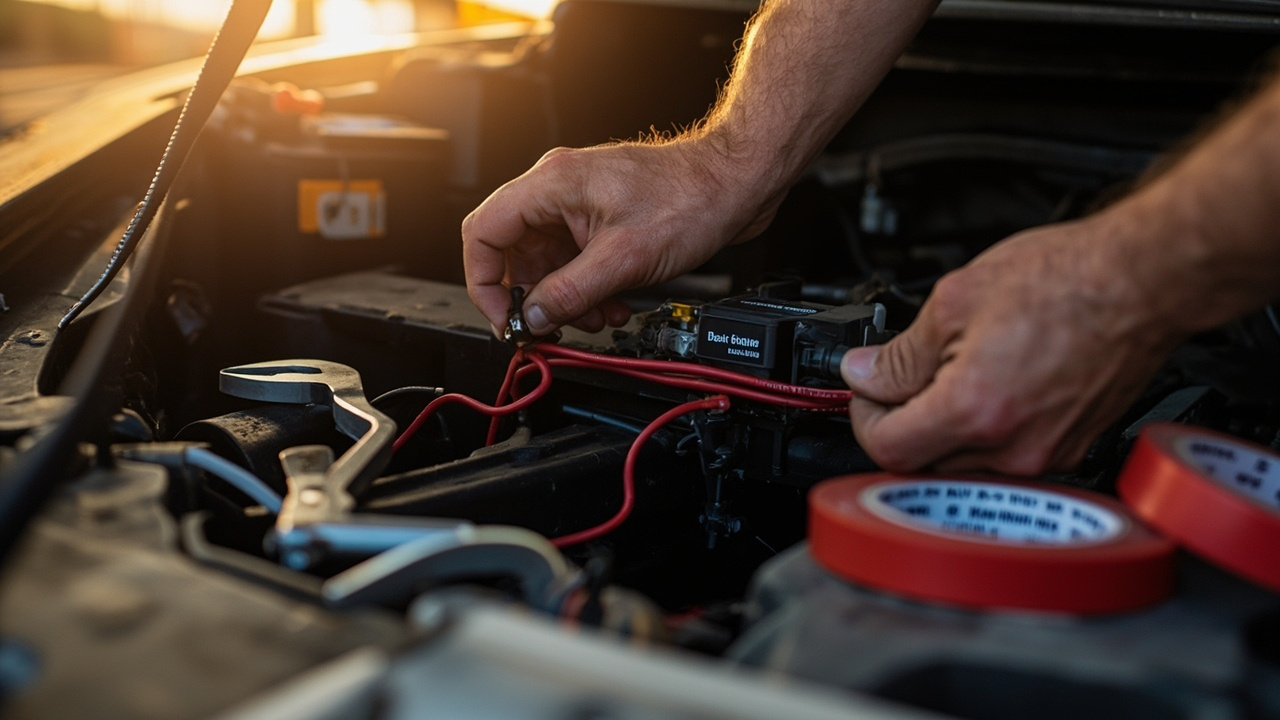
Wire Sizing
Use marine-grade tinned copper wire with appropriate gauge:
| Component | Wire Size | Fuse Size |
|---|---|---|
| VSR/DC-DC to house battery (30A) | 6 AWG | 40A |
| VSR/DC-DC to house battery (50A) | 4 AWG | 60A |
| House battery to fuse panel | 6 AWG | 50A |
| Fuse panel to individual circuits | 14-16 AWG | 5-20A |
Grounding
Proper grounding is critical:
- Both batteries should share a common ground
- Ground to vehicle chassis at both battery locations
- Use star washers for good metal contact
- Clean paint from grounding points
Fusing
Protect every positive wire near the battery:
- Class T or ANL fuse within 6" of starting battery
- Class T or ANL fuse within 6" of house battery
- Blade fuses at distribution panel
- Fuse rating: 125% of maximum expected current
Ignition Sense (for DC-DC chargers)
Most DC-DC chargers need an ignition signal:
- Tap into ignition-switched circuit (radio, cigarette lighter)
- Use 1A fuse on sense wire
- Some chargers have voltage-sense ignition option
- Prevents house battery from draining starting battery
Installation Steps
- Mount house battery securely (battery box or tray)
- Install isolator/DC-DC charger near starting battery
- Run positive cable from starting battery to isolator (fused)
- Run positive cable from isolator to house battery (fused)
- Connect ground cables for both batteries
- Install ignition sense wire (DC-DC chargers)
- Install fuse panel for house circuits
- Test system with engine running and off
House Battery vs Starting Battery
Starting Battery Characteristics
- Design: Thin lead plates for maximum surface area
- Function: Short bursts of high current (200-1000A)
- Discharge: Should never discharge below 90%
- Lifespan: Shortened dramatically by deep discharges
- Rating: CCA (Cold Cranking Amps) is primary metric
House Battery Characteristics
- Design: Thick lead plates for durability
- Function: Steady moderate current over long periods
- Discharge: Designed for 50-80% depth of discharge
- Lifespan: Hundreds of deep cycles expected
- Rating: Amp-hours (Ah) at 20-hour rate is primary metric
Why They Shouldn't Be Mixed
Using a starting battery for house loads will:
- Destroy the battery within months
- Provide very limited usable capacity
- Risk being unable to start your vehicle
Using a house battery for starting is inefficient but won't damage the battery.
Charging from Alternator
Standard Alternator Output
Vehicle alternators typically output:

- Voltage: 13.8-14.4V (temperature compensated)
- Current: Varies by alternator rating (60-200A typical)
- Regulation: Maintains vehicle system voltage
Charging Rates with Different Isolators
For a 100Ah house battery at 50% discharge:
- VSR: Charges at alternator voltage, 30-60A possible
- DC-DC (30A): Limited to 30A, ~1.5 hours to full
- DC-DC (50A): Limited to 50A, ~1 hour to full
Charge While Driving Efficiency
Typical charging per hour of driving:
- VSR with standard alternator: 40-60A
- DC-DC 30A: 30A (regulated)
- DC-DC 50A: 50A (regulated)
Long drives can fully recharge house batteries from deep discharge.
Idling Concerns
Smart alternators may not charge effectively at idle:
- Variable voltage output based on load calculation
- May drop to 12.6V at idle (not charging)
- Higher RPM needed for full output
- DC-DC chargers help maintain charging profile
Monitoring and Protection
Battery Monitors
Essential for understanding your system:
- Victron BMV-712: $200, Bluetooth, precise SOC
- Renogy 500A Monitor: $80, budget option
- AiLi Voltmeter: $30, basic voltage/current
What to Monitor
- House battery voltage: Should stay above 12.0V (50%)
- Current flow: Charging vs discharging
- State of charge: Percentage remaining
- Amp-hours used: Daily consumption tracking
Low Voltage Disconnect (LVD)
Protects house battery from over-discharge:
- Disconnects loads at preset voltage (typically 11.8-12.0V)
- Prevents permanent battery damage
- Automatic or manual reset
- Some inverters have built-in LVD
Temperature Considerations
- Charging voltage should compensate for temperature
- LiFePO4 batteries need cutoff below freezing
- Avoid mounting batteries near exhaust or engine heat
- Ventilated battery boxes for lead-acid
Recommended Products
Budget Setup ($200-400)
- Isolator: Stinger SGP38 VSR ($55)
- House battery: 100Ah AGM ($180)
- Wiring and fuses: ($50)
- Battery box: ($30)
Mid-Range Setup ($500-900)
- Charger: Victron Orion-Tr Smart 30A ($200)
- House battery: 100Ah LiFePO4 ($400)
- Monitor: Victron BMV-712 ($200)
- Wiring and fuses: ($80)
Premium Setup ($1,000+)
- Charger: Redarc BCDC1250D ($500)
- House battery: 200Ah Victron LiFePO4 ($1,400)
- Monitor: Victron SmartShunt ($130)
- Distribution: Blue Sea fuse block ($80)
- Premium wiring and installation kit ($150)
Troubleshooting
House Battery Not Charging
- Check voltage at alternator (should be 13.8V+ running)
- Test VSR/DC-DC with multimeter
- Verify all fuse continuity
- Check ground connections
- Verify ignition sense (DC-DC chargers)
Starting Battery Draining
- VSR may be stuck closed—test relay operation
- Parasitic draw on starting battery
- Ignition sense not working (DC-DC)
- Wiring fault causing bypass
Charging Too Slowly
- Long cable runs causing voltage drop
- Loose or corroded connections
- Alternator not outputting full voltage
- DC-DC charger current limited
Conclusion
A properly designed dual battery system with an appropriate isolator or DC-DC charger transforms your vehicle into a capable mobile power platform. Whether you're weekend camping or living full-time on the road, the ability to charge house batteries while driving ensures you have power when you need it.
For most jobs, a VSR hits the sweet spot between simplicity and getting the job done. If you've got lithium house batteries or specific charging needs, you need to bite the bullet and fit a DC-DC charger instead. Regardless of which path you take, proper installation with adequate wiring and protection is the only way to keep things safe and reliable.
Worth a watch: DUMMIES Guide to DUAL BATTERY Systems for Overlanding/Van Life/Off-Grid · Rhino Offroad