
By Dave Miller · off-grid sparky · 22 years wiring solar, batteries and sheds in central QLD
“I once blew a $15 fuse in 1200 amps of solar current because I assumed a car fuse would hold, leaving my shed dead for a week in the Queensland heat.”
— Dave. Measure twice, buy once.
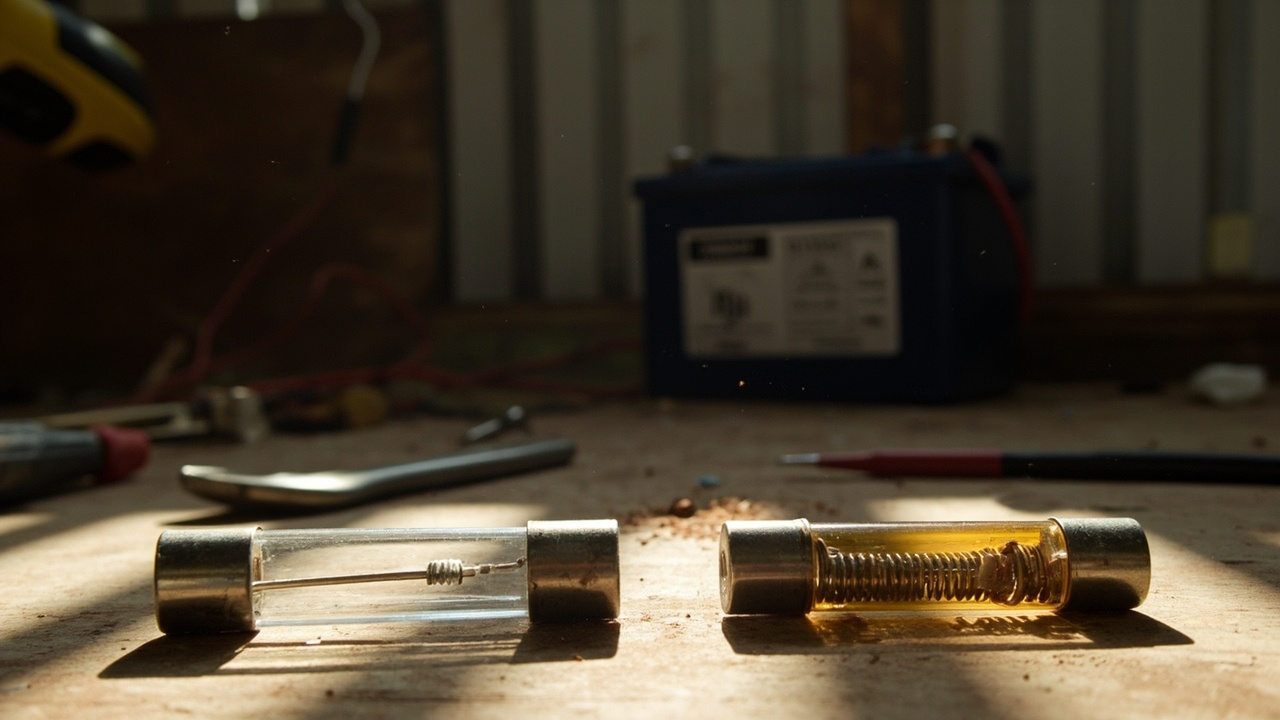
ArticlesCalculatorsSite PlannerShopA battery bank sitting in a dusty shed outside Winton doesn’t care how much you spent on it. When a 48-volt, 400 amp-hour lithium pack shorts because a snake found its way behind the inverter, the only thing between you and a fire is the fuse. A slow-blow automotive fuse or a cheap ANL holder from a weekend-market stall won’t clear that fault before the copper busbar softens. I’ve pulled a half-melted 200-amp ANL from a mates’ install where the fuse element sagged but never parted, while the 70-millimetre-square cable jacket blistered along its full length.
A proper gG cylindrical fuse, rated 125 volts DC and built to interrupt 50,000 amps, reacts in milliseconds. It costs around $80, fits a standard 22 x 58 mm holder, and doesn’t leave a paddock full of smoke. Off-grid in Australia, you’ve got a battery bank. You aren’t waiting for a fuse to blow — you’re betting the shed on it. Get the right one.
Off-grid in central Queensland, you’ve got a battery bank in a shed that hits 45 degrees before lunch. You’re not going to be sitting around waiting for a fuse to blow while the inverter is trying to start a bore pump and the missus has the kettle on. But if you grab whatever is hanging on the peg at the roadhouse, you’re asking for trouble.
I’ve replaced too many melted fuse holders where a 48 volt lithium bank pushed a lazy 180 amps through a 32 volt Mega fuse that never opened—just turned into a glowing resistor until the plastic caught fire. A proper NH00 blade fuse in a DIN rail carrier, rated 80 volt DC with a 25 kiloamp interrupt capacity, costs around thirty bucks at the electrical wholesaler and won’t arc-weld itself into a permanent short.
Every positive cable in my installs gets a fuse within 300 millimetres of the terminal, no exceptions, because I’ve seen what a dropped spanner does across an unprotected 250 amp busbar. Cut the crap: pick a fuse that matches the battery voltage and the potential fault current, or you’ll be scraping carbon off the MPPT in the dark with a head-torch full of dead moths.
You have exactly two paths to follow once you terminate the positive stud on a 48 V lithium rack. Either you install a semiconductor-protection fuse with a breaking capacity of 50 000 amps at 125 V DC, like a Littelfuse L50S or a Bussmann FWP, or you fit an HRC bolted-tag fuse with an interrupt rating verified above 20 000 amps DC, such as an NH1 gG curve link. Every 200 Ah server battery I commission in a galvanised shed west of Dulacca gets one or the other.
An ANL strip with a plastic window and a 5000 amp AIC rating will vaporise when a 70 mm² cable dead-shorts across a busbar—I’ve peeled that tinned copper spatter off a plywood board twice. A Mega link melts its tin-plated legs clean off the holder before the arc quenches, leaving you with a glowing stud and no isolation. I keep both types on the bench: the semiconductor fuse in a 30 mm x 57 mm cylinder runs $60–$90, the NH1 in a 70 mm wide blade-and-bolt carrier sits around $25–$45. That price gap isn’t an invitation to experiment.
There’s no third option. You’re either using one or the other. Stop overcomplicating it.
On a hot tin shed roof in central Queensland, a 50A fast-blow fuse sits between the panels and the charge controller — a $2 ceramic job in a weatherproof holder right next to the isolator. Fast‑blow fuses belong on anything with delicate electronics: inverters, charge controllers, solar regulators. They blow instantly on overcurrent. If your inverter has a 50A max draw, a 50A fast‑blow fuse is the minimum. Don’t be a dick and use a 60A one. I’ve pulled melted fuse holders out of boards where someone upsized because the 50A blew twice. The 60A ANL fuse has the same bolt centres and the same white lettering, costs maybe
Only use these if you have a big motor (like a water pump or fridge compressor) that draws a huge surge when it starts. They tolerate short-term spikes. But if you're running a standard off-grid setup? You don't need them. If you're not sure, use fast-blow. It's safer.
Last spring I pulled up to a grader shed south of Barcaldine where the lights had gone out for the third time in a month. Inside a dusty plywood box, a 3000 W inverter was paired to a 48 V LiFePO₄ bank with a 250 A ANL fuse tucked into a corroded holder. The owner had read the inverter’s surge figure and bolted in a fuse to match—250 A for a 10-second peak. What the fuse saw every afternoon was 80 A continuous from a set of panels feeding through a 50 mm² DC cable.
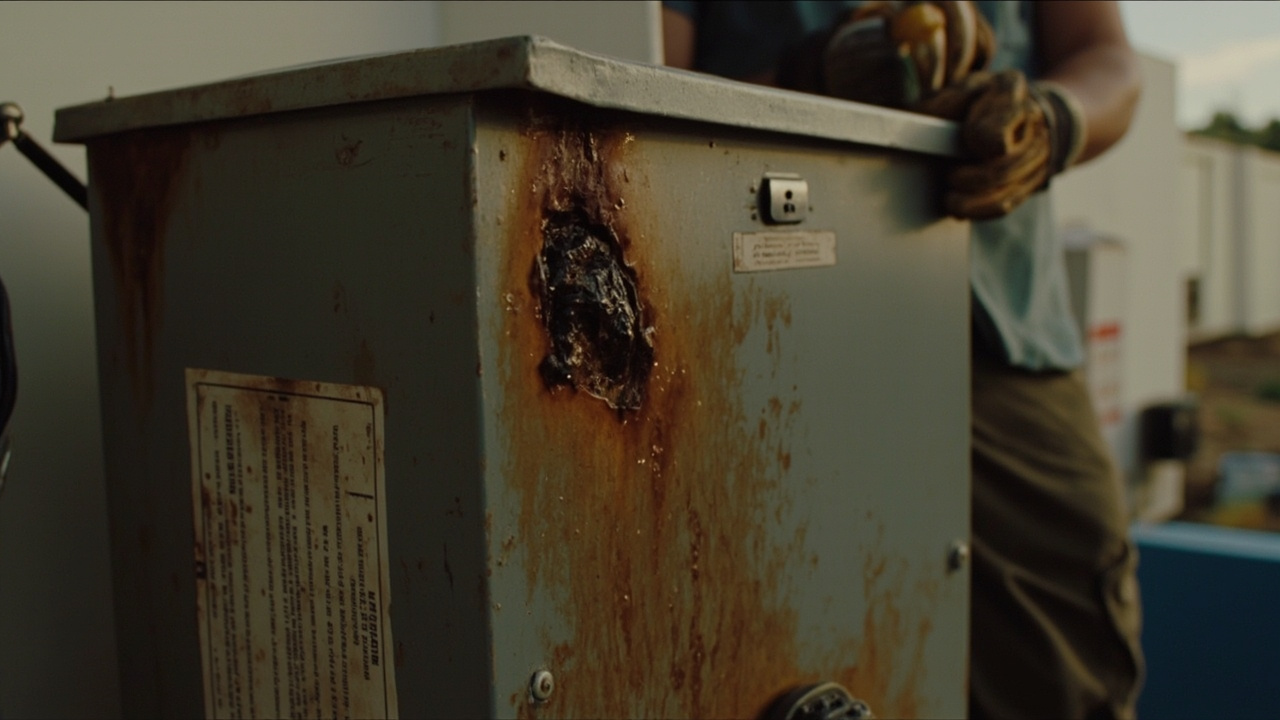
The ANL terminals ran hot enough to soften the grey PVC conduit stub right above the gland, and the positive lug had oxidised to a dull grey crust. The fuse never opened, because it was sized for a transient the inverter never sustained, while the steady 80 A was overwhelming the cable’s 100 A-ish rating at the conduit’s internal 50 °C ambient. The insulation had relaxed back 40 mm from the lug, leaving bright copper exposed. We ripped out the 50 mm², pulled 70 mm² twin-core, and fitted a 100 A Mega fuse in a sealed holder.
80 A multiplied by 125% lands on 100 A. The 125% multiplier is inside every Australian off-grid wiring manual worth its salt, and it’s not a suggestion. Rule of thumb: Fuse rating = 125% of your system's maximum continuous current. Simple. No excuses. That 250 A ANL wasn’t protecting the cable; it was protecting the inverter manufacturer’s warranty department from a call about nuisance blowing.
Don't waste time hunting. Here's what's actually available in Australia. A standard 12V AGM bank in a shed halfway between Emerald and Alpha swings 120 amps when the 3000-watt inverter spools up the bore pump. The fuse that came with the battery box, a generic 150A ANL wafer in a tinned brass holder, will drop 0.3 volts across its tin-plated contacts at that load. That's 36 watts of heat rising from a single connection point. I've measured 83°C on the body of the holder after three minutes of pumping. The plastic softens on a 40°C afternoon.
The tinning wicks heat into the 70mm² cable, which only makes the insulation go gummy faster. Over the years I've learned to bin those ANL kits before the first cable lug lands. The fuse element itself might open under a dead short, but the real fire starts at the crimp or the stud — resistance you can't spot by eye. I reach instead for an NH pattern HRC fuse, the type sparkies in Australia have been bolting into 250A switch-fuse combinations on mine-site switchrooms for decades. Size NH00, 125A, 120kA breaking capacity, body length 78mm, width 50mm, thickness 35mm.
The copper lugs bolt onto solid silver-plated contacts with an M8 steel stud torqued to 15Nm. On the same load, that fuse body sits below 60°C because the contact resistance is a fraction of the pressed-tin alternative. Price from any branch of L&H or Rexel is typically $18 to $28 for a known industrial brand like Bussmann or Mersen, not some glittery anodised mystery-metal block from a caravan catalogue. Back in the farm workshop I keep a few NH00 carriers in the bottom drawer.
A three-pole Clipsal 56 series fuse-switch takes three NH00 fuses and gives you a manual isolator with a visible break. AS/NZS 3000 says the overcurrent protection on an ungrounded battery conductor must sit as close as practical to the terminal, generally within 200mm. I mount that switch straight onto a folded galv bracket off the battery tray, then run 70mm² double-insulated welding cable from the switch down to the inverter through a vented conduit. No extra inline holders, no extra joins.
The fuse blows only when something truly catastrophic happens — a spanner across the terminals, a seized starter motor rewound short — and when it does, the arc is quenched inside fine quartz sand packed around the element. The plastic body of the NH00 might char but it doesn't sustain flame. A 125A element will carry 160A for a couple of minutes before it starts to sag, which is exactly what a loaded battery bank needs during a long crank on a cold diesel morning.
Get a fast-blow fuse. Size it to 125% of your max draw. Buy it from Jaycar or Battery World. Don't be the bloke who uses a 100A fuse on a 60A system because he "thought it was fine". That's how you end up with a melted battery tray and a $5k insurance claim. Get it right the first time.
Worth a watch: How to Size Your Battery Fuse to Inverter · Cleversolarpower by Nick
Fast-blow fuses trip the instant they see a fault, while slow-blow (time-delay) ones can handle a brief surge — like an inverter kicking in — before they let go. For most off-grid battery setups, slow-blow is your mate, because gear like inverters and motors pull a big hit of current for a split second at start-up. Pick the wrong type and you'll be replacing fuses every time you switch something on.
You size the fuse to protect the wiring, not the battery — work out what your cables can safely carry, then choose a fuse rated just above your normal load but below the cable's limit. The article hammers this: grabbing a fuse rated way too high "just to be safe" is the opposite of safe, and that's exactly the sort of mistake that lands people in the cautionary tale pile. If the maths feels over your head, that's a call-the-sparky moment.
The article runs through Australian suppliers with indicative pricing, so have a squiz at that section for current ballpark figures. Generally, you'll find decent stock at solar wholesalers, 4WD outlets, and the bigger online retailers that post out to the bush. If you're remote, factor in the postage — some of the chunkier fuses aren't light and the freight adds up.
Too right you do. The article opens with a lithium battery bank that shorted out because someone skipped a fuse, and the outcome wasn't pretty — melted busbars and a write-off job. A correctly sized fuse is the cheapest insurance you'll ever own on a battery bank worth a small fortune. Skipping it is how you end up as the story everyone tells down at the pub.
While many off-grid projects are achievable as DIY, certain situations require licensed professionals:
Always check local regulations and obtain necessary permits before commencing work.