By Dave Miller · off-grid sparky · 22 years wiring solar, batteries and sheds in central QLD
“I once melted a 50mm cable on a 12V bank in a QLD summer shed because I ignored voltage drop, costing me $800 and a week of power.”
By Dave Miller · off-grid sparky · 22 years wiring solar, batteries and sheds in central QLD
“I once melted a 50mm cable on a 12V bank in a QLD summer shed because I ignored voltage drop, costing me $800 and a week of power.”
Battery cable sizing in Australia must follow AS/NZS standards and account for voltage drop over distance. Undersized cables melt, waste energy and risk fire, as one QLD owner discovered after a $800 failure. Correct sizing on a 12V bank protects gear and stops cash going up in smoke.
Your off-grid system runs on battery power. If your cables are too small, you lose money, waste energy, and risk a fire. Stop being cheap. Size them properly.
I'll be straight: the wrong battery cable doesn't just underperform, it burns holes in gear and, in the worst cases, starts fires. The "$800 mistake" framing is real, because once you factor in a replacement lithium bank, scorched inverter lugs and a callout, that's roughly where the damage lands. The fix is unglamorous: pick the right size, the right type, and terminate it properly. This guide walks through exactly that.
There is no single universal battery cable size that works for every RV, caravan, 4x4 dual-battery setup, or off-grid solar install. Correct sizing depends on two main factors: how much current needs to be carried and how long the cable run needs to be.
A cable's resistance increases as its diameter decreases or as its length increases. That resistance translates directly into voltage drop — wasted energy, sag at the inverter, and heat build-up at the terminals. In a 12V or 24V system, even a small drop in absolute voltage is a large percentage of the working supply, so cable sizing matters more here than it does in a 230V mains run.
Most off-the-shelf battery cable in Australia is sold in either AWG (American Wire Gauge) or mm² (square millimetres). In the AWG system, the higher the gauge number, the thinner the wire and the less current it can carry. So 6 AWG is fat, 14 AWG is skinny.
For reference:
As cable length increases, the required cable thickness also increases. That's the rule people miss. They'll use the same 6 B&S (roughly 6 AWG equivalent) for a 300 mm jump-start lead and a 4 m run to a rear-mounted inverter, then wonder why the inverter throws low-voltage faults under load.
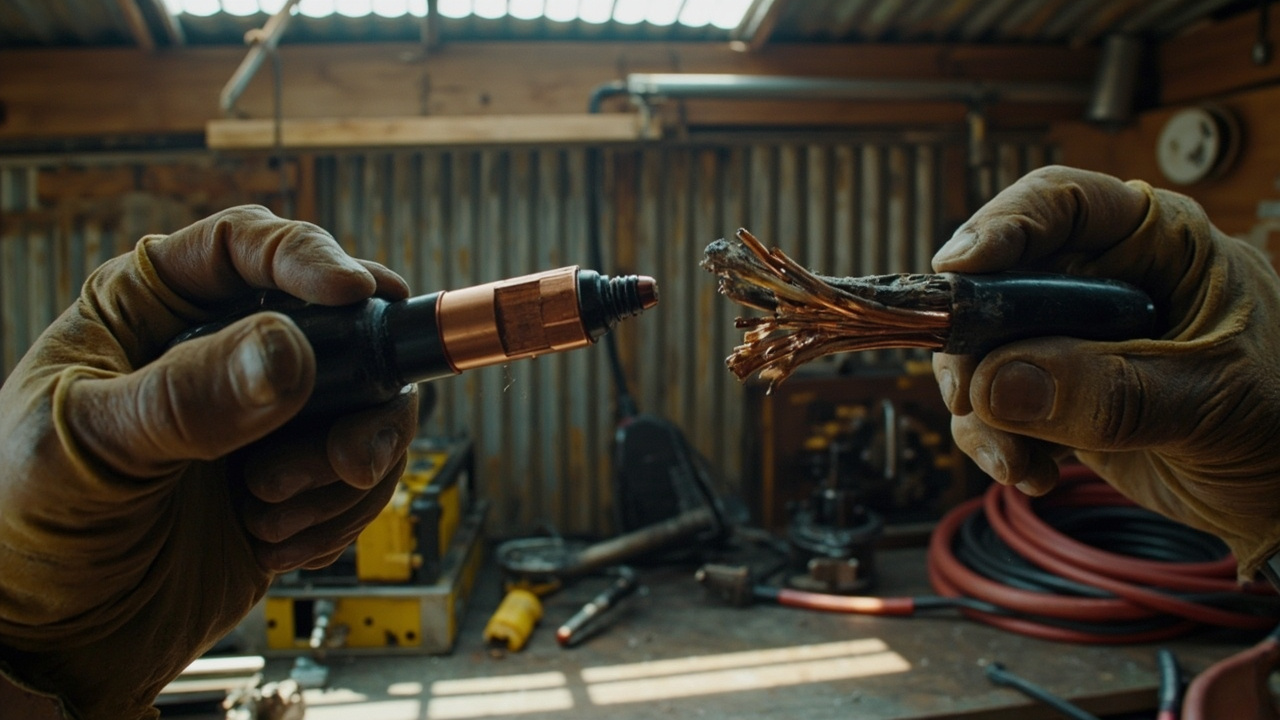
Undersized battery cables can cause voltage drop, overheating, nuisance shutdowns, inverter faults, or fire risk. Heat is the killer — a cable run hot at 70 °C under a seat base is a cable run that will eventually fail.
Oversized battery cables can add unnecessary cost, weight, and installation difficulty, especially in tight RV or boat compartments. In a caravan tunnel boot or under a ute tub, "bigger" often means "won't bend around the chassis rail." The right size is the smallest cable that keeps voltage drop within tolerance for the run length.
Battery cable is a single-conductor wire made of heavy-duty copper, typically insulated with PVC. It has two leads: a positive lead connecting the battery to the system being powered and a negative lead connecting the battery back to chassis ground or the battery bank's negative bus.
The main types you'll see:
Automotive battery cable, which covers most 12V and 24V vehicle and off-grid work, is insulated with PVC or XLPE, has a 60 V rating, and is flame-retardant. It's typically insulated to resist environmental hazards including salt, fuel, oil, water, lubricants, and acid — all relevant in a coastal Queensland setup.
Battery cable specifications are governed by SAE J1127, which defines five types: SGR (synthetic rubber), SGT (thermoplastic), SGX (XLPE), STX (XLPE with thinner wall), and EV & Hybrid (XLPE or TPE). SGT and SGX battery cables must pass SAE J1127 tests including strand coating, physical properties, high temperature, dielectric, cold bend, flame, oil absorption, and abrasion resistance. If you want a cable that has actually been certified for under-bonnet or battery-box duty, J1127-rated cable is the floor.
The table below is for short-to-medium runs in typical off-grid and automotive use. For long runs (over 3–4 m), step up at least one gauge size.
| Cable size | Typical amp capacity | Common use |
|---|---|---|
| 2.5 mm² | 15–20 A | Low-current accessories, short runs |
| 4 mm² | 20–25 A | Lights, pumps, short accessory runs |
| 10 mm² | ~40–50 A | Medium-duty accessories, small inverters |
| 16 mm² | ~50–75 A | Golf carts, ATVs, small inverter links |
| 25 mm² | Up to 100 A | Battery-to-starter, mid-size inverter runs |
| 35 mm² | Up to 150 A | Large 4xDs, big inverter feeds |
| 50 mm² | Up to 200 A | V8 engine bays, big inverter feeds |
| 70 mm² | Up to 250 A | Long cable runs, exceptionally high-power demands |
Most car batteries use a 12-volt power supply, which is best suited to a 16 mm² battery cable for the starter feed. For 24V systems or large lithium banks feeding 2000 W+ inverters, you're usually up at 35 mm² or 70 mm² territory, and often doubling runs.
The general principle that voltage drop is critical in low-voltage (12V/24V) systems and that cable size must be increased to compensate for distance is correct, and it's the single biggest reason off-grid installs underperform. As a working rule for DC battery cables in vehicles and off-grid:
Doubling the cable run roughly doubles the voltage drop. Halving the current halves the drop. Going one gauge heavier (e.g. 25 mm² instead of 16 mm²) drops resistance by roughly 40%. These are the levers.
The recommendation to use copper over aluminium for battery connections is sound for most off-grid applications due to conductivity and connection reliability. Copper has higher conductivity per mm², crimps and solders more reliably, and doesn't suffer the creep and oxidation issues that aluminium does at lug interfaces. CCA (copper-clad aluminium) is a budget compromise: lighter than pure copper but with higher resistance and weaker crimps. For a battery-to-inverter run, full copper is the safer call.
The emphasis on proper crimping and termination quality is correct and important for safety and longevity. A $2 ratchet crimper makes a better joint than a $30 hammer crimper, and either beats the "smash it with pliers" method that turns up on too many job sites.
Use tinned copper lugs, sized to the cable (don't fold a 16 mm² tail into a 25 mm² lug), and heat-shrink the crimp with adhesive-lined tubing. For battery posts, use proper post clamps or lugs that match the post type (top-post, side-post, M8 stud). No bare copper stranded cable wrapped under a wing nut — that's how you get hot joints.
Battery work sits in a strange spot in Australia. Low-voltage DC (under 50 V) is not "prescribed electrical work" under most state wiring rules, so a licensed sparkie isn't legally required to crimp a battery lug. That doesn't mean you should wing it. Call a licensed professional when:
The advice to consult a licensed electrician for complex or high-power installations is appropriate and aligns with Australian safety standards. Off-grid and vehicle work often blurs the line, but the moment AC joins the system, the rules tighten.
What gauge battery cable do I need for a 2000 W inverter?
At 12 V, a 2000 W inverter draws around 165–170 A under full load. For a short run (under 1.5 m) you can get away with 35 mm², but most installers use 70 mm² to keep voltage drop below 3% on a realistic 2–4 m run. At 24 V the current halves and you can step back to 25 or 35 mm².
Does cable length really matter that much for 12 V systems?
Yes. Voltage drop scales linearly with cable length for a given gauge. A 16 mm² cable that drops 2% over 1 m might drop 8% over 4 m. For long runs, the cable upgrade often matters more than the inverter brand.
Can I use CCA (copper-clad aluminium) cable for battery connections?
Technically yes, but it's not recommended. CCA has higher resistance than pure copper and is more prone to connection failure at crimped lugs over time. For battery interconnects the small saving isn't worth the long-term reliability hit.
Is marine-rated cable worth the extra cost in an RV?
If the cable runs through a wet area, near a battery box that vents, or anywhere salt spray is possible, yes. Marine cable's self-extinguishing rating and wet-rated insulation are worth the premium. In a dry, sealed enclosure, SGT or SGX is fine.
What's the difference between SGT and SGX battery cable?
SGT uses thermoplastic PVC insulation rated to 105 °C or 85 °C. SGX uses cross-linked polyolefin rated from −40 °C to +125 °C. SGX is the better choice for engine bays, hot climates (Central Queensland summers under-bonnet will test 85 °C cable) and anywhere the cable sees wide temperature swings.
How do I know if my existing battery cable is undersized?
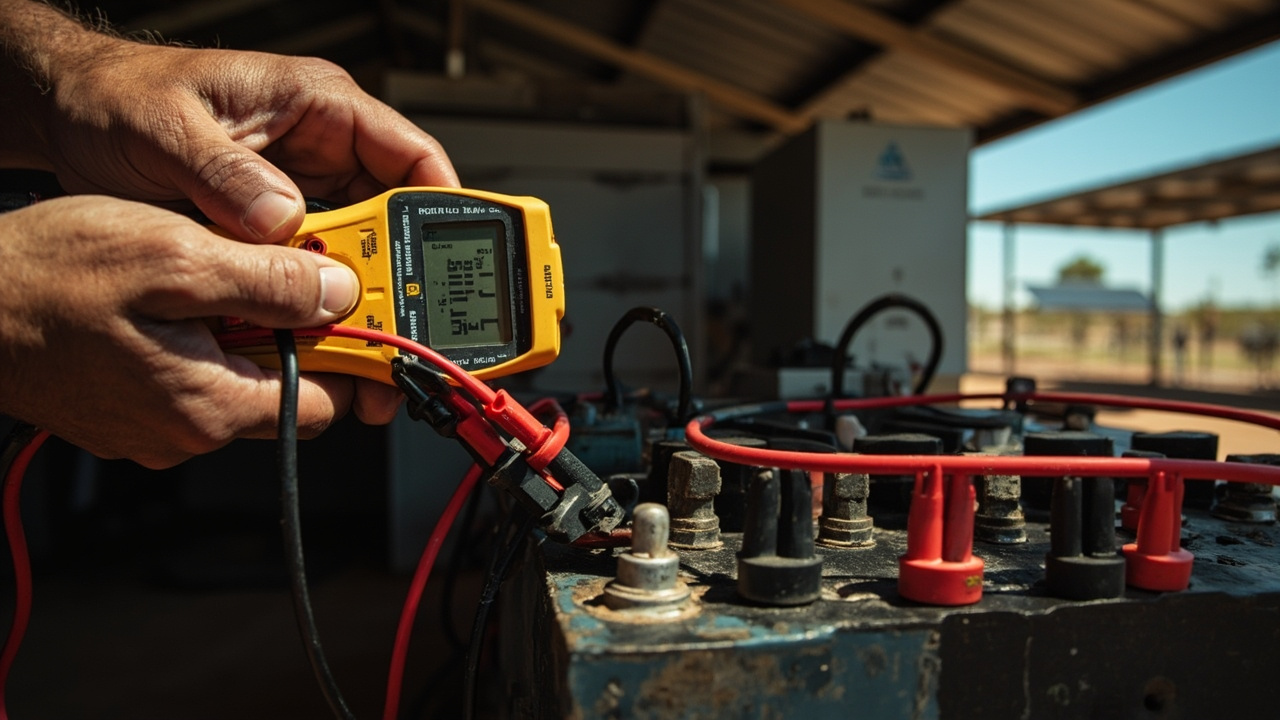
Three warning signs: voltage at the load drops more than 3% under load compared to the battery terminals, the cable feels hot to the touch after sustained use, or the insulation is discoloured or stiff. Any of those means re-spec.
Sizing battery cable is one of those jobs where the cheap, fast choice is usually the wrong one, and the cost of getting it wrong lands months later as a damaged inverter or a fire. Measure the run length, work out the real current (not the nameplate — the worst-case continuous load), pick the gauge that keeps voltage drop under 3%, use full copper, crimp it properly, and fuse the positive side close to the battery. Skip the shortcuts and you skip the callout.
Worth a watch: Wire Sizes Explained for Mobile, Marine & Off-Grid Electrical Systems · EXPLORIST life Mobile Marine & Off-Grid Electrical