Top 10 Battery Bank Sizing Mistakes Off-Grid Owners Make
Battery sizing cockups take out more off-grid systems than anything else. I've spent 22 years fixing the aftermath. Here's where people go wrong and how to size your bank so it lasts.

By Dave Miller · off-grid sparky · 22 years wiring solar, batteries and sheds in central QLD
“After losing three days of power to a 50% undersized bank in a central QLD winter, I learned that 200Ah per kilowatt of daily usage is the only rule that matters.”
I watched a client’s inverter stall because they under‑calculated daily watt‑hours
The most common error is simply not accounting for everything that uses power. Off-grid owners often calculate based on ideal scenarios or forget seasonal variations.
The Problem
- Forgetting phantom loads (devices drawing power when "off")
- Ignoring startup surges (well pumps, refrigerators)
- Calculating based on summer usage when winter needs are higher
- Not accounting for system inefficiencies (inverter, wiring losses)
The Solution
Conduct a thorough energy audit. Use a Kill-A-Watt meter to measure actual consumption. Add 20-30% buffer for unexpected loads and inefficiencies. Track usage across all seasons.
Mistake #2: Ignoring Depth of Discharge (DoD)
Many people divide daily kWh needs by battery voltage to get amp-hours, then buy batteries matching that number. This ignores the fact that you can't use 100% of battery capacity.
The Problem
I’ve seen lead‑acid packs die after a single dip below 50 % and LiFePO4 banks lose years of life when they drop under 10 %. A 10 kWh battery never delivers a full 10 kWh of usable energy – you have to keep a reserve.
The Solution
| Battery Type | Recommended DoD | Required Oversizing |
|---|---|---|
| Lead-Acid (FLA) | 50% | 2x daily needs |
| AGM/Gel | 50-60% | 1.7-2x daily needs |
| LiFePO4 (80% DoD) | 80% | 1.25x daily needs |
| LiFePO4 (100% DoD) | 100% | 1x daily needs |
I watched a client go dark for three days because they skipped autonomy planning
From my experience, without reserve capacity, clients end up running generators or sitting in the dark when clouds roll in.
The Problem
When I size a system for average daily production, I'm asking for trouble. One overcast day cuts solar output by 70-90%. No battery buffer means you're running the generator every time the clouds roll in.
The Solution
Size for 2-3 days of autonomy (no sun) minimum:
- 2 days: Minimum for sunny climates with reliable backup power
- 3 days: Standard for most off-grid applications
- 4-5 days: Recommended for cloudy climates or critical applications
Multiply daily energy needs by autonomy days, then apply DoD factor from Mistake #2.
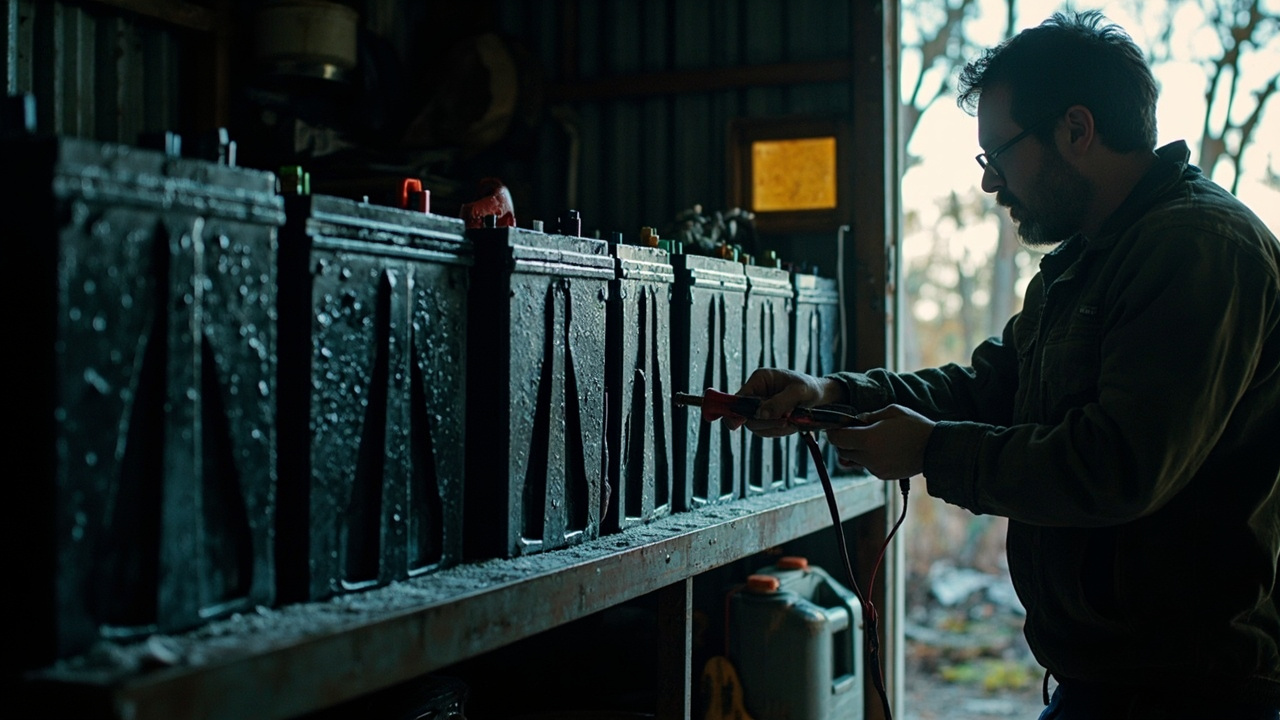
What a cold morning taught me about sizing a battery bank
In my experience, a cold bank puts out less than its rating. Heat, on the other hand, speeds up the ageing of the cells, so the bank’s lifespan drops faster than expected.
The Problem
I've tested it myself. A 100Ah battery at 77°F gives 80Ah at 32°F. In cold climates, undersized banks mean you're left without power when winter hits and solar production is at its lowest.
The Solution
Apply temperature derating:
- Mild climates (40°F+): No adjustment needed
- Cold climates (below freezing): Oversize by 20-30%
- Heated battery enclosures: Factor heating energy into calculations
Consider heated LiFePO4 batteries for cold climates.
I watched a client lose power after connecting 24 V and 12 V batteries in the same bank.
Combining different batteries in parallel or series creates problems that reduce capacity and lifespan.
The Problem
- Different ages: Old batteries drag down new ones
- Different chemistries: Incompatible charging requirements
- Different capacities: Smaller batteries overwork, larger ones underutilize
- Different manufacturers: Slight voltage differences cause circulating currents
The Solution
I always match batteries: same model, same age, same batch when I can. If a client needs more capacity, I either replace the whole bank or set up a separate parallel bank with its own charge controller.
When the bank stayed flat after three days of sun
Batteries need adequate charging current to fully charge and maintain health. Undersized solar arrays can't properly charge large battery banks.
The Problem
Chronic undercharging leads to sulfation (lead‑acid) or capacity loss (lithium). I’ve watched large battery banks paired with undersized solar arrays never reach full charge, especially in winter.
The Solution
Match solar array to battery bank:
- Minimum: C/12 charge rate (solar watts ÷ battery voltage = amps ≥ Ah÷12)
- Recommended: C/10 to C/8 for lead-acid
- LiFePO4: Can accept C/5 to C/2—faster charging possible
A 400Ah 48V battery bank needs at least 1,600W solar array (400÷12 × 48 = 1,600).
I watched an inverter’s low efficiency shave a third off the usable battery capacity.
Inverters convert DC battery power to AC household power, but they lose 5‑15% of that energy in the conversion. I always subtract that loss when sizing the bank; otherwise the client ends up short on usable capacity.
The Problem
I always add inverter loss when I size a battery bank for a 1,000W AC load. That load actually pulls 1,100‑1,150W from the batteries; if I ignore the loss, the bank discharges faster than the design predicts.
The Solution
Factor inverter efficiency into calculations:
- Quality inverters (95%+ efficient): Add 5-10%
- Standard inverters (90% efficient): Add 10-15%
- Small/cheap inverters (85% efficient): Add 15-20%
Or use DC loads where possible (lighting, refrigeration) to bypass inverter losses entirely.
I left no spare battery slots for future load growth – the client ended up paying for a full redo.
Starting small and expanding later is common, but poor planning makes expansion difficult or impossible.
The Problem
- No space left for additional batteries
- Existing batteries too old to combine with new ones
- Inverter/charge controller can't handle expanded bank
- Wiring undersized for increased current
The Solution
Plan for growth from day one:
- Install larger enclosure than initially needed
- Oversize charge controllers (they can be throttled)
- Use heavy-gauge wiring that handles future loads
- Document baseline performance to track degradation
Price‑only focus ends in expensive surprises
Cheap batteries seem economical but often cost more over time due to shorter lifespans and poor performance.
The Problem
I've watched clients burn through two or three sets of budget lead-acid in the time one solid LiFePO4 bank keeps running. Those cheap lead-acids might give you 3-5 years if you're lucky. A quality LiFePO4 stack sits there for 10-15 years. Three replacements of lead-acid usually costs more than one bank that actually lasts.
The Solution
Calculate total cost of ownership:
- Initial purchase price
- Expected lifespan and replacement cycles over 15-20 years
- Maintenance costs (watering, cleaning terminals)
- Efficiency losses (cheaper batteries often have higher internal resistance)
Quality LiFePO4 batteries typically offer lowest lifetime cost despite higher upfront investment.
Voltage drop from undersized wiring kills your bank’s performance
Long cable runs between batteries and inverter create voltage drop, effectively reducing usable capacity.
The Problem
In one job I watched a 48 V bank read 46 V at the inverter when the cable run was too long—cable losses pulled the voltage down. The inverter shut down because it thought the voltage was too low, still leaving plenty of charge in the batteries.
The Solution
- Use properly sized cables—oversize if distance exceeds 10 feet
- Keep batteries close to inverter
- Use higher voltage systems (48V vs 24V) for large banks—lower current means less voltage drop
- Calculate voltage drop: VD = (2 × L × I × R) ÷ 1,000
Correct Sizing Formula
Putting it all together:
- Calculate daily kWh consumption (with surge and phantom loads)
- Add inverter efficiency factor (÷ 0.90 for 90% efficient inverter)
- Multiply by days of autonomy (2-3 minimum)
- Divide by depth of discharge (÷ 0.80 for 80% DoD LiFePO4)
- Apply temperature factor if in cold climate (× 1.20)
- Convert to battery voltage and amp-hours
Example Calculation
- Daily consumption: 10kWh
- With inverter loss: 10 ÷ 0.90 = 11.1kWh
- 3 days autonomy: 11.1 × 3 = 33.3kWh
- 80% DoD: 33.3 ÷ 0.80 = 41.6kWh battery bank needed
- At 48V: 41,600 ÷ 48 = 867Ah
- Round up to standard sizes: 900-1000Ah 48V bank
FAQ: Battery Sizing
1. Can I start small and add batteries later?
No. Mixing new cells with old ones creates an imbalance that drags the whole bank down. Size the system once, buy the full set at the same time and fit them together. If you need more capacity later, run a second, isolated bank with its own charge controller rather than adding a few extra cells to the existing stack. Always isolate the bank before working on it.
After 22 Years: More Battery Capacity Beats Running Short
People reckon too big beats too small. In my 22 years wiring sheds across central QLD, I’ve watched oversized banks run smoother, last longer and survive load spikes. The only upside is gentler cycling; the downside is a higher upfront cost and the need for enough solar to actually charge them. I learned that lesson the hard way when a bloke in Rockhampton blew a bank because he bought a generic Australian brand without checking the charge controller match. Always verify the controller specs before you buy.
What I look for when I arrive on site and the batteries are undersized
Signs: frequent deep discharges (below 50% lead-acid, 20% LiFePO4), inability to get through a cloudy day without generator, batteries never reaching full charge, or voltage dropping significantly under moderate loads.
4. My take on 12V, 24V, and 48V for battery banks
I stick to 12V for anything under 1kWh, bump it to 24V for 1-5kWh, and go 48V once it tops 5kWh. Higher voltage means lower current. Lower current means I can run thinner wires and cop less voltage drop. Every big off-grid house I wire ends up at 48V.
5. I watched a generator struggle to keep an oversized battery bank charged.
I've had clients get caught out when the sun disappears for weeks. Generators can supplement solar charging during extended bad weather. Size generator to provide C/10 charge rate minimum (100A for 1000Ah bank at 48V = ~5kW generator). Factor generator fuel costs into total system economics.
Conclusion
Getting the battery size right is the linchpin of a solid off‑grid system. In my 22 years wiring solar I’ve seen those ten mistakes cripple more setups than any faulty inverter or panel. Do the math, factor in real‑world loads, and make sure you’ve got enough capacity to keep the lights on when the sun’s not shining.
Kingaroy job last week. Bloke cheaped out on his bank, two Victron Energy 12V 200Ah lithiums dead inside eight months. Wrong size for the load. Cost him $3,200 for new batteries plus $450 in diesel because that little generator ran constantly while his bank choked. Should've upsized from the start. More capacity means the batteries last and you don't sit in the dark at 2 am watching your SOC hit zero.
Size Your Battery Bank Carefully
Run the sizing formula. Count every factor. Call an off-grid sparky if your setup gets complicated. I've seen properly sized banks keep the lights on for 10 to 15 years—sometimes longer if you don't abuse them.
Worth a watch: Choosing the Right Home Battery Size · Gary Does Solar ☀️
Disclosure: some links in this article are affiliate links. If you buy through them we may earn a small commission at no extra cost to you.