By Mick O'Brien · carpenter & builder · sheds-to-homes, cabins and things that stay up in a storm
“I learned the hard way that Australian storms turn my first bamboo shed into kindling in a single squall.”
By Mick O'Brien · carpenter & builder · sheds-to-homes, cabins and things that stay up in a storm
“I learned the hard way that Australian storms turn my first bamboo shed into kindling in a single squall.”
Look, bamboo’s not magic. It’s fast-growing, strong, and looks cool. But if you’re building off-grid in Australia, you need to know the real deal. No fluff.
Bamboo has a reputation as a miracle material: fast-growing, strong, and renewable. Some of that reputation is earned. In Australia, though, the practical reality for an off-grid builder is more nuanced than the marketing suggests. This article lays out what bamboo actually offers structurally, what it doesn't, and where the regulatory and supply-chain edges sit before you commit a slab of your budget to it.
The construction sector is under genuine pressure. The building sector accounts for 37% of global CO2 emissions, with roughly a quarter of that tied to materials production. Construction also extracts an estimated 50 billion tonnes of sand annually, while global required floor area is projected to nearly double between 2020 and 2050. Three-quarters of the infrastructure that will exist in 2050 has yet to be built.
Against that backdrop, any material with a short rotation and lower processing energy looks attractive. Widespread adoption of minimally processed bamboo materials has significant potential to reduce emissions and energy use in the global construction sector. That potential is real, but it is not evenly distributed across geographies, and Australia is not a natural bamboo-producing country.
Bamboo is a fast-growing grass, not a timber, and it reaches structural maturity in years rather than decades. Its strength-to-weight ratio rivals steel in the right species. That second claim is worth reading carefully: "in the right species" is doing the heavy lifting. Not every bamboo performs like steel, and not every bamboo on the market is the species you think it is.
Bamboo can be used in both full-culm (pole) form and as engineered bamboo composite (EBC) materials such as glue-laminated bamboo, cross-laminated bamboo, and bamboo scrimber. The engineered products behave more predictably than raw poles because their variability is averaged out during manufacture. Raw poles behave like a natural material — they vary.
Two facts shape whether bamboo makes sense here:
1. Bamboo is unlikely to see adoption in markets such as North America where bamboo is not endemic and sustainable softwood is abundant. The same logic applies to most of Australia. We have plantation pine and hardwoods in commercial volumes. Bamboo is not a native resource and is not a mainstream structural material in Western construction.
2. Moso bamboo (Phyllostachys edulis) is a common species used in construction globally, though its availability and suitability in Australia depend on local climate and supply chains.
The practical consequence: imported bamboo costs more than locally milled timber per metre, lead times are longer, and spec sheets are often written for tropical-humid climates, not the dry heat, termites, and bushfire zones we deal with at places like Beecher.
That doesn't make bamboo unusable. It makes it a specialty material — good for specific applications, expensive as a default.
If you treat bamboo as a structural material on your property, you should plan around these specs and constraints. Some of these are factual; others are general guidance where the verified literature doesn't give a single number.
| Parameter | Detail / Requirement | Notes |
|---|---|---|
| Material form | Full culm (pole) or EBC (glulam, CLT, scrimber) | EBC is more predictable; poles are cheaper but variable |
| Structural maturity | Years, not decades | Depends on species and growing conditions |
| Compressive strength (axial) | Strong along the grain | Bamboo has high tensile strength but low compressive strength perpendicular to the grain |
| Treatment | Required for structural use | Untreated bamboo is unsuitable for structural use in humid climates |
| Fasteners | Galvanised steel minimum; stainless in coastal/marine areas | Prevents rust and galvanic corrosion |
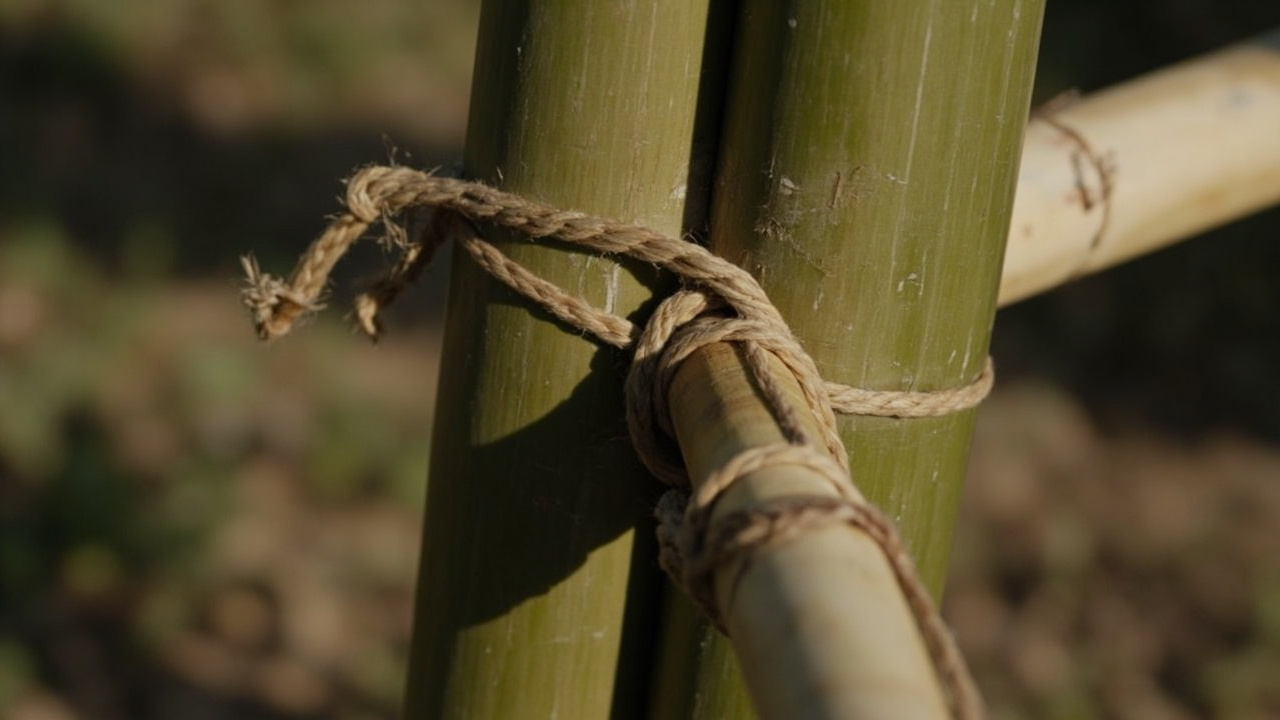
| Joining | Cross-bracing and proper joining are critical for structural integrity | Especially for pole construction |
| Design standards | Use context-appropriate building material and design standards | Significant variation inherent in bamboo material properties — design accordingly |
| Termite exposure | High | Common Australian pest; treat or avoid ground contact |
| Bushfire exposure | Variable | Depends on treatment, wall thickness, and detailing |
Even with the supply-chain friction, there are places where bamboo is genuinely useful:
What bamboo is not, in practical Australian terms, is a substitute for the framing lumber in your house. The Australian standards environment treats timber-framed construction as a solved problem. Bamboo is not.
The single biggest brake on bamboo in markets like Australia is not engineering — it's data. Adoption of bamboo as a structural material is hindered by the significant variation in bamboo material properties and the relative dearth of available data. Engineers want characteristic values they can design to. Raw bamboo doesn't provide them cleanly. Engineered bamboo products do, but the test data and code recognition tend to come from the species and processing facilities that produced the data, not from a generic "bamboo" you bought from a wholesaler.
If you're hiring an engineer to sign off a bamboo element, expect them to want:
If you can't produce those, expect them to refuse the design.
This section is not optional reading.
Call a licensed structural engineer if:
Call a licensed pest-control / building inspector if:
Do not rely on supplier test data alone. Supplier data tells you what their product was tested to. It does not tell you what your building needs.
The general principle from the literature is straightforward: structural bamboo should be used in accordance with context-appropriate building material and design standards, given the significant variation inherent in bamboo material properties. In Australia, that means the NCC, AS 1720 (timber structures), and any state-specific variations. If a design doesn't fit those, it isn't going to pass.
Is bamboo as strong as steel?
No. Bamboo's strength-to-weight ratio rivals steel in the right species. "Strength-to-weight" and "as strong as" are not the same claim. Bamboo outperforms many timbers at a fraction of the weight; steel outperforms bamboo in absolute terms.
Can I build a house out of bamboo in Australia?
Technically possible, practically difficult. You'd be navigating the National Construction Code with limited Australian test data, importing material, and paying engineering fees to demonstrate compliance. Most off-grid builders find this slower and more expensive than conventional framing.
Do I need to treat bamboo?
Yes, for any structural or long-service-life use. Untreated bamboo is unsuitable for structural use in humid climates, and most of Australia's coastal and tropical zones count as humid for material purposes.
Is bamboo good for bushfire-prone blocks?
Untreated bamboo is a fire risk. Treated and dense EBC products can perform, but you need test evidence and an engineer to sign off on the BAL rating. Don't trust marketing on this.
What about termites?
Termites eat bamboo. In Central Queensland, they will absolutely find it. Ground contact is a no-go without serious treatment; above-ground use requires either preservative treatment or physical barriers.
Is bamboo cheaper than timber?
Usually no, in Australia. Imported poles and EBC products carry transport and import costs. Local plantation pine or hardwood is generally cheaper per metre and better understood by local engineers and councils.
Bamboo is a genuinely interesting material with real structural potential. In tropical Asia and parts of South America, it is a mainstream structural material with mature supply chains and codes. In Australia, it is a specialty import, with all the friction that implies: cost, lead time, code uncertainty, and pest exposure.
For most off-grid builders here, bamboo makes sense as a secondary material — cladding, screening, garden structures, fit-out — not as the primary structural system of a house. Where it does carry loads, treat it, brace it properly, use the right fasteners, and get an engineer to sign off. The literature is clear: significant variation in bamboo material properties means you don't get to skip the engineering.
Worth a watch: How Old is Your Bamboo? · Homesteadin' Hawai'i