By Dave Miller · off-grid sparky · 22 years wiring solar, batteries and sheds in central QLD
“After frying three 12V inverters in a single summer, I switched to 48V and finally kept my lights on during a Queensland heatwave.”
— Dave. Measure twice, buy once.
ArticlesCalculatorsSite PlannerShopLook, mate. If you're building an off-grid system in Australia, 12V is a money pit. 48V is the only sensible choice for anything beyond a tiny shed. Let's cut the fluff and get to the facts.
Look, mate. If you're building an off-grid system in Australia, 12V is a money pit. 48V is the only sensible choice for anything beyond a tiny shed. Let's cut the fluff and get to the facts.
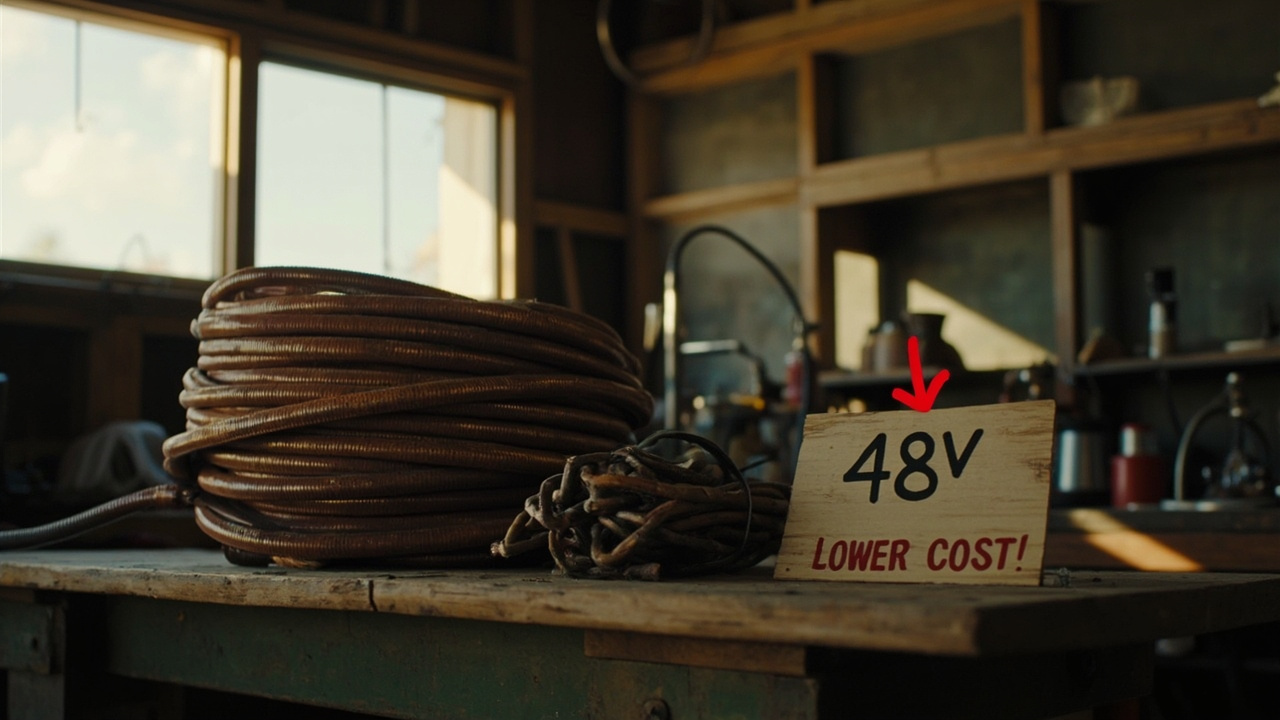
At 12V, you need massive cables to handle the insane current. For a 2kW system, 12V needs 167A (2000W / 12V). That means 10mm² cable. At 48V, it's only 42A (2000W / 48V) – you can use 2.5mm² cable. Simple math: 48V uses 75% less copper.
Example: Running 10m of cable for a 2kW system. 12V needs $15/m cable (10mm²) = $150. 48V uses $5/m cable (2.5mm²) = $50. You save $100 right there. For a whole house? You're looking at $500-$1000 in cable savings alone. Don't be that bloke spending $2k on cables because he thought 12V was "safe".
12V systems lose 10-15% of your solar power in the cables. 48V systems lose only 2-5%. That means less power to your fridge, lights, and coffee maker. For a 3kW system, 12V might waste 300W of your hard-earned solar. 48V keeps it in your system.
Bottom line: You're paying for solar, not for cable heat. 48V gives you more usable power. Period.
12V is "safe" in theory, but a short circuit can draw 1000A+ from a big battery. That melts wires and starts fires. 48V is still below the 50V safety threshold (so no special permits), but the lower current means less fire risk. Plus, all modern off-grid gear (inverters, charge controllers) is built for 48V. 12V is obsolete – it's like using a flip phone for a solar system.
Here's the real cost for a basic 48V system (10kWh storage, 3kW inverter) from Australian suppliers:
48V isn't just cheaper – it's the only system that won't cost you a fortune in cables and wasted power.
So, if you're off-grid in Australia, stop messing around with 12V. It's a dead end. Go 48V. It's the standard for a reason. Your wallet and your safety will thank you.
Worth a watch: 12V vs 48V Cable Heat Test — Thermal Camera Shows the Truth at 2000W · solar circuit 360
While many off-grid projects are achievable as DIY, certain situations require licensed professionals:
Always check local regulations and obtain necessary permits before commencing work.